



Sanjaya continued his narration to Dhritarashtra, describing the fierce exchange that unfolded between Karna and the king of Madra, Shalya, as the armies stood poised for the final and most dreadful encounters of the great war. Inflamed with confidence and eager for battle, Karna declared that he would slay the foremost heroes of the Pandavas with the irresistible Bhargava Astra bestowed upon him by his revered preceptor. To him, no fortune could surpass the glory of confronting Krishna, the unfailing guide of righteousness, and Arjuna, the unrivalled master of celestial weapons. He proclaimed that he had never been fashioned by destiny to tremble before their banners, their bows, or their divine missiles. In the arrogance of his confidence, he boasted that he possessed the strength to withstand a thousand Krishnas and ten thousand Arjunas, and that none born upon the earth could shake his resolve in battle.
Turning toward Shalya, Karna rebuked him with bitter words. He accused the Madra king of speaking without understanding the profound science of warfare and insinuated that his counsel sprang from secret affection for the Pandavas. Karna warned that if such speech continued, he would not hesitate to strike down even his own charioteer. His anger overflowed into cruel insults against the Madra race, questioning their honour, lineage, and conduct. He declared that the people of Madra were notorious for wickedness, treachery, and moral corruption, alleging that they betrayed even trusted friends and possessed neither noble customs nor righteous restraint. Blinded by wrath, Karna hurled many harsh accusations concerning their way of life, believing that such words would silence Shalya. At last he commanded him to cease his counsel, drive the chariot forward, and allow destiny to decide the issue of war. Better, he said, to perish with courage while destroying hostile armies than to survive with cowardice while wishing for the enemy’s triumph.
Shalya listened with remarkable composure, neither shaken by insults nor provoked by threats. With serene dignity he reminded Karna that he had accepted the office of charioteer only because Duryodhana had entrusted him with that sacred responsibility. It was therefore his solemn duty to speak what was beneficial, whether such counsel pleased the warrior or not. A worthy charioteer, he explained, must possess complete knowledge of a warrior’s strength, courage, mastery of weapons, the condition of the horses, the significance of omens, and the ever-changing movements of battle. Truthful advice was not an offence but an indispensable principle of righteous warfare. Whether Karna responded with anger or gratitude, Shalya resolved never to abandon the path of honest counsel.
Seeing that words alone could not pierce the armour of Karna’s pride, Shalya began to relate an ancient tale rich with wisdom. On an island there lived a prosperous merchant devoted to sacrifices, charity, self-restraint, compassion, and peaceful living. His household flourished in abundance, and he gave generously to all who sought his help. One day a crow arrived at his residence. The merchant’s sons, amused by the bird, nurtured it with morsels of food already chewed. Nourished in effortless luxury, the crow grew fat and conceited. Forgetting the discipline and struggle through which other birds survived, it began to despise them and imagined itself supreme among all creatures of the sky.
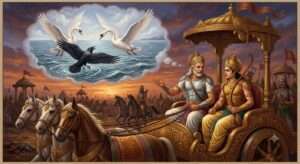
In due time, a majestic flock of swans descended near the shore while journeying from the sacred Manasa Sarovar. Their graceful flight filled the heavens with beauty. The merchant’s sons mockingly encouraged the crow to challenge the swans, praising it as the greatest of birds. Inflamed by empty flattery, the foolish crow approached the swans and demanded a contest of flight. The royal swans smiled gently and replied that they had long dwelt upon the sacred waters of Manasa Sarovar, where endurance, discipline, and strength were tested beyond measure. They possessed the power to cross immeasurable distances with effortless ease. Nevertheless, the crow persisted, boasting that it knew hundreds of styles of flight. It claimed it could soar, descend, twist, glide, and perform dazzling manoeuvres unmatched by any bird, insisting that it would prove the superiority of crows over swans.
The swans accepted the challenge without pride or anger. One noble swan rose into the sky and began its steady flight across the vast ocean. The crow hurried after it, displaying every trick it had proudly described. At times it darted ahead, circled back, and mocked the swan’s calm and measured pace. The gathered crows rejoiced at these antics, ridiculing the swan and proclaiming that their leader would surely triumph. Yet the royal swan continued without haste, conserving its strength while pressing steadily toward the distant horizon. Before long the crow’s reckless display exhausted its energy. The endless ocean stretched beneath it without a single tree, rock, or shore upon which it might rest. Fear seized its heart as it realised that retreat was impossible and progress equally hopeless. Overwhelmed by fatigue and despair, it lost control of its wings and began falling helplessly toward the waters.
The swan looked back with compassion and gently asked, “Where are those countless methods of flight in which you glorified yourself? Why do your wings now falter?” The crow, unable even to lift itself above the waves, confessed its folly. It admitted that luxurious living and constant praise had deceived it into believing itself greater than Garuda himself. Recognising its ignorance, it begged the swan for mercy and pleaded to be carried safely back to land. Moved by compassion, the royal swan lifted the half-drowned crow with its powerful feet and bore it across the ocean to safety. The birds everywhere praised not merely the swan’s unmatched strength but also its wisdom, mercy, and noble restraint. Humbled by its near destruction, the crow warned its companions never again to undertake any endeavour driven by arrogance or empty pride. Having fulfilled both victory and compassion, the swan departed with majestic dignity alongside its noble flock.
Completing the parable, Shalya fixed his gaze upon Karna and reminded him of events that could not be denied. During the cattle raid, Arjuna had single-handedly defeated the assembled Kaurava warriors, slain Karna’s brother, and recovered the captured herds, while Karna had failed to alter the outcome. Again, during the Ghosha Yatra, when Duryodhana faced grave humiliation, Karna had abandoned the field instead of standing firmly beside his friend. These were not tales invented by enemies but witnessed events engraved upon the memory of history. Thus, with measured words sharper than arrows, Shalya shattered Karna’s boastfulness by confronting him with the truth of his own past.
Sanjaya concluded this portion of his narration by informing Dhritarashtra that Shalya had answered Karna neither with rage nor with abuse, but with wisdom, memory, and unanswerable truth. The clash of words had become as intense as the clash of weapons soon to follow, and the next movement of this profound encounter would reveal how destiny gradually unfolded upon the sacred field where pride, courage, truth, and fate converged.

