MS Shanker
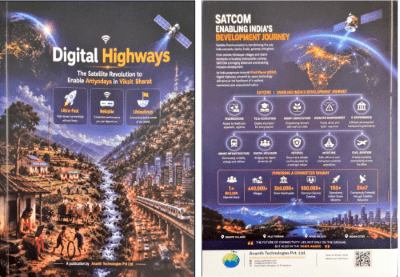
“Digital Highways: The Satellite Revolution to Enable Antyodaya in Viksit Bharat” by Dr Pavuluri Subba Rao is far more than a conventional book on space technology. Spread across 240 pages and eight chapters, it is an informative and remarkably accessible exploration of how satellites and emerging space technologies are steadily becoming an integral part of everyday life and, more importantly, how they can become powerful instruments of inclusive development.
Beginning with the deceptively simple question, “Why satellites matter in your everyday life?”, the book takes the reader through the vast possibilities of satellite technology before culminating in a discussion on the States’ ecosystem and vision. In between, Dr Pavuluri explains, often in considerable technical detail, how space-based technologies can address some of the most pressing developmental challenges confronting a country as vast and diverse as Bharat.
Dr Pavuluri brings considerable authority to the subject. A distinguished space scientist, he began his professional journey with institutions associated with India’s premier scientific establishment, including the National Remote Sensing Agency. He subsequently established Ananth Technologies, which has emerged as an important industry partner of the Indian Space Research Organisation (ISRO), contributing critical components and systems to several satellite and space missions.
It is this rare combination of scientific expertise, entrepreneurship and close association with Bharat’s space programme that gives the book its distinctive character. The author does not look at satellites merely as sophisticated machines orbiting thousands of kilometres above the Earth. Instead, he asks a far more relevant question: How can this extraordinary technology improve the life of the ordinary citizen?
That question lies at the heart of Digital Highways.
The book makes a compelling case for satellites as indispensable pillars of the emerging digital economy. In a country of more than 1.4 billion people, where geographical distances and difficult terrain can still create barriers to access, space-based connectivity offers an opportunity to bridge the digital divide. Satellite-enabled communication, navigation, remote sensing and broadband can take essential services to places where conventional physical infrastructure may be difficult, expensive or time-consuming to establish.
The book’s discussion of tele-education and tele-medicine is particularly relevant. Technologies and platforms such as e-Sanjeevani demonstrate how digital connectivity can potentially take medical consultation and specialised healthcare closer to people in remote and underserved areas. Similarly, satellite-enabled education can expand access to quality learning resources beyond the limitations of geography.
The larger message is unmistakable: technology becomes truly transformative only when its benefits reach the last person and the last mile. That is the essence of Antyodaya.
Dr Pavuluri also places satellite technology within the larger national ambition of building a Viksit Bharat by 2047. The book therefore goes beyond technical exposition and becomes a reflection on how space technology can contribute to socio-economic development, digital inclusion, education, healthcare, connectivity and national capability.
For a generation that increasingly takes digital connectivity for granted, Digital Highways offers an important reminder of the sophisticated technological infrastructure working silently behind everyday services. The strategic importance of space technology has also become increasingly evident in national security and modern operations, making space awareness particularly relevant for today’s students.
The book’s greatest strength is perhaps its ability to connect the seemingly distant world of satellites with ordinary human aspirations. It explains why space technology is not merely about rockets, launch vehicles and missions, but about people, access and opportunity.
Digital Highways deserves to find a place not only in libraries and institutions offering space and engineering education, but also in schools and colleges across the country. It can help young readers understand how India’s space capabilities are evolving and, more importantly, how those capabilities can be harnessed for the larger national objective of inclusive development.
In that sense, Dr Pavuluri’s book is both a primer on the satellite revolution and a vision document for a technologically empowered Bharat. For the present generation, it is a book worth reading—and for the next generation, perhaps, a book worth learning from.