MS Shanker
(An account of defining years of Telangana statehood movement)
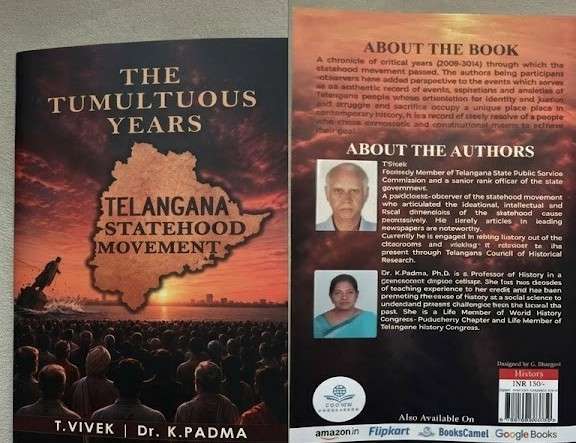
“Telangana Statehood Movement: The Tumultuous Years”, jointly authored by T. Vivek and Dr. K. Padma, is an engaging and important first-hand chronicle-cum-commentary of the intense struggle for a separate Telangana state during the crucial years between 2009 and 2014. Published by Crown Publishing, this brief volume approaches a defining chapter of contemporary Telangana history through the eyes of authors who were closely associated with the movement.
Vivek, a former TSPSC member and senior State official, was closely involved with the intellectual and fiscal dimensions of the movement’s discourse. His co-author, Dr. K. Padma, is a seasoned history professor. Their respective backgrounds lend the book a useful combination of administrative experience, historical perspective and personal observation.
T.Vivek is among the many learned friends I have known over the years. What distinguishes him, in my view, is an independent intellectual temperament. Even during his college years, when ideologies had considerable influence among students and intellectual circles, he remained his own man and, importantly, was not easily influenced by prevailing political or ideological currents.
The title itself immediately caught my attention. But, at first glance, I did wonder why the authors chose to begin their narrative with 2009, rather than tracing the origins of the Telangana statehood movement to the earlier agitation of the late 1960s. That earlier phase remains an important part of Telangana’s political and social history.
However, as I read the book, the reason became clear. The authors have consciously confined themselves to what they describe as “The Tumultuous Years (2009–2014)”—the decisive final phase that culminated in the creation of Telangana as a separate State in 2014. It is therefore not intended to be an exhaustive history of the movement across several decades, but a focused account of its climactic years.
One of the book’s significant strengths is its emphasis on the democratic and constitutional character of the movement. It records how the people of Telangana, particularly during this final phase, relied predominantly on peaceful mobilisation, political negotiation, public campaigns and constitutional processes to articulate their demand for statehood.
The authors also capture the aspirations, anxieties and emotional core of the movement—questions of regional identity, political representation, perceived inequalities and the sacrifices made by ordinary people. Particularly valuable is the account of the role played by employees, public intellectuals, academics of colleges and universities, women and a cross-section of Telangana society in shaping public discourse during the movement.
The book’s brevity is both a strength and a limitation. It offers a crisp and easy-to- read account rather than an exhaustive political, economic or sociological examination of Telangana’s entire statehood struggle. Readers seeking the broader historical canvas may, however, have to turn to more comprehensive works.
Nevertheless, “Telangana Statehood Movement: The Tumultuous Years” succeeds in what it sets out to do: preserve the memory of the decisive years when a long-cherished aspiration finally moved towards political and constitutional reality.
For anyone who lived through those tumultuous years—and particularly for the younger generation that knows Telangana as a State but may not fully appreciate the struggle that preceded its formation—this is a book worth reading.
For every Telanganite, it is not merely a book about history. It is a reminder of how history was made.