



King Dhritarashtra, consumed by anxiety and grief, continued his lamentation before Sanjaya. His mind dwelt incessantly upon Karna, the mighty son of Radha, who had obtained the invincible Brahmastra from the revered sage-warrior Parashurama. He possessed the formidable Nagamukhastra and numerous celestial weapons acquired through rigorous discipline and divine favor. Endowed with immense resourcefulness and unconquerable courage, Karna had shattered the bow of the valiant Abhimanyu, whose prowess had shaken the hearts of countless warriors upon the battlefield. Even Bhimasena, whose strength rivaled that of ten thousand elephants, had suffered humiliation at Karna’s hands. Sahadeva, though trapped in a hopeless situation, had been spared by Karna’s generosity. The mighty Ghatotkacha, master of illusion and terror of armies, had also fallen before him. Reflecting upon these deeds, the blind monarch wondered how such a hero could ever have met defeat.
Dhritarashtra pondered further. Had fate destroyed Karna’s horses, shattered his chariot, slain his charioteer, or rendered his celestial weapons ineffective? For if his chariot had remained intact, if his steeds had retained their vigor, and if destiny had not intervened against him, Karna could not have been overcome even by the lord of heaven and the assembled hosts of the celestials. With King Shalya of Madra serving as his charioteer, equal to Sri Krishna in mastery of horses and chariot warfare, and with warriors such as Shakuni, Ashwatthama, Kripacharya, and Kritavarma supporting him, Karna seemed protected on every side. Duryodhana trusted Kritavarma’s efficiency, valor, and loyalty. Surely such guardianship, reinforced by the vast fourfold Kaurava army, should have rendered Karna invincible. These thoughts bewildered the king more than they grieved him.
His curiosity then turned to the details of battle. How had the Pandava army assaulted Karna? By what means had Arjuna survived the deadly force of the serpent-headed weapon? How had Yudhishthira, Nakula, and Sahadeva conducted themselves amidst the carnage? What had transpired during those two dreadful days of warfare? Beneath these questions lay a deeper desire. Dhritarashtra sought comfort in believing that his warriors had fallen through deception and that the Pandavas were no less cunning than his own sons. He wished to measure virtue against virtue, valor against valor, and thereby justify the cause for which his sons had fought and died. His restless intellect searched for satisfaction in comparisons drawn from the tragedies of war.
Sanjaya, perceiving the subtle hypocrisy hidden beneath the king’s inquiries, resolved to present the events with complete truth and clarity. He would not merely report occurrences but would illuminate their meaning without distortion. Bowing respectfully, he addressed the king. “Listen, O monarch, and I shall recount faithfully how these events unfolded.”
After the fall of Dronacharya, Ashwatthama fought with extraordinary fury and skill. Yet, when the day’s struggle ended, he withdrew from the battlefield and returned to the camp. Thereupon Duryodhana assembled his foremost counselors and warriors to deliberate upon the future course of the war. Addressing Ashwatthama and the assembled chiefs, he asked what strategy should now be adopted and who should lead the army in its darkest hour.
The son of the preceptor replied thoughtfully. “O King, success in every undertaking depends upon support, enthusiasm, strength, energy, righteousness, and the favor of destiny. When these qualities unite, accomplishment follows naturally. Bhishma and Drona, those noble abodes of virtue, have departed from this world. Yet your own valor remains undiminished. The affection of your followers, the devotion of your relatives, the skill of your commanders, and the righteousness that still survives among your allies continue to stand beside you. Under your leadership, these strengths may flourish, and divine grace may yet accompany your efforts.”
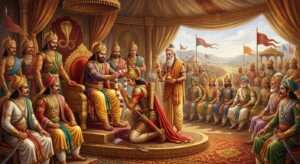
Ashwatthama continued his analysis. “Among the warriors who remain, Karna surpasses all others in strength, courage, and martial excellence. Let him be installed as Commander-in-Chief. Such an appointment will inspire confidence throughout the army and rekindle the enthusiasm of every warrior. Karna is the embodiment of heroic virtues. His arsenal of celestial weapons remains formidable, and he possesses the power to destroy the enemy host. Let him lead us, and let us march forward to crush our foes.”
These words delighted Duryodhana and strengthened his conviction that Karna alone could secure victory. Turning toward his beloved friend, he spoke with deep affection. “Your valor and loyalty are renowned throughout the world. Bhishma, the pillar of our lineage, and Drona, the guardian of our throne, have ascended to heaven. Now the protection of the Kaurava army and the honor of our crown rest upon you. Out of affection for the Pandavas, those elders restrained themselves from destroying them. Therefore, you waited. Otherwise, would it truly have required so much time for you to annihilate our enemies and avenge my humiliation? You are brilliant, learned, invincible in strength, and above all, my greatest protector. Just as the rising sun dispels darkness, so must your leadership scatter our foes. As Kumara commands the celestial hosts, so do I ask you to command the Kaurava army and secure victory for me.”
Hearing these words, Karna’s heart swelled with gratitude and joy. Before the assembled kings, he declared, “O King, I have not forgotten my pledge. I shall conquer the sons of Pandu and display such mastery of archery that all mankind will praise my prowess. Cast away your fears and anxieties. Appoint me commander, and witness the destruction of your enemies.”
Duryodhana’s delight knew no bounds. Sacred waters were brought in golden vessels by allied monarchs. The vessels were adorned with precious gems, fragrant flowers, medicinal herbs, sandalwood, sacred rice, and aromatic substances. Priests recited Vedic hymns while scholars chanted blessings. A lofty seat fashioned from the holy wood of the cluster fig tree was prepared and covered with cloth woven of gold and studded with jewels. Upon this auspicious throne Karna was seated.
Amidst the chanting of sacred mantras, the blessings of elders, the joyful cries of princes, and the harmonious sounds of drums, conches, and musical instruments, Karna was formally consecrated as Commander-in-Chief of the Kaurava army. The gathered kings rejoiced and proclaimed perpetual victory for him. Priests invoked divine blessings for his triumph over the Pandavas. Waves of enthusiasm swept through the camp as warriors celebrated the elevation of their champion.
Resplendent like the rising sun, Karna turned toward Duryodhana and spoke with solemn resolve. “You first raised me to kingship by granting me the throne of Anga. Today you have bestowed upon me an even greater honor by making me commander of your armies. Therefore, in the presence of all these rulers, I vow to slay Arjuna and all who support him. I shall win for you wealth, dominion, and sovereignty, enabling you to rule peacefully with your sons and grandsons. You may wonder how such a task can be accomplished. Know this: the endeavors of truthful and virtuous men are fulfilled swiftly, and victory naturally accompanies strength joined with righteous determination.”
Having installed Karna as supreme commander, Duryodhana dismissed the assembly with royal splendor. Guards escorted the newly appointed leader to his quarters, while the king himself retired with a heart overflowing with hope and satisfaction. Believing that the tide of war had finally turned in his favor, he rested that night with renewed confidence.
Sanjaya concluded this portion of his narration by reminding Dhritarashtra that after witnessing these events he had come directly to the royal court and faithfully reported all that had transpired during those two momentous days. Thereafter he returned once more to the battlefield camp, ever vigilant, so that he might continue to relate the unfolding destiny of the Kurukshetra war with precision, truthfulness, and unwavering clarity.

