



Rampura Sri Kubera Anjaneya Swamy Temple is located in Rampura village, Srirangapatna Taluk, in Mandya district of Karnataka. The temple stands peacefully on the banks of the River Cauvery, around 8 kilometres from Srirangapatna and about 22 kilometres from Mysuru. The village considers Sri Anjaneya Swamy as its main guardian deity and the spiritual centre of its community.
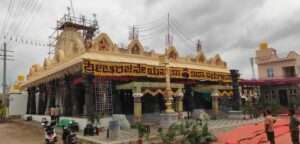
The main Anjaneya idol is traditionally believed to be an ancient murti associated with Sri Vyasaraja, the great Madhwa saint of the Vijayanagara period. According to temple tradition, Sri Vyasaraja consecrated 1,008 Hanuman idols across different parts of India, and Rampura is believed to be one among them. The old temple was recently renovated, with the Jeernoddhara Maha Kumbhabhishekam held from July 3 to 5, 2026.
What makes this temple especially unique is its rare form of Anjaneya. Unlike the usual heroic standing form of Hanuman seen in many temples, the deity here is traditionally described as Narthaki Anjaneya, a dancing form with a gentle and innocent expression. There are two Anjaneya idols in the temple. The Dodda Anjaneya is about nine feet tall, faces north and has his right hand raised in Abhaya Mudra. The Balanjaneya is about six feet tall, also faces north, and is associated with the Rashi Chakra and Navagraha traditions. Both idols have a small bell at the tip of their tails.
The renovated temple also has some fascinating architectural features. The new shikhara is built in a curvilinear Kalinga style, while the sanctum has a layered southern-style vimana. The granite mandapam is supported by 27 pillars, with each pillar representing one of the 27 Nakshatras. Devotees can perform Nakshatra Dosha Parihara at the pillar representing their birth star. There is also a mandapam associated with the 12 Rasis. A new shrine dedicated to Sri Vidya Hayagreeva has also been established beside the historic Anjaneya shrine.
The Sthalapurana of Rampura is closely connected with the Ramayana. According to local tradition, Hanuman returned from Lanka after meeting Mother Sita and receiving her Chudamani. It is believed that on his journey back to Sri Rama, he stopped at this very bend of the Cauvery, joyful after completing his mission. Another tradition says that Lord Rama himself travelled through this region during his journey south. He is believed to have stopped at Rampura, installed Ramalingeshwara, and rested near Sage Gautama before continuing his journey.
The traditions of Rampura also connect the place with Sage Gautama Maharshi. One belief says that the Prana Pratishtha of the Anjaneya idol was performed by Sage Gautama according to the Pancharatra Agama tradition. The small bell at the tip of Anjaneya’s tail is traditionally believed to be connected with this ancient association.
Local tradition also connects the surrounding fields with Ahalya, who is believed to have been released from her stone curse when Lord Rama touched her with his foot. These Ramayana traditions are an important part of the spiritual identity of Rampura.
Rampura is also considered special because of its sacred surroundings. The village is believed to be held by four important kshetras in the four directions — Sri Ranganatha of Srirangapatna to the east, Chamundeshwari of Mysuru to the west, Gunjalakshmi Narasimha of T. Narasipura to the south, and Bhu Varaha to the north.
Devotees traditionally visit Sri Kubera Anjaneya Swamy seeking blessings for children, marriage, employment and relief from Navagraha and Nakshatra-related difficulties.
The temple celebrates special poojas and festivals throughout the year. Saturdays are considered important for special Anjaneya worship, while Rama-related and Vaishnava festivals are also observed with devotion. Hayagreeva Jayanthi is celebrated at the new Sri Vidya Hayagreeva shrine, along with special rituals such as Aksharabhyasam for children. Other important sevas include Nakshatra Dosha Parihara, Rasi Dosha Parihara, Shashtipoorthi, Bheemaratha Shanthi and Sahasra Kalasha Darshana.


