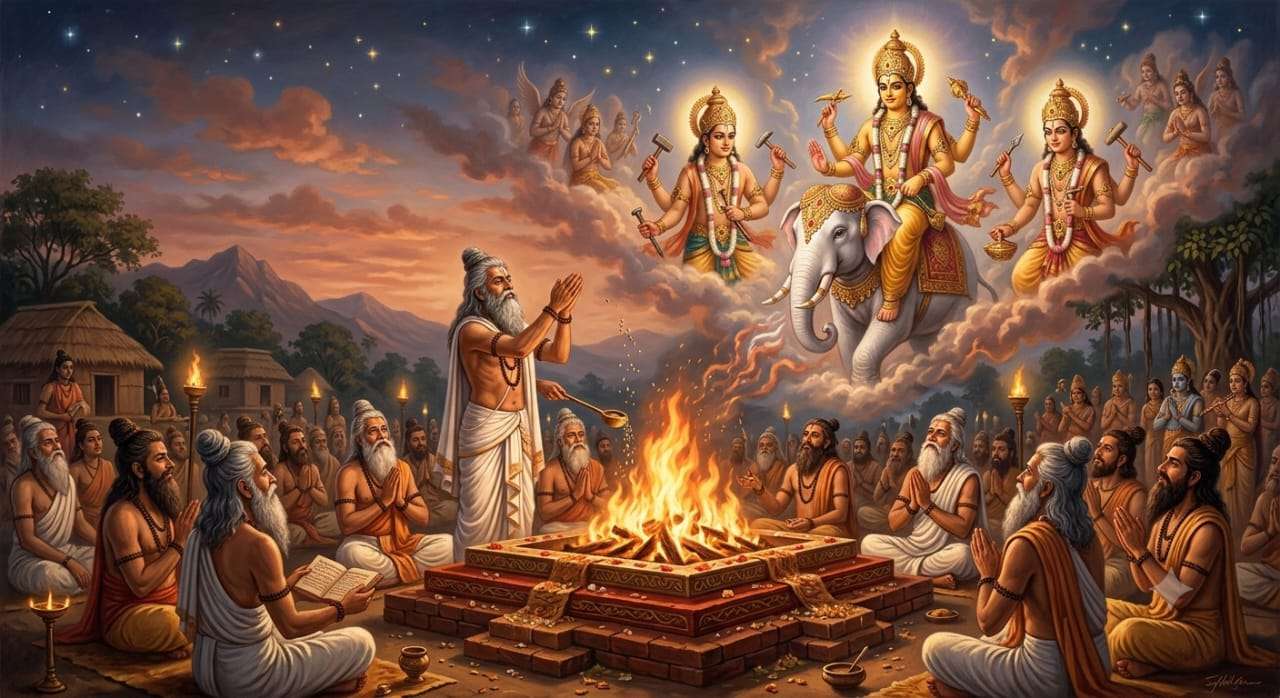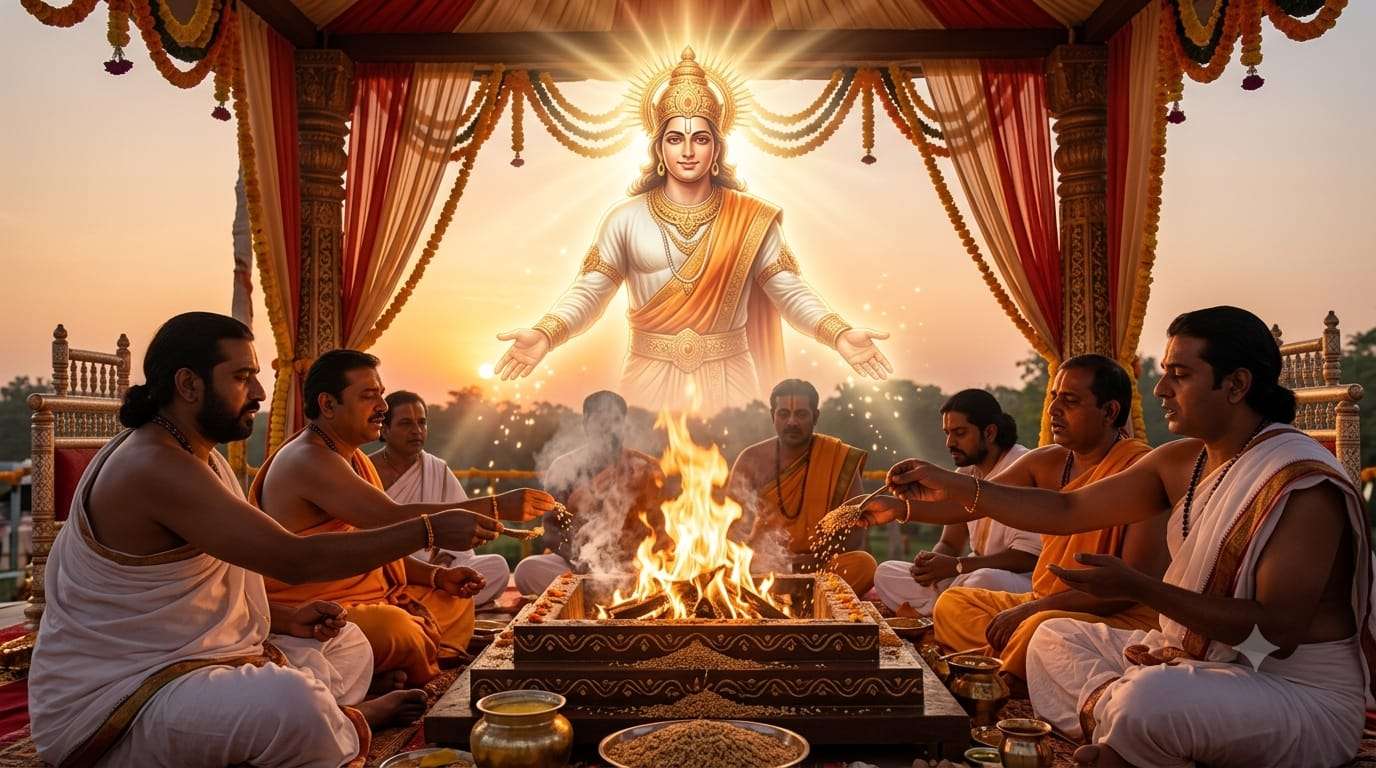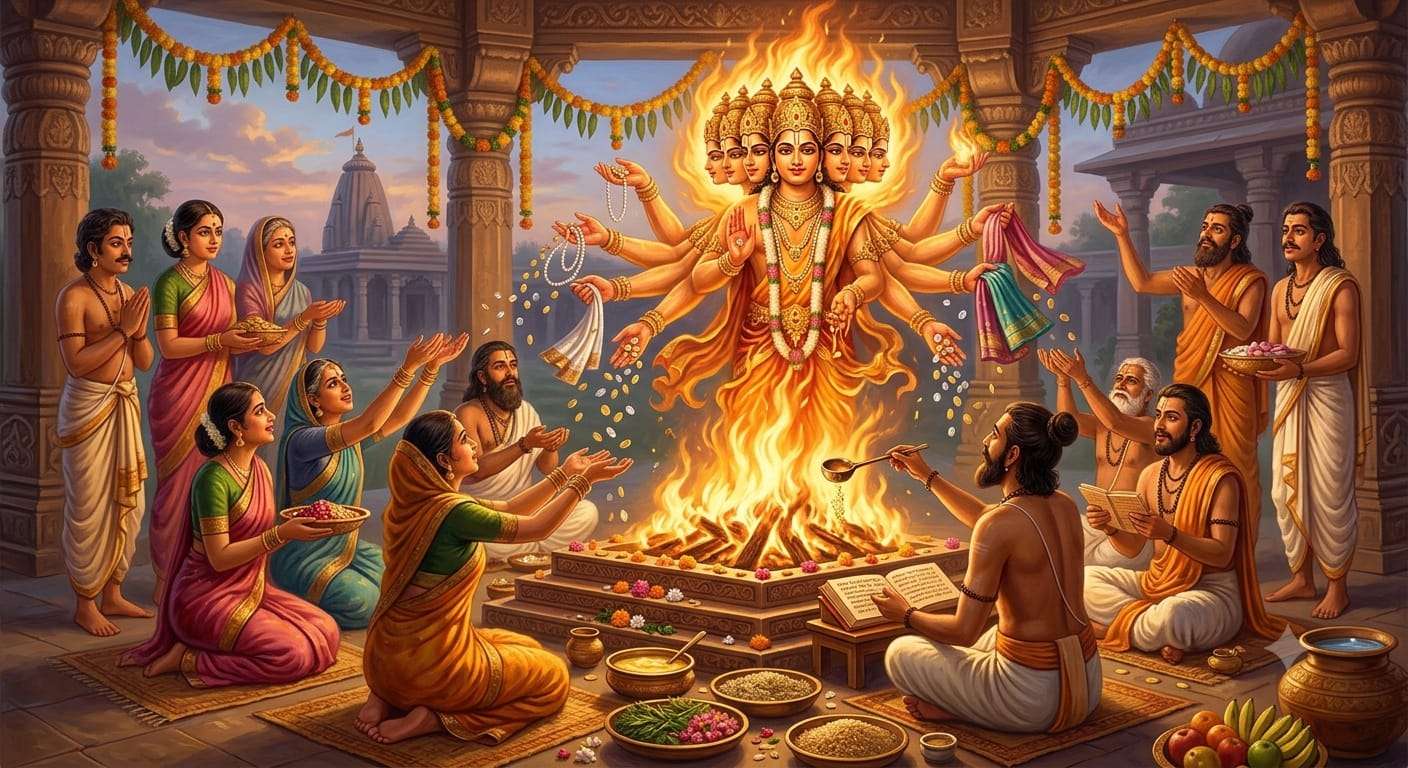
In the sacred tradition of the Rigveda, the sage Rishabha, illustrious son of the seer Vishwamitra, invokes the divine presence of Agni through hymns composed in the majestic Tristup chandas. These mantras arise not merely as poetic utterances, but as luminous currents of consciousness flowing from the inner realization of the rishis. Agni stands at the forefront of Vedic worship as the eternal inviter of the gods, the sacred mediator who carries the offerings of humanity to the celestial realms. He is the visible flame upon the altar and simultaneously the invisible principle of transformation operating throughout existence. In every yajna, Agni becomes the living bridge between mortal aspiration and divine grace, sanctifying the sacrificial ground with truth, discipline, and spiritual radiance.
The sages proclaim Agni as the enhancer of the joy and prosperity of priests who uphold sacred duties with purity of intention. Established firmly in the vow of truth, he is regarded as the sustaining cause of yajna itself. Without Agni, sacrifice remains lifeless, for it is through his fiery essence that offerings attain subtle form and ascend toward the gods. The Vedic vision perceives him not only as ritual fire but as the cosmic intelligence permeating all worlds. He is hailed as the Lord of realms, dwelling simultaneously in the heavens as lightning, in the atmosphere as energy, and upon earth as sacrificial flame. Therefore, the rishis fervently invite such a divine Agni to descend into their yajna and illuminate their sacred undertaking with celestial brilliance.
The imagery surrounding Agni is rich with symbolic grandeur. His chariot is described as radiant and effulgent, moving swiftly across the cosmic pathways with unstoppable force. His blazing flames appear like luminous hairs dancing upward toward the heavens, signifying the ascent of prayer and aspiration. The Vedic seers portray him as the mighty son of strength whose brilliance dispels darkness from the earth. In spiritual understanding, this illumination represents the awakening of wisdom within the human mind. Scientifically viewed, the ancient sages recognized fire as the primal transformer of matter, converting offerings into heat, light, fragrance, and subtle energy. Thus Agni became both a divine symbol and a profound observation of nature’s transformative power.
The worshipper bows before Agni as the very embodiment of yajna. With folded hands and reverence, the devotee salutes him as the guardian and kinsman of sacred rituals. Every oblation offered into the fire becomes an act of communion between the visible and invisible worlds. The priests request Agni to accept their salutations and offerings with benevolence, acknowledging his omniscient nature. He is invoked to bring learned scholars, wise seers, and noble minds into the sacrificial assembly so that wisdom may flourish alongside devotion. The kusa grass spread upon the altar signifies purity, order, and sanctified discipline. Upon these holy seats, Agni is respectfully invited to reside and bestow shelter, harmony, and spiritual protection upon all participants of the yajna.
The hymns further invoke the divine presence of Usha, the radiant dawn, and Ratri, the sacred night, both moving harmoniously under the guidance of Agni. Usha, the bringer of nourishment and awakening, symbolizes illumination, knowledge, and renewed life, while Ratri embodies contemplation, rest, and inward reflection. The Vedic sages perceived no conflict between them; instead, they recognized a cosmic rhythm governed by eternal order. Like two yugas moving in mutual respect, dawn and night sustain the balance of existence. Agni travels between them through the pathways of wind, symbolizing the movement of energy through the atmosphere. In this poetic expression lies an intuitive scientific temperament, reflecting the ancient awareness of cyclical processes governing nature, time, and life itself.
As Agni approaches through the currents of wind, the priests worship his ancient and eternal form with sacred chants and oblations. The continuity of these rituals across generations reflects the Vedic understanding of tradition as a living stream of knowledge rather than mere repetition. The fire upon the altar becomes a center of psychological concentration, social unity, ecological reverence, and spiritual aspiration. Offerings made into Agni were not acts of destruction but acts of transformation, acknowledging the interconnectedness of all elements within creation. Through yajna, the sages cultivated gratitude toward nature, disciplined thought, and harmony between humanity and the cosmos.
The rishis declare Agni to be equal to the Sun in his power to reveal the path to humanity through light. Just as the Sun illuminates the physical world, Agni enlightens the inner consciousness of beings. Therefore, even deities such as Mitra and Varuna honor and invoke him. Agni represents divine guidance, moral clarity, and the power of discernment. His flames symbolize intellect purified by truth and devotion. The upward movement of fire mirrors the upward striving of the human spirit toward higher wisdom and liberation. In this way, Vedic spirituality harmonizes symbolic insight with natural observation, blending metaphysical vision with empirical awareness.
With uplifted hands, the worshippers offer auspicious oblations into the sacred fire and pray for Agni’s grace. Their hymns resound through the yajna, creating an atmosphere filled with devotion, rhythm, and sacred resonance. The chanting of mantras was understood not merely as ritual recitation but as the disciplined use of sound vibrations capable of refining consciousness and fostering collective harmony. Agni is requested to remain steadfast in his divine function and continue supporting the sacred performance of yajna. Through this devotion, the community seeks both spiritual elevation and material well-being, recognizing no separation between ethical living and cosmic prosperity.
The mighty Agni is finally invoked as the compassionate protector of patrons and devotees. The sages pray that nourishment, abundance, and auspicious blessings may reach humanity through his grace. They seek perpetual and undiminishing wealth, not merely in material possessions but in wisdom, health, courage, and righteous living. Agni, the luminous and omniscient deity, is lovingly reminded that human beings offer oblations with sincerity and faith. Therefore, he is entreated to partake of these offerings and vigilantly guard the welfare of those who sustain the sacred order. In this profound Vedic vision, Agni emerges not simply as physical fire but as the eternal principle of transformation, illumination, protection, and divine communion that sustains both the cosmos and the human soul.