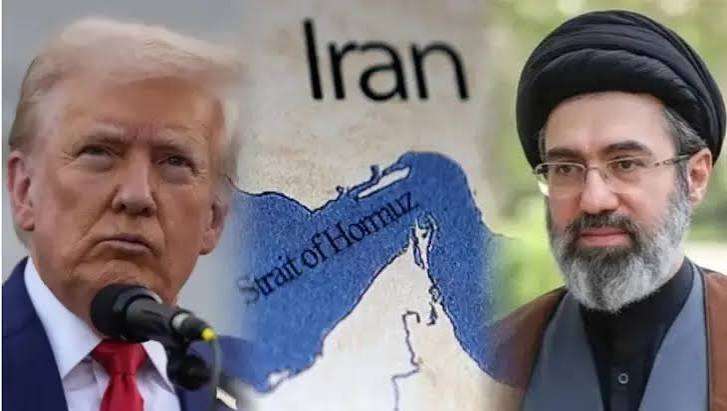
Washington: The United States has dramatically escalated its confrontation with Iran, with President Donald Trump asserting that Washington has “almost total control” of the strategically vital Strait of Hormuz while making clear that he is in no hurry to revive diplomatic negotiations with Tehran.
Trump’s latest stance comes as the fragile US-Iran ceasefire has effectively collapsed and American forces have resumed strikes against Iranian military targets, while Tehran has retaliated with ballistic missiles and drones against US military positions and regional targets.
The renewed hostilities have once again placed the Strait of Hormuz — one of the world’s most important energy arteries — at the centre of the conflict, raising fresh concerns over global oil supplies, shipping and energy prices.
Trump has dismissed suggestions that Washington is seeking an immediate diplomatic settlement with Tehran. Instead, he has continued to emphasise military and economic pressure, arguing that the US has gained the upper hand and that Iran is being pushed towards an economic crisis.
The latest escalation follows US strikes on Iranian military positions associated with attempts to disrupt shipping through the strait. On Sunday, US forces struck two Iranian rocket launchers on Larak Island after American officials said Islamic Revolutionary Guard Corps (IRGC) personnel were preparing to launch rockets carrying sea mines into the Strait of Hormuz. Larak Island lies close to Bandar Abbas and overlooks important shipping routes.
The US subsequently carried out another round of strikes inside Iran on Tuesday, targeting air-defence systems, radar, communications and maritime capabilities. US Central Command said the attacks were in response to attempted Iranian attacks on commercial shipping and US personnel in the region.
Iran responded by firing ballistic missiles at US military positions in Jordan and launching drones towards the region. Jordan said it intercepted eight Iranian missiles that entered its airspace, while the United Arab Emirates reported intercepting a drone over its territorial waters. Iranian attacks on US positions in Iraq and Bahrain were also reported amid the rapidly widening confrontation.
Trump has warned that any further Iranian retaliation would invite an even more severe American response. On Tuesday, after the Iranian missile attacks, he warned that Tehran would be hit “again at a much harder and higher level” if it retaliated against the latest US strikes.
However, reports suggesting that Trump has renewed or threatened a nuclear strike against Iran would be misleading. Asked directly whether he could rule out the use of nuclear weapons against Tehran, Trump said he did rule it out, arguing that there was no reason to use nuclear weapons against a country he claimed was already militarily defeated.
The nuclear issue nevertheless remains at the heart of the confrontation. Washington continues to insist that Iran must not be allowed to acquire a nuclear weapon, while Tehran maintains that its nuclear programme is peaceful and rejects what it regards as coercive American demands.
Hormuz becomes the central battleground
The Strait of Hormuz has emerged as the most dangerous flashpoint in the confrontation. The narrow waterway connects the Persian Gulf with the Gulf of Oman and is critical to the movement of oil and other energy supplies from the Gulf to international markets.
The United States says it has taken military measures to keep internationally recognised shipping lanes open. US Central Command commander Admiral Brad Cooper said American forces had cleared Iranian sea mines from the international shipping routes, allowing commercial vessels to resume passage. According to US officials, nearly 1,500 commercial vessels carrying close to 750 million barrels of crude had transited the waterway following the mine-clearing operations.
Iran, however, disputes Washington’s characterisation of the situation and continues to assert its authority over security arrangements in the waterway. Tehran has warned that vessels attempting to use routes it considers unauthorised could face consequences.
The standoff has already disrupted shipping and pushed global oil prices higher. Brent crude rose sharply amid the latest exchange of attacks, while US benchmark WTI also climbed as traders priced in the possibility of prolonged disruption to Gulf energy supplies.
Washington is simultaneously attempting to reduce the long-term strategic importance of Hormuz. US Treasury Secretary Scott Bessent said on Tuesday that new overland oil pipelines could eventually bypass much of the waterway’s importance, predicting that within two years Hormuz could become “a worthless piece of water” as more Gulf energy reaches world markets through land-based routes.
Diplomatic track in tatters
The latest military confrontation has also dealt another major blow to the Islamabad Memorandum of Understanding between Washington and Tehran.
The MoU was electronically signed on June 18 with Pakistan acting as mediator and Qatar playing a co-mediating role. Under the framework announced at the time, Iran was to reopen the Strait of Hormuz while the United States would lift its naval blockade. The two sides were also expected to work towards a comprehensive agreement covering the broader conflict and Iran’s nuclear programme.
High-level talks subsequently took place in Switzerland under the Islamabad framework, with the establishment of mechanisms covering nuclear issues, sanctions, monitoring and dispute resolution. The participants also sought to establish communication arrangements to reduce the risk of incidents involving commercial shipping in Hormuz.
But the diplomatic process failed to hold. By July, Pakistan was still describing the Islamabad MoU as an “enduring framework” while acknowledging serious implementation difficulties and calling for a return to technical-level negotiations.
Those hopes have now been overtaken by renewed military action.
Iranian President Masoud Pezeshkian has continued to indicate an interest in a negotiated settlement, but Washington and Tehran remain sharply divided over sanctions, Iran’s nuclear programme, maritime security and the future of the Strait of Hormuz.
The latest escalation therefore represents more than another exchange of missiles and airstrikes. It signals the possible return of the US-Iran conflict to an open-ended military phase after weeks in which Washington had increasingly relied on sanctions and economic pressure.
For the global economy, the immediate concern is Hormuz. For the region, it is the danger that attacks on US and Iranian forces could draw in additional Gulf states and turn a bilateral confrontation into a much wider war.
And for diplomacy, the message is stark: the Islamabad framework that briefly offered a route out of the conflict has so far failed to prevent the two sides from returning to the battlefield.