


King Dhritarashtra, overwhelmed with grief, listened as the account unfolded before him. The mighty Narayanastra, upon which the Kauravas had placed such immense hope, had failed to secure their triumph. The king lamented that every effort of his sons seemed only to strengthen the fortunes of their enemies. Yet destiny moved onward, indifferent to the wishes of men. Hearing this, Prince Duryodhana turned to Ashwatthama and urged him to employ the other celestial weapons at his command. “If the Narayanastra has not served our cause,” he declared, “then unleash your remaining divine astras and annihilate our foes.”
Inflamed with martial pride and conscious of his extraordinary mastery over celestial warfare, Ashwatthama advanced against the Pandava forces with terrible vigor. The death of his father, the revered preceptor Drona, had intensified the fire within his heart and sharpened his resolve. Like a tempest descending upon a forest, he showered arrows upon the opposing ranks. With astonishing speed he scattered the Pandava soldiers and confronted Dhrishtadyumna. He pierced the Panchala prince with twenty-five shafts and followed them with five more, tormenting him with relentless precision.
Dhrishtadyumna answered in equal measure, repaying every arrow with another. Yet the son of Drona, consumed by fury, struck with devastating force. He slew the horses of his adversary, felled the charioteer, shattered the standard, and tore apart the banner that fluttered above the chariot. Witnessing the peril of his ally, Satyaki rushed forward in support. Ashwatthama, however, struck him with a single shaft of such power that Satyaki fell unconscious. Turning once more upon Dhrishtadyumna, he overwhelmed him with arrows until he too lost consciousness upon the battlefield.
When Bhima and Arjuna beheld the condition of Satyaki and Dhrishtadyumna, their hearts were seized by twin emotions—wrath against Ashwatthama and sorrow for their fallen companions. These passions surged within them with equal force. Alongside them advanced the grandson of Sisupala, the prince of Chedi, the prince of Malava, Sudarshana, and Vrudhakshatra. Together these warriors released a tremendous volley of arrows upon the son of Drona.
Yet Ashwatthama severed every shaft in midair. His movements became so swift and elusive that he appeared to be fighting in many places at once. To the bewildered warriors, countless Ashwatthamas seemed to be engaged simultaneously in combat. His ferocity increased with every passing moment. First he severed the arms of Sudarshana and then struck off his head. Next he shattered the chariot of Vrudhakshatra and severed his head as well. Turning again, he slew the prince of Chedi and roared with the voice of a lion echoing through the mountains.
Panic swept through the Pandava and Panchala armies. Courage deserted many hearts, and the soldiers fled in confusion from the field. Yet Bhima and Arjuna stood firm. Fully armed and resolute, they turned once more toward battle. Observing Ashwatthama moving with the confidence of apparent victory, Arjuna addressed him in a voice that carried across the tumult of war.
“O son of our revered preceptor, we have witnessed the strength of your arms, the greatness of your celestial weapons, and your unwavering devotion to royal duty. Yet the contest remains undecided. Why do you withdraw from the battlefield while we still stand before you? Remain and continue the struggle.”
Burning with indignation, Ashwatthama invoked the dreadful Agneyastra. Sanctifying it with sacred mantras, he released it against the Pandava host. Instantly, a blazing torrent of divine fire swept across the battlefield, devouring everything in its path. Horses, elephants, chariots, and foot soldiers alike were consumed by its terrible radiance. The fourfold army groaned beneath its fury, and an entire Akshauhini of the Pandava forces perished in the conflagration.
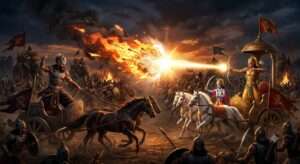
The Kaurava army erupted in jubilation. Warriors spoke among themselves with delight, declaring that even Krishna and Arjuna would soon be reduced to ashes by the celestial fire. They proclaimed that no warrior upon earth could equal the son of Drona. Drums thundered, conches blared, and cries of victory reverberated through the heavens.
Then, as Sanjaya narrated to Dhritarashtra, Arjuna calmly invoked the Brahmastra. Consecrating it with sacred rites, he released the supreme weapon. Its divine brilliance manifested across the battlefield and gradually subdued the raging Agneyastra. The consuming flames were pacified, and tranquility returned where devastation had reigned. Arjuna then sounded his conch in triumph, and the Pandava warriors answered with their own mighty blasts, restoring confidence and enthusiasm throughout their ranks.
Ashwatthama stood astonished and deeply disheartened. Realizing that even his most formidable weapons could not secure victory, despair settled upon his spirit. “My celestial astras no longer strengthen me,” he reflected. “It is futile to continue this struggle.” Casting aside his weapons within the chariot, he prepared to abandon the battlefield.
At that moment a wondrous sight appeared before him. A mysterious radiance spread in every direction, neither wholly light nor darkness. A luminous cloud descended from the heavens, and from within it emerged the great sage Vyasa. Ashwatthama immediately prostrated himself in profound reverence and stood before the sage with folded hands and a humbled heart.
With a voice choked by emotion, he addressed the venerable seer. “O great sage, I cannot understand why my Agneyastra became powerless. By what mystery was it rendered ineffective? This divine weapon cannot ordinarily be resisted by gods, Gandharvas, or celestial warriors. How then could mortal beings such as Krishna and Arjuna withstand its force? Please remove my doubt and enlighten me.”
Vyasa replied with serene compassion. “Ashwatthama, I shall dispel your confusion. In ancient times the Supreme Lord Vishnu manifested as the sage Narayana for the protection of the worlds. Seeking the highest spiritual attainment, he journeyed to Mount Mainaka and performed severe penance in honor of Lord Shiva. His austerities were extraordinary. Raising his arms upward, subsisting solely upon air, and renouncing all food, he remained absorbed in meditation for a prolonged period.”
“Pleased by such unparalleled devotion, Lord Shiva appeared before Narayana. His matted locks were adorned with the crescent moon; serpents formed his sacred thread, and the mighty Vasuki encircled his neck as an ornament. Bearing the bow Pinaka, the great Lord shone with divine majesty. Narayana immediately bowed before him and worshiped him with profound reverence.”
Vyasa continued, recounting the sacred praise offered by Narayana: “O Supreme Lord, the entire animate and inanimate universe arises from Your will. The guardians of the worlds protect their realms only through the power bestowed by Your grace. Without that grace, no being possesses true strength. The moving and unmoving creation flourishes under Your protection; therefore You are rightly praised as Maheshvara. O wearer of braided locks, by Your compassion all creatures attain the four goals of life and enjoy their blessings. The Vedas themselves proclaim Your glory. The sacred hymns chanted by assemblies of Brahmins arise according to Your divine purpose. Whoever worships You with unwavering devotion receives enduring joy through Your boundless mercy.”
Thus the discourse of Vyasa flowed before Ashwatthama like a sacred river, carrying currents of wisdom, peace, and spiritual illumination. As Sanjaya narrated these sublime events to Dhritarashtra, the battlefield itself seemed momentarily transformed, for amid the roar of war arose the eternal truth that divine power bows before higher divine grace, and that the deepest mysteries of victory and defeat are governed not by weapons alone, but by the will of the Supreme.

