


The true spirit of unity was powerfully expressed by Dhrishtadyumna, who reminded the warriors that they were assembled for a single sacred purpose—the triumph of righteousness. He questioned why personal hostility should endanger an opportunity secured through immense labour, sacrifice, and the blood of countless warriors, kings, and princes. Yet his words failed to calm Satyaki. His anger surged like molten lava rushing from the depths of a volcanic mountain. His eyes blazed crimson with wrath. Casting aside his bow upon the chariot, he seized his mace and thundered, “Dhrishtadyumna, you grow angry merely because I speak the truth. Why should words suffice when deeds can answer? Endure the punishment of my actions.” With that, he leapt from his chariot and rushed toward Dhrishtadyumna.
Sri Krishna immediately perceived the danger and dispatched Bhimasena to intervene. Leaping down from his own chariot, Bhima seized Satyaki with immense strength, preventing him from advancing even a single step. At that moment Sahadeva hurried forward and spoke with wisdom and affection. “Why do you quarrel among yourselves? Both of you are dear to us, and we are equally dear to you. The Yadava, Panchala, and Pandava families are united by bonds that cannot be severed. Our relationship is founded not merely upon kinship but upon mutual respect, affection, and love. You are destined to stand together. Do not allow anger to divide those whom destiny has joined.”
Dhrishtadyumna, however, was not inclined toward reconciliation. Turning to Bhima, he declared, “Do not restrain Satyaki. It is not within your power to hold him forever. It is my duty to answer him. His pride and arrogance do not intimidate me. I am not the one-handed Bhurishrava to tolerate his haughtiness. I shall humble him and cut his pride to its proper measure.” Hearing these words, Satyaki writhed like a serpent caught in an iron grip, struggling fiercely within Bhima’s powerful embrace. At last, through the combined efforts of Sri Krishna and Dharmaraja, the dispute was subdued, and both heroes were directed once more toward their common duty upon the battlefield.
Soon the Pandava forces sounded conches, kettledrums, trumpets, horns, tabors, and cymbals. Their combined resonance rose to the heavens and echoed across the earth. The two vast armies then surged against one another like mighty oceans colliding in fury. The Pandavas were inspired by the fall of Dronacharya, while the Kauravas drew fresh confidence from the unwavering support of the seemingly invincible Ashwatthama. Both sides stood resolute in their respective hopes, and a fierce battle commenced.
Observing Duryodhana’s distress, Ashwatthama resolved upon a terrible course. Concentrating his mind upon the sacred Narayanastra, he sanctified and unleashed it against the Pandava army. Instantly the universe seemed shaken. The earth spun as though seized by cosmic turbulence. The brilliance of the sun dimmed, and the quarters trembled. The sky quivered ominously. Mountains appeared to shake in succession, while oceans surged beyond their boundaries, roaring as though intent upon consuming the world. Thunder rolled repeatedly across the heavens. The manifestation of the Narayanastra inspired immeasurable terror in all who beheld it.
The celestial weapon released innumerable half-moon-tipped arrows, spears, swords, razor-edged shafts, and specially designed missiles of irresistible power. These divine weapons descended upon the Pandava hosts from every direction. Though many warriors resisted with courage and concentration, their efforts could only partially deflect the assault. Flames and smoke spread across earth and sky, enveloping every region and devastating the fourfold divisions of the army. Those who resisted were consumed and reduced to ashes, while only those who ceased opposition found temporary refuge from destruction.
Witnessing the calamity, Dharmaraja grew deeply troubled. He looked toward Arjuna, who remained strangely silent and made no effort to counter the weapon. Addressing Satyaki and Dhrishtadyumna in the hearing of Krishna and Arjuna, he spoke with bitterness born of grief. “Drona was celebrated as a righteous man. Yet when Draupadi was humiliated before the Kuru assembly, he remained silent. When she appealed to the elders for justice, he did not speak. He participated in the conspiracy that led to the death of the youthful Abhimanyu. If we delay any longer, Arjuna may choose self-destruction for failing his vows. Let such righteousness remain with him. I shall enter the fire of this celestial weapon. Satyaki and Dhrishtadyumna, withdraw with the army. Let Arjuna’s purpose be fulfilled. As for Krishna, he will act according to his own wisdom.”
Hearing these despairing words, Sri Krishna immediately raised his voice and addressed the entire army. “Descend at once from your chariots, elephants, horses, and every vehicle. Lay down your weapons and stand motionless upon the earth. The Narayanastra harms only those who resist it. This instruction was revealed when the weapon was bestowed. There exists no means to withdraw it; this alone is its antidote.” Trusting Krishna’s wisdom, many warriors obeyed.
Bhimasena, however, could not accept such submission. Rushing forward, he exhorted the soldiers, “Do not abandon your weapons. Do not forsake the duty of warriors upon the battlefield. Like Indra wielding the Vajra, I shall confront and overcome this weapon. Let even our enemies witness my strength. Fear not.” Filled with indomitable courage, Bhima advanced. He sounded his conch, struck his mighty arms, and roared like a lion, causing the directions themselves to tremble. Then he charged directly toward Ashwatthama.
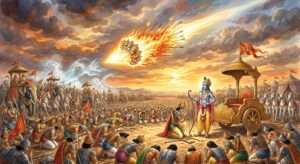
Seeing Bhima’s defiance, Ashwatthama concentrated the full fury of the Narayanastra upon him. Innumerable blazing missiles encircled Bhima’s chariot. The sight was so terrifying that soldiers everywhere descended from their vehicles and cast aside their weapons. The celestial weapon, deprived of resisting targets, redirected its overwhelming force toward Bhima alone, who remained steadfast in battle.
Recognizing the danger, Arjuna invoked the Varunastra in an attempt to diminish the blazing energy of the Narayanastra. Yet Ashwatthama intensified the celestial weapon through renewed sanctification, increasing its destructive power. The flames surged higher and closed around Bhima. Krishna and Arjuna watched closely, while Dharmaraja and the others refrained from resistance and thus remained safe. Bhima alone persisted, refusing the counsel of reason and the pleas of those who loved him.
As the inferno drew near, Krishna spoke urgently. “No one can withdraw this divine weapon. Had such a thing been possible, would we remain inactive? This resistance serves no purpose. Do not gamble with your life. Descend from the chariot immediately.” When Bhima still refused, Krishna and Arjuna forcibly removed his weapons and pushed him down from the chariot. Once Bhima ceased resistance, there remained no warrior on the Pandava side opposing the Narayanastra. The entire army stood unarmed and motionless, watching in awe as the celestial weapon gradually calmed itself and vanished, having found no resistance upon which to feed.
Thereafter, Krishna instructed the warriors to rearm themselves. The enthusiasm that had earlier animated the Pandava forces returned with renewed vigor. Conches sounded once more, weapons were raised, and the army surged forward against the Kauravas with irresistible determination. Observing this revival, Duryodhana urged Ashwatthama to unleash the Narayanastra a second time. Ashwatthama replied, “This weapon cannot be employed again. My father informed me when it was bestowed that a second use would turn its fury upon its wielder and bring destruction upon us. Its withdrawal occurred because the enemy surrendered resistance. Krishna alone is responsible for our failure. He understood the secret of escaping its power and instructed the Pandavas to lay down their arms. Thus the weapon found no target and disappeared. What more could we have done?”
Dhritarashtra, listening to Sanjaya’s narration, was deeply disappointed by the turn of events and waited anxiously for further news from the battlefield. Yet within these events lay profound lessons. The quarrel between Satyaki and Dhrishtadyumna revealed the dangers of pride, anger, and wounded honor, while the destruction averted by Krishna revealed the supremacy of wisdom over force. The Kauravas had placed their highest hopes upon a celestial weapon of unparalleled power, yet its fury was neutralized through understanding, restraint, and unity.
Thus the episode stands as an enduring testimony that no challenge, however overwhelming, can prevail against harmonious action guided by wisdom. When courage is joined with humility, and strength is governed by discernment, even the most dreadful forces lose their power. Under the guidance of the wise, unity transforms impending destruction into victory, and confusion yields to clarity. Such was the lesson witnessed upon the battlefield, as Sanjaya continued his sacred narration of the great war.

