


The mighty assaults of Karna, resounding across the battlefield like the crash of storm-driven waves, deeply provoked Bhīmasena. Unable to endure the devastation inflicted upon the Pāṇḍava ranks, Bhīma advanced and challenged Karna to a decisive encounter. Nakula hastened to support his brother, while Arjuna remained fiercely engaged against the invincible Drona, aided by the valiant warriors of Pañchāla. Across the vast plain of Kurukṣetra, countless battles unfolded simultaneously, each contributing to the terrible symphony of war.
Meanwhile, the dreadful demon Alāyudha hurled a massive iron club at Ghaṭotkacha. Struck with tremendous force, the mighty son of Bhīma was momentarily dazed, his vision obscured. Yet his recovery was swift. Seizing a colossal mace, he whirled it with irresistible momentum and launched it at his adversary. The blow shattered Alāyudha’s chariot into fragments, crushed his horses, and slew his charioteer instantly.
Enraged beyond measure, Alāyudha ascended into the heavens and resorted to his demonic powers. Roaring like thunder that shook both earth and sky, he assumed the form of a vast cloud and rained torrents of blood, flesh, bones, and blazing thunderbolts upon the battlefield. The terrifying spectacle filled warriors with dread. Yet Ghaṭotkacha, master of illusion himself, countered every enchantment with equal skill. The dreadful manifestations dissolved as swiftly as they had arisen, leaving the demon’s sorcery powerless before him.
Abandoning his illusions, Alāyudha descended to engage in direct combat. The two titans fought with rocks, trees, and uprooted trunks, recalling the legendary duel between Vāli and Sugrīva in the ancient age of the Rāmāyaṇa. The earth trembled beneath their blows as stones and timber flew in all directions. When these crude weapons were exhausted, they seized clubs, maces, and other instruments of destruction, clashing like enraged elephants battling for supremacy. Their weapons shattered upon impact, scattering sparks and fragments across the blood-soaked ground.
At length, Alāyudha leapt forward with a sword in hand, and Ghaṭotkacha answered with equal ferocity. The combat became so intense that the flashing weapons filled the air with fire and smoke, obscuring sight amid the deafening din of battle. Then, perceiving the decisive moment, Ghaṭotkacha struck with devastating precision and severed Alāyudha’s head. Raising a triumphant roar that echoed like a succession of conch blasts, he spread terror through the enemy ranks.
The Pāṇḍava army erupted in celebration. Drums thundered, trumpets blared, horns sounded, and bells rang proudly in honor of the fallen demon. Warriors shouted victory cries that rolled across the battlefield like waves, creating confusion among the Kaurava forces. Inflamed by wrath and exhilarated by triumph, Ghaṭotkacha surged toward Duryodhana and cast the severed head of Alāyudha before him. The sight filled Duryodhana and his soldiers with grief and foreboding.
Sañjaya then addressed King Dhṛtarāṣṭra. “O Monarch, your son Duryodhana had firmly believed that Alāyudha, the brother of the slain Bakāsura, would surely destroy Bhīmasena and his brothers, thereby freeing the Kauravas to wage war without fear. But now that Alāyudha has fallen at the hands of Ghaṭotkacha, Duryodhana is haunted by the thought that Bhīma may ultimately annihilate them all. This fear has greatly diminished his spirit and compelled him to ponder his next course of action.”
While such anxieties troubled the Kaurava camp, Karna continued to devastate the Pāṇḍava forces with unmatched skill and a dazzling variety of weapons. Seeing this, Ghaṭotkacha mounted his chariot and advanced with overwhelming confidence. The two warriors exchanged torrents of arrows with equal prowess. Then Karna seized an opportunity and slew Ghaṭotkacha’s horses. Instantly the demon vanished, chariot and all, leaving the Kaurava army trembling in uncertainty. None knew where he might appear next or upon whom his supernatural fury would descend.
As fear spread among the ranks, Ghaṭotkacha manifested as a colossal cloud in the heavens. Thunder roared, lightning flashed, and dreadful shadows engulfed the battlefield. From the sky descended showers of arrows, swords, spears, pestles, daggers, and knives. The demon hosts accompanying their prince likewise transformed into clouds and joined in the assault. Massive stones crashed upon soldiers, horses, and elephants. Chariots splintered beneath the bombardment, and countless warriors perished. Even Karna found it difficult to restrain the overwhelming tide of demonic warfare.
The surviving Kauravas became convinced that no ordinary conflict was unfolding before them. Many believed that Indra himself and the celestial hosts had come to aid the Pāṇḍavas. Such thoughts drained their courage, and numerous warriors fled in search of safety. Amid the chaos, Karna alone stood firm. Armed with courage as his companion and resolve as his army, he fought relentlessly to restore confidence among the fleeing troops.
Invoking divine astras, Karna gradually dispelled the vast web of illusions. The false clouds vanished like mist before the rising sun. The thunder ceased, the rain of weapons ended, and peace slowly returned to the sky. Yet the terror lingered in the hearts of the soldiers. Sañjaya declared, “O King, I remain astonished by the havoc wrought through Ghaṭotkacha’s sorcery. His demonic powers seemed to overshadow even Karna’s valor. Many believed that if such illusions could not be subdued, then slaying Ghaṭotkacha would be impossible. Yet Karna remained steadfast, unshaken by fear.”
The Kaurava warriors, inspired by Karna’s unwavering composure, gathered around him and said, “O Karna, this Ghaṭotkacha is the supreme master of illusion. Only you possess the power to save us from his deadly grasp. During the time when you gave your natural armor and earrings to Indra, he bestowed upon you the invincible celestial weapon known as Śakti. Why preserve it for some distant future? There can be no greater necessity than this moment. Use it now against Ghaṭotkacha and rescue us from destruction.”
Even as these words were spoken, Ghaṭotkacha descended with fierce determination to kill Karna. Wielding his mighty mace, he slew Karna’s horses and shattered his chariot. Karna staggered beneath the tremendous impact and realized that continued hesitation could prove fatal. Accepting the counsel of the assembled warriors, he resolved to unleash the divine weapon.
The Śakti blazed with terrifying radiance. Flames seemed to leap from every direction, spreading dread throughout the battlefield. Bestowed by Indra in exchange for Karna’s celestial armor and earrings, the weapon was irresistible and could never fail its target. Yet it could be used only once. Karna had long preserved it for Arjuna, but necessity now overruled desire. With no alternative remaining, he released the divine missile against Ghaṭotkacha.
The celestial weapon surged through the sky with a sound resembling countless bells reverberating through the heavens. Ghaṭotkacha beheld its approach and understood the peril. His enormous form twisted and swayed amid the clouds as he sought escape, but none was possible. The blazing missile seemed like the twin sister of Yama, the lord of death himself. From the heavens the gods acclaimed Karna’s deed.
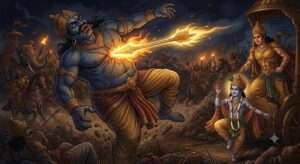
First dispelling every demonic illusion, the Śakti pierced Ghaṭotkacha’s chest and burst through his body before ascending toward the heavens. Its brilliance dimmed the light of the stars. Stricken mortally, Ghaṭotkacha lost consciousness and plunged toward the earth. Writhing in agony during his final moments, he collapsed with terrifying force. His vast form lay grotesque upon the battlefield, tongue protruding, his mighty life extinguished.
Sañjaya continued, “O King Dhṛtarāṣṭra, Karna slew Ghaṭotkacha with the divine Śakti. The Kaurava army erupted in celebration. Conches sounded, trumpets blared, kettle-drums thundered, and bells rang joyfully. Warriors roared like lions. Duryodhana, Śakuni, allied kings, and kinsmen rejoiced greatly. Overwhelmed with gratitude, Duryodhana approached Karna and embraced him warmly.”
Then Dhṛtarāṣṭra inquired, “With the death of Ghaṭotkacha, the Pāṇḍavas must have been overcome not only by grief but also by anger. How did they respond, and what course did they adopt thereafter?”
Sañjaya replied, “The Pāṇḍavas were indeed plunged into sorrow at the fall of Ghaṭotkacha. Yet amidst their grief stood one remarkable exception. Krishna suddenly uttered a lion-like roar and sounded his divine conch, the Pañchajanya. Grasping the reins, he danced with transcendent joy. His movements resembled a blossoming tree swaying gracefully in a gentle breeze.”
Arjuna watched in astonishment. While sorrow darkened every face, Krishna appeared radiant with delight. Unable to comprehend this unexpected reaction, Arjuna approached him, embraced him affectionately, and gently struck his shoulder in wonder. Krishna again sounded a triumphant roar.
Arjuna then spoke with deep perplexity. “O Purushottama, Ghaṭotkacha has fallen. Our army is shaken and scattered. Grief engulfs us all, yet you rejoice and dance as though a great victory has been won. Your conduct lies beyond the understanding of ordinary men like me. Surely there is a profound mystery hidden within your joy. I beseech you, reveal the secret that has filled your heart with such happiness amidst this hour of sorrow.”
Thus, before the anxious king, Sañjaya continued his narration, preparing to unveil the deeper wisdom behind Krishna’s extraordinary rejoicing at the death of the mighty Ghaṭotkacha.

