



Bangladesh’s reported openness to joining the Makkah Joint Defence Agreement involving Saudi Arabia, Türkiye and Pakistan deserves attention in Bharat—but certainly not panic. Dhaka has, at this stage, not formally joined the arrangement, and that distinction matters. The Makkah pact itself is still a relatively new security framework whose practical military architecture remains to be tested.
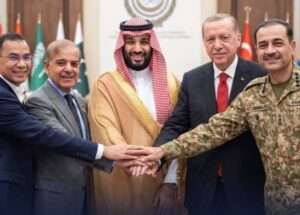
The agreement, signed in Makkah on August 7 by Saudi Crown Prince Mohammed bin Salman, Turkish President Recep Tayyip Erdoğan and Pakistani Prime Minister Shehbaz Sharif, provides that an armed attack against one signatory will be regarded as an attack against all three. It also envisages deeper defence cooperation. However, unlike NATO’s highly institutionalised collective-defence system, the Makkah pact does not publicly prescribe an automatic military response.
That is the first reality check.
The second is equally important: this is not, at least officially, an anti-Bharat alliance. Pakistan, Saudi Arabia and Türkiye have all described the agreement as defensive and not directed against any particular country. Pakistan has also said the pact is open to other regional countries willing to accept its principles.
Yet New Delhi would be foolish to dismiss its possible expansion.
If Bangladesh were eventually to join, the strategic geography would change. Pakistan would gain an additional diplomatic and security partner in Bharat’s immediate eastern neighbourhood, while Türkiye would acquire another channel through which its defence-industrial and geopolitical influence could expand into South Asia and the Bay of Bengal. That does not suddenly create a military encirclement of Bharat—but it would create another layer of strategic complexity.
And that is precisely where the Makkah pact should be viewed: not as an existential threat, but as a developing strategic variable.
There is also a temptation to exaggerate the combined military power of Saudi Arabia, Pakistan and Türkiye. Yes, the three bring very different strengths. Pakistan has a nuclear arsenal and substantial military experience; Saudi Arabia possesses enormous financial resources and regional influence; Türkiye has a large military and a growing indigenous defence industry.
But putting three flags on one agreement does not automatically produce a NATO.
Nor does Turkish defence technology suddenly make Pakistan or any prospective member capable of overpowering Bharat. Türkiye’s drones and defence systems deserve respect, but military technology must be judged by battlefield performance, integration, training, intelligence, logistics and the broader balance of capabilities—not by marketing brochures.
Operation Sindoor offered precisely such a reality check. Turkish-origin drones were reportedly employed by Pakistan during the confrontation, but their presence did not fundamentally change the strategic outcome. Bharat demonstrated that sophisticated imported platforms alone cannot compensate for weaknesses in planning, intelligence, targeting and operational integration.
So Islamabad should perhaps think twice before imagining that adding Dhaka to a Saudi-Turkish-Pakistani framework would somehow transform the strategic equation with Bharat. It would not.
The bigger question is Saudi Arabia.
Riyadh’s calculations cannot simply be reduced to an anti-India or pro-Pakistan framework. The Makkah agreement emerged amid a profoundly unstable West Asian security environment, particularly the confrontation involving Iran and the uncertainty surrounding traditional American security guarantees. Reuters reported that the pact was driven substantially by the signatories’ desire for greater regional security cooperation amid the turmoil, rather than by an explicit plan to confront Bharat.
That is important because Bharat-Saudi Arabia relations have been steadily broadening beyond the old oil-and-remittances paradigm. Energy, investment, trade, connectivity, counterterrorism and strategic cooperation have all acquired greater significance. New Delhi therefore has little reason to view Riyadh through the narrow prism of Pakistan.
The same sophistication should apply to Dhaka.
Bangladesh has every right to diversify its strategic partnerships. But it also has enormous economic, geographical and connectivity interests tied to Bharat. A decision to enter a defence framework involving Pakistan and Türkiye would inevitably carry consequences for its relationship with its giant neighbour. Dhaka would have to calculate whether the symbolic advantages of joining a new security grouping outweigh the economic and strategic costs of unnecessarily antagonising New Delhi.
Bharat, meanwhile, should neither issue hysterical warnings nor sit complacently.
Diplomacy, trade, connectivity and neighbourhood engagement must remain the first line of defence. At the same time, New Delhi must closely monitor Türkiye’s expanding defence footprint, Pakistan’s attempts to internationalise its security narrative and any move to establish a permanent Makkah-pact presence in South Asia.
The message from New Delhi should therefore be simple: Bharat is watching, but Bharat is not worried.
Pakistan and Bangladesh may seek new friends. Türkiye may seek new markets for its defence industry. Saudi Arabia may seek new security arrangements in a turbulent region. All of that is legitimate geopolitics.
But alliances are not magic wands.
For any combination of Pakistan, Bangladesh, Türkiye and even Saudi Arabia to pose a serious conventional challenge to Bharat, far more than a ceremonial agreement in Makkah would be required. It would require sustained military integration, common strategic objectives, interoperable forces, logistics, intelligence sharing and, most importantly, a willingness to accept the enormous political and economic consequences of confrontation with a rising Bharat.
That is a very different proposition.
The wise course for New Delhi is neither complacency nor alarmism. It is strategic patience backed by credible military strength, economic leverage and active diplomacy.
Let others build their pacts.
Bharat must build its power.

