

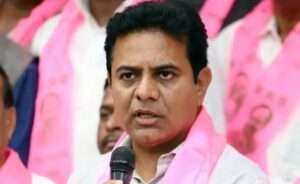
Bharat Rashtra Samithi (BRS) Working President Kalwakuntla Taraka Rama Rao’s (KTR)recent remarks about his daughter choosing to study in the United States because she felt Bharat did not have colleges of comparable quality have opened a debate that goes far beyond one politician’s family. The real question is not whether an individual has the right to choose an overseas university. Of course, he does. The question is one of political credibility and public accountability. KTR argues that Bharat must build world-class universities, strengthen research infrastructure, improve academic standards and prevent the migration of talented students abroad. Fair enough. These are legitimate concerns. But when such observations come from a leader whose party governed Telangana for nearly a decade, the obvious question cannot be avoided: what did his government do to create the very institutions he now says Bharat lacks? It is remarkably easy for politicians to diagnose the country’s problems after their own children have secured admission abroad. It is considerably harder to explain why governments that enjoyed years of power did not transform public education into an ecosystem capable of competing with the world’s best. And there is an even more fundamental question that political parties should answer. If government schools and government institutions are genuinely incapable of providing quality education, why merely complain about the education system? Why not bring legislation requiring those who run the system to use it? Why shouldn’t elected representatives, senior bureaucrats, legislators, ministers and other influential government officials be encouraged—or even required, subject to constitutional and legal safeguards—to educate their children in government schools? If government schools are good enough for the children of ordinary citizens, why should the children of those administering the system automatically be sent to expensive private schools or foreign institutions? Such a policy would immediately change the political equation. Imagine a government school where the children of ministers, IAS officers, senior officials and legislators study alongside children from ordinary families. Suddenly, the quality of classrooms would matter personally to those in power. Teacher absenteeism would no longer be somebody else’s problem. Toilets, laboratories, libraries, digital infrastructure, safety, transport and academic standards would become matters demanding urgent attention.
Nothing improves a public institution faster than making the powerful depend on it. This is precisely why the education debate should not be reduced to the convenient argument that Bharat’s policies are inadequate. If politicians genuinely believe the country’s public education system is failing, they should first ask why governments—successive governments, at both the Centre and in the states—have allowed such gaps to persist. There is nothing inherently wrong with an Bharatiya student choosing Harvard, Stanford, MIT or any other foreign university. Global exposure can be enormously valuable. But political leaders cannot have it both ways: they cannot celebrate their children’s access to global opportunities while simultaneously lecturing ordinary citizens about the deficiencies of the very system they themselves have failed to reform. Nor should Bharat’s universities be casually dismissed. The IITs, IIMs, IISc and numerous central and state institutions have produced scientists, entrepreneurs, administrators, researchers and professionals who have succeeded across the world. The answer to Bharat’s educational shortcomings is not contempt for Bharatiya institutions; it is greater investment, accountability, competition, research and reform. KTR is also right about one thing: political discourse must focus more on development and less on manufactured divisions. But that principle applies equally to his own political establishment. If education is truly the priority, let the politics stop at the school gate. The ultimate test of any education policy is simple: Would those who frame it trust it for their own children? If the answer is no, the problem is not merely Bharat’s education policy. The problem is the policymakers themselves. And perhaps the most effective education reform Bharat can introduce is not another committee, slogan or scheme—but a simple rule of political honesty: before demanding faith in government schools from the public, let those in power demonstrate that faith themselves.