This is an article series. Please read all previous articles before reading this article. The URLs for all previous articles are located in the SPECIAL THOUGHTS section.
Earlier, we were pondering over Bhaarati Devi and her Avataara as Draupadi, daughter of King Drupada. We are to take the names of 5 Mahaa Pativrataa-s (those consorts who were devout to their husband) every morning. There are many variations to this list in various traditions. But all the traditions venerate Drapuadi as one of the 5 Mahaa Pativrataa-s. How come, though? As we learn from the Mahaabhaarata, Draupadi was married to 5 men. Isn’t this sinful? How can she be considered a Pativrataa? To understand this, we need to digress a little and understand a concept called “Jeeva Dwaya Samaavesha”. Let’s ponder over this.
Jeeva Dwaya Samaavesha
Normally, it is fair to assume that there will be one Jeevaatma in a Shareera. But sometimes, there may be more than one Jeevaatma in one Shareera. We specifically see this example in the 3 Avataara-s taken by Jaya and Vijaya who are two Dwaara Paalaka-s of Vaikuntha. They were cursed and opted to take 3 Avataara-s as enemies of Vishnu. Their first Avataara was Hiranya Kashipu & Hiranyaaksha, second being Raavana & Kumbhakarna, and the third being Shishupaala & Dantavakra. In each of these 3 Avataara-s, there were 2 Jeevaatma-s involved in each Shareera. The Asura named Hiranya Kashipu had both Jaya and a Daitya by name Hiranya Kashipu. His brother Hiranyaaksha had both Vijaya and a Daitya by name Hiranyaaksha. Similarly, Raavana had both Jaya and a Daitya by name Hiranya Kashipu. His brother Kumbha Karna had both Vijaya and a Daitya by name Hiranyaaksha. It is the same case with Shishupaala and Danta Vakra. This is called Jeeva Dwaya Samaavesha. In such cases, both Jeevaatma-s are in a constant battle within that particular Shareera to wrest control over it. This is especially true when the Jeevaatma-s are of opposite nature, which is exactly the case with the above. There are several things to be understood pertaining to Jeeva Dwaya Samaavesha. Since we are on this topic, let’s go over them because it is very relevant.
Firstly, we learn from Shreemad Bhaagavata that when Shree Krishna slew Shishupaala, a light emanates from Shishupaala’s Shareera and merges with Shree Krishna. All those assembled were puzzled watching this. Why? Well, because Shishupaala hated Krishna, even though Krishna was Shishupaala’s cousin. Shishupaala was a protégé of Jaraasandha. Kamsa was Jaraasandha’s son-in-law, whom Krishna had slain, which widowed Jaraasandha’s daughters. Therefore, Jaraasandha was very upset with Krishna. Jaraasandha had a son who disapproved his father’s hate toward Krishna. Therefore, Jaraasandha had neglected his own son and had taken Shishupaala as his protégé because Shishupaala hated Krishna, which was because of the Jeeva Dwaya Samaavesha mentioned above and because of the presence of Hiranya Kashipu inside Shishupaala’s Shareera. Jaraasandha had his own agenda to rule the entire continent and to advance his agenda, he attempted to get Shishupaala married to Rugmini. Krishna had foiled this attempt, which caused Shishupaala to hate Krishna even more. But Krishna had given his word to Shishupaala’s mother that he would pardon Shishupaala’s 100 mistakes. So, when Shishupaala crossed that limit, Shree Krishna had slain Shishupaala. It is for this reason that everyone was puzzled watching a light emanate from Shishupaala when he was slain by Krishna and they were even more puzzled to watch that light merge with Krishna, the very person who slew Shishupaala. Especially, Yudhishthira specifically asks what this meant, because it seemed as though one can merge with Paramaatma even by hating him… and, if that is true, then why not hate Paramaatma, which seems much easier to do than to learn anything about him and revere him. This whole incident is yet another example for Darshana Bhaashaa where “as seen” is not “as is”. Darshana Bhaashaa has been explained earlier.
Today, you will find countless philosophers (especially non-Hindus) who will tell you that everyone goes to heaven… and that even those who hate him will go to heaven… because God is very kind. These philosophers seem to assume that Paramaatma is a dimwit. While non-Hindus not knowing about Jeeva Dwaya Samaavesha is not a surprise, I find it appalling that most “Hindu Philosophers” and “Preachers” are either completely unaware of the aforementioned Jeeva Dwaya Samaavesha. As stated many times earlier, Paramaatma is not a Manda Buddhi. He has the ability to evaluate us based on our Jeeva Swabhaava and our Karma and rewards only those who have the facts right and are well deserving.
The “takeaway” from the above incident has been beautifully captured by Shree Naarada Muni, who also witnessed a Jyoti emanating from Shishupaala and merging with Krishna. Naarada Muni explains that Jaya, Vishnu Dwaara Paalaka, was inside Shishupaala. Naarada Muni clarifies further as captured in the verse below:
gopya: kaamaat bhaayaat kamsa: dweshaat chaidyaadyo nrupaah
sambandhaat vrushnaya: snehaat yooyam bhaktyaa vayam
The above verse summarizes some basic facts about human psychology. Naarada Muni hints at the various thoughts which make us get fixated on someone or something. Gopika-s desired physical union with Krishna. Kamsa was mortally afraid of Krishna. Chaidya (Shishupaala, the ruler of the kingdom of Chedi) and others (Dantavakra, Shrugaala Vaasudeva, Paundraka Vaasudeva, Jaraasandha, Narakaasura etc.) hated Krishna. The cow herding folks bragged about Krishna being their relative. Paandava-s considered Krishna their friend. Naarada and other wise ones like him were always reverent and devoted to Krishna. Thus, Shree Naarada Muni hints that one can get fixated about someone by desiring physical union with him/her. Similarly, one can get fixated on someone they really fear or hate. One may even get fixated on someone by merely bragging about his/her relation or friendship with that someone. But none of these can help a Jeevaatma that seeks to merge with the Paramaatma, especially hate. Shree Naarada Muni says that “Pure Bhakti” is the ONLY way to reach Paramaatma and not any of the aforesaid emotions that can get one fixated on Paramaatma. Pure Bhakti is not a random thing. It requires Yathaartha Jnyaana (correct and resourceful knowledge) about Paramaatma, which makes one feel that he is the Supreme. Only by knowing that Paramaatma is the Supreme Omnipresent, Omnipotent, Omniscient Ultimate Reality can one expect a sense of reverence towards Paramaatma to come through in his/her heart, which is what is referred to as Bhakti.
In reality, you may come across hundreds or even thousands of people discoursing as if they know the Vedic philosophy extremely well. You may hear them say that there is a Jnyaana Maarga (a path involving knowledge) and one can pursue it by studying the Veda-s… and that there is another path called Bhakti Maarga which does not require any knowledge at all. Such claims are nonsensical, illogical and irrational. Bhakti refers to Prema Bhaava filled with reverence towards someone who is far superior to us. But therein, the basic knowledge of “why is that someone far superior and respect-worthy” is essential. Bhakti can blossom only when that specific knowledge about someone’s spiritual superiority has been acquired, and this is what is referred to as Yathaartha Jnyaana. Thus, Jnyaana and Bhakti MUST ALWAYS go hand in hand. And therefore, as stated earlier, preaching that Jnyaana Maarga and Bhakti Maarga are separate are simply nonsensical, basically illogical and primarily irrational.
Now, coming back to Draupadi… there were 5 Devata-s in a single Shareera. They were, Bhaarati Devi (consort of Mukhya Praana Vaayu, about whom we’ll learn in the future), Paarvati (consort of Shiva), Shachi Devi (consort of Indra), Shyaamalaa Devi (consort of Yama) and Usha Devi (consort of Ashwini Devata-s). Per Mahaabhaarata, Draupadi dedicated one year to be with only one of her 5 husbands at a time. When it was Yushishtira’s turn to be with Draupadi, Shyaamalaa Devi would be active in her. This is because Yudhishtira was Yama’s Avataara. For this reason, the rest of the Devi-s would be dormant during this time. Next, when it was Bheema’s turn to be with Draupadi, Bhaarati Devi would be active in her. This is because Bheema was Mukhya Praana Vaayu’s Avataara. And, as before, all the other Devi-s would be dormant during this time. Similarly, Shachi Devi would be active in Draupadi when she would be with Arjuna, who was Indra’s Avataara. And Shyaamalaa Devi would be active in Draupadi when she would be with Yudhishtira who was Yama’s Avataara. Lastly, Usha Devi would split her presence in Draupadi into two, with one half dedicated to Nakula and the other dedicated to Sahadeva, who were both Avataara-s of Ashvini Devata-s, namely Naasatya and Dasra. Each time, the other Devi-s would be dormant. And Paarvati Devi was dormant throughout the entire duration of Draupadi’s Avataara because her consort, Shiva, was not one of the Avataara-s of any of the 5 Paandava-s.
Thus, Draupadi being not just an Avataara of Bhaarati Devi, a Devata in Level 4 in the hierarchy of Devata-s, but also having Amsha of Paarvati Devi, Shachi Devi, Shyaamalaa Devi, and Usha Devi, she deserves protection of the highest order. And that protection manifests as 5 husbands who are all Avataara-s of the respective consorts of the aforementioned Devi-s. Presence of 5 Devi-s is also the reason why Draupadi was so immensely beautiful. In other words, Suroopa (good form/shape/features), Saundarya (beauty), Laavanya (radiance) is are all traits that manifest in a person’s external appearance when there is a very highly elevated presence of Devata-s in the internal space of that person.
Next, let’s ponder over the topic of Draupadi Swayamvara. When it was time for Draupadi to choose a life partner, her father Drupada had arranged a Swayamvara which had attracted kings and princes from all across the continent. One of the princes attracted to Draupadi was Duryodhana (Avataara of Kali, the evillest among all the Taamasik Jeevaatma-s). And one of the Kings who was not quite attracted to Draupadi was Karna (Avataara of Soorya, a Devata in level 12). Drupada had set an extremely difficult archery contest and had vowed to give his daughter’s hand to the one who won the contest. Duryodhana knew very well that he was incapable of winning the contest. But he was so attracted to Draupadi that he had to do something. So, he hatched a plan. He had already befriended Karna, who was a great archer. Duryodhana planned to have Karna win the archery contest and then have Karna reject Draupadi. Once rejected by Karna, orthodox society would not let anyone accept her. Duryodhana planned to take advantage of this situation and pretend to be extremely magnanimous and offer to marry Draupadi. But, fortunately for Draupadi, Krishna was also present at her Swayamvara. The moment Karna came forward to try his chance at winning the archery contest, Krishna indicated to Draupadi to reject Karna. At this point, Draupadi is said to have rejected Karna by saying that she is unwilling to wed someone who is a Soota Putra. Was this fair? Wasn’t this discrimination? How could someone as elevated as Draupadi discriminate based on someone’s caste? And how can we revere such a person who is supposedly an Avataara of Bhaarati Devi? These are the questions being asked to this day. Below is what I’ve learnt. I’m offering it to you all, hoping that it makes sense to you.
A mule is a species born to a female horse (mare) and a male donkey (jack). A horse has longer legs and therefore can run significantly faster than a donkey. A donkey has relatively shorter legs and therefore is not capable of running as fast as a horse. But structurally, a donkey can carry a significantly higher load than a horse of the same size. A mule is like a go-between two species. It has some genes of a horse and some genes of a donkey… and for this very reason, mules are sterile and cannot reproduce. A male mule is always sterile. But, apparently, in extremely rare cases, a female mule can give birth if it mates with either a male horse or a male donkey… but never with a male mule. This should hint to us commoners about the outcome of mixing up of gene pools. It is a well-known fact that a pure-bred dog puppy or horse foal fetches a lot of money. There are so many varieties of dogs. Mixing up of two varieties of dogs and then further mixing up of those offspring with other similarly mixed-born dogs results in what is called a “Mutt”, and a “Mutt” puppy doesn’t sell too well compared to a thoroughbred puppy.
The same is true, or actually even more true, to us humans too. Our ancestors had understood this. Shree Krishna himself mentions in Bhagavad Gita (chapter 4, verse 13) about the 4 Varna-s created through him based on Guna and Karma. The four Varna-s are Braahmana, Kshatriya, Vaishya and Shoodra. These Varna-s pertain to a Jeevaatma’s intrinsic traits, which are permanent. Societal order requires maintenance of these Varna-s. Mixing up of the Varna-s is what is referred to as “Varna Sankara”, which Arjuna refers to in Bhagavad Gita (chapter 1, verse 41). Arjuna also refers to the dangers and societal disorder caused by “Varna Saankarya” (mix-up of gene pools among humans). Unfortunately, these days we seem to pay a lot of attention to the maintenance of gene pool of animals. But we don’t seem to apply the same to us humans ourselves. We somehow lost the way and seem to be believing more in “Varna Saankarya”, which is going against ancient wisdom and therefore counterintuitive, and really unfortunate.
While all this is popularly known, what’s not so well known is the definition of the term “Soota”. “Soota” refers to a child fathered by a Kshatriya man through a Braahmana woman. A Kshatriya has the valour to battle, to kill the enemy or lay down his own life to protect society. A Braahmana strives to seek knowledge and offer guidance to society. But a Soota is neither here nor there. He neither has the valour of a Kshatriya nor the rigor and thirst to seek knowledge. In other words, a Soota is an outcome of Varna Saankarya. There are other such categories of Varna Saankarya. A child fathered by a Vaishya through a Braahmana woman is called Vaidehika, and the one fathered by a Shoodra through a Braahmana woman is called Chandaala.
In case of Draupadi, she is Kshatriya by birth and Karna is a Soota. A Soota fathering a child through a Kshatriya woman leads to further mix-up of the gene pool. Further, a child born to a Soota father and a Soota mother is not to be referred to as Soota. So, whichever way we look at it… the gene pool is mixed up uncontrollably, leading to total disorder in society, which is what Arjuna laments about (as documented in Bhagavad Gita, Chapter 1). This, along with Duryodhana’s evil designs, is why Drapadi refused to accept Karna.
There are a few more things to elaborate on about Draupadi. We’ll ponder over them and also over the depiction of Sarasvati next.
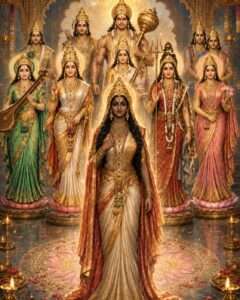
Picture generated through AI by Karthik Dinesh