



Politicians are entitled to dream. Democracy thrives on aspirations and ambitious visions. But dreams acquire credibility only when they are anchored in performance. Otherwise, they remain what Indians fondly remember from television folklore—Mungerilal Ke Haseen Sapne—beautiful dreams that evaporate the moment reality knocks on the door.
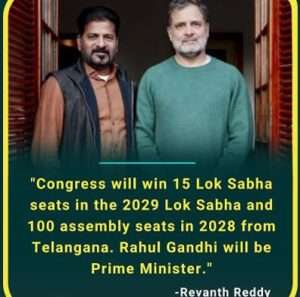
Telangana Chief Minister A. Revanth Reddy’s recent declaration that the Congress would form the next government at the Centre in 2029, Rahul Gandhi would become Prime Minister and his party would find a GenZ leader as Union Education Minister to usher in path-breaking educational reforms falls precisely into that category.
There is absolutely nothing wrong in dreaming of his party bouncing back to power and having a GenZ leader as the future Education Minister. What is perplexing, however, is why one must wait for his party to return to power at the Centre to reform education when he, as the Chief Minister of Telangana, has retained the Education portfolio himself and possesses both the authority and opportunity to reform the state’s educational landscape today.
Why postpone tomorrow what can be accomplished today?
Education is not beyond the reach of the Telangana Chief Minister. It is not locked away in some bureaucratic vault in New Delhi. Telangana’s government schools, universities, teacher recruitment, fee regulation and educational infrastructure are all matters demanding his immediate attention. If educational reforms are indeed his life’s mission, Telangana ought to have become his laboratory of excellence by now.
After nearly two years in office, what transformative educational reforms can this government legitimately showcase?
Announcements are not achievements. Committees are not reforms. Headlines are not outcomes.
Can model schools alone become the answer when thousands of government schools continue to suffer from inadequate infrastructure, teacher shortages and declining public confidence? Have we reached a stage where a poor labourer’s dream is not admission into a government school but somehow arranging Rs.30,000 or Rs.40,000 annually to send his child to a private institution?
My own driver offers the most telling example. Despite struggling financially, he prefers a private school over a government institution for his child. He is not paying for luxury. He is paying for confidence—the confidence that his child will receive quality education.
That should worry every government.
Successive governments have reduced education to statistical presentations and budgetary announcements while parents have quietly delivered their verdict by voting with their wallets.
The irony becomes even more striking when one examines Telangana’s literacy statistics. Hyderabad boasts literacy levels exceeding 83 per cent, aided by superior urban infrastructure and educational institutions. Rural Telangana, however, presents a disturbing contrast.
Districts such as Jogulamba Gadwal and Mahabubnagar continue to languish at the bottom of the literacy rankings. Mahabubnagar, incidentally, happens to be the Chief Minister’s native district.
Before reforming India’s educational future, perhaps Telangana deserves an explanation about its educational present.
The larger question remains unanswered. Why has education become prohibitively expensive for the common man?
Government schools provide free education, textbooks, uniforms and mid-day meals. Yet, private schools continue to flourish because parents perceive quality, discipline and accountability in them.
Nursery education itself begins at Rs.30,000 in many institutions. Mid-range private schools charge anywhere between Rs.50,000 and Rs.1.5 lakh annually. Premium institutions command several lakhs every year. Add transportation, books, uniforms and miscellaneous charges, and education has become one of the biggest financial burdens for middle-class families.
Surprisingly, this critical issue receives far less political attention than it deserves.
The Telangana Education Commission submitted its comprehensive report earlier this year recommending wide-ranging reforms—from increased budgetary allocations and teacher recruitment to fee regulation and restructuring of public education. Several recommendations deserve serious consideration.
The proposed Telangana Private Schools and Junior Colleges Fee Regulatory Bill could become a meaningful intervention if implemented sincerely. Integrating pre-primary education into government schools can potentially stem the migration of students to expensive private institutions. Teacher recruitment, performance-based promotions and strengthening higher education institutions are equally important.
But reports alone do not educate children. Governments do.
Educational reforms cannot remain ornamental promises adorning political speeches delivered before television cameras.
The National Education Policy envisages public expenditure on education touching six per cent of GDP. India continues to remain significantly below that benchmark. States consequently bear enormous responsibilities in financing and implementing educational programmes.
Telangana can certainly become a model state in education. It possesses the financial resources, institutional framework and administrative capability to accomplish that objective. What it requires is political will and relentless execution.
Political rhetoric has its place in democratic discourse. So do national ambitions. But the people of Telangana would perhaps appreciate fewer declarations about educational revolutions to be scripted in Delhi after 2029 and more visible improvements in their neighbourhood government schools.
Great educational reformers are not remembered because they occupied high office. They are remembered because they transformed institutions and changed lives.
If Revanth Reddy genuinely believes that India requires path-breaking educational reforms under a future GenZ Education Minister, Telangana offers him the finest opportunity to demonstrate what such reforms should look like.
Let every government school become his calling card. Let teacher vacancies disappear. Let literacy rates in the state’s most backward districts become matters of pride rather than concern. Let fee regulation protect ordinary families from educational exploitation.
Then, neither political speeches nor electoral victories will be required to validate that vision. Telangana itself will become the recommendation for larger educational reforms.
Until then, dreams will remain dreams—and Telangana’s children deserve something far more substantial than another episode of Mungerilal Ke Haseen Sapne. (To be concluded)


This article is a treasure of useful information. If not the CM, at least his advisers can take a cue from this marvellous piece and do something before Telangana’s education slips to abysmal levels.