



Politics is not merely about winning elections. It is equally about managing relationships, accommodating differences and building trust among allies. The Congress party seems to have forgotten this fundamental principle. The visible cracks appearing in the INDIA alliance today are perhaps less about the BJP’s political dominance and more about the Congress party’s inability to play the role of a consensus builder.
What was projected as the grandest Opposition experiment in recent political history increasingly resembles an alliance held together only by its opposition to Prime Minister Narendra Modi. Beyond that, there appears little ideological cohesion or political chemistry among its constituents.
The latest controversy surrounding Leader of the Opposition Rahul Gandhi’s decision to march towards the Prime Minister’s residence and stage a dharna demanding Union Education Minister Dharmendra Pradhan’s resignation has only exposed the growing unease among the Congress party’s allies. It is not the protest itself that has raised eyebrows, but the manner in which political decisions are increasingly being taken.
Several allies are believed to be uncomfortable with what they perceive as the Congress party’s unilateralism—appropriating issues championed by regional parties and projecting them as Congress-led movements. Political alliances cannot survive when one partner behaves like an elder brother and expects others to merely applaud.
The discomfort within the INDIA bloc is no longer confined to drawing room discussions. It is becoming increasingly visible in political conduct.
Sharad Pawar’s meeting with Prime Minister Narendra Modi along with his daughter Supriya Sule may or may not culminate in any political realignment. But symbolism matters in politics. Pawar is perhaps India’s most astute political survivor, who once walked out of the Congress questioning Sonia Gandhi’s foreign origin and refusing to compromise on what he believed was his political space. If political compulsions today demand newer equations, Pawar is unlikely to hesitate. Like every regional satrap, securing his party’s future would naturally remain his foremost priority.
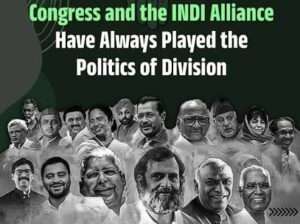
The Congress has problems elsewhere too. Its relationship with allies has seldom been smooth. Regional parties have increasingly realised that aligning with the Congress often comes at the cost of sacrificing their own political identities. Tamil Nadu’s changing political landscape is another reminder that allies are no longer willing to remain politically subordinate merely because the Congress was once India’s grand old party.
Meanwhile, parliamentary arithmetic is quietly changing in favour of the BJP-led NDA.
The ruling alliance is expected to pursue several significant legislative proposals in the coming days in the ongoing Winter session of parliament, including One Nation, One Election, delimitation and possible reforms relating to foreign contributions and electoral processes. Political analysts point out that if parties maintaining issue-based positions choose to abstain rather than oppose such legislations, the effective numbers required for securing special majorities could substantially change in Parliament.
Ironically, the Congress may find itself becoming the biggest beneficiary of neither victory nor defeat—but of political irrelevance.
The INDI alliance’s numbers have steadily diminished, while regional parties are increasingly preferring political flexibility over permanent Opposition politics. Their priorities are simple—political survival first and ideological posturing later.
For the BJP-led NDA, the road ahead appears considerably smoother. Its dominance across northern India continues to remain largely intact. Uttar Pradesh, Bharat’s biggest political battleground, has witnessed massive infrastructure expansion under Chief Minister Yogi Adityanath, whose tough law-and-order model continues to find considerable political acceptance despite criticism from his opponents. Electoral politics ultimately rewards narratives that resonate with voters, and governance remains one such powerful narrative.
History offers a simple political lesson. Whoever dominates Uttar Pradesh, Bihar and Madhya Pradesh invariably commands enormous advantages in Delhi. Fragmentation within the Opposition only strengthens that political reality.
Yet, this column is not about celebrating the decline of the Opposition. Democracies do not become stronger when Opposition benches become empty. Governments perform better when challenged by competent and credible adversaries.
The greatest tragedy for Bhara’s politics today is not that the BJP has become electorally formidable. It is that the principal Opposition continues to weaken itself through political arrogance, strategic miscalculations and an excessive preference for street politics over parliamentary engagement.
Parliament was never meant to be reduced to a stage for disruptions or boycotts. Debate, discussion and disagreement constitute the very soul of democracy. Unfortunately, the Congress appears more comfortable taking every political battle to the streets than winning arguments inside Parliament.
If the INDI alliance eventually collapses, history may record that it was not defeated by Narendra Modi alone. It first collapsed under the weight of its own contradictions.
And if a new Opposition eventually emerges after 2029, it may well be led not by the Congress party, but by the very regional forces that are today quietly preparing for life beyond the INDI alliance.


Indi alliance took its birth on the foundations of division. It can never be united. BJP can be rest assured that Rahul is the guarantee card to ensure that any protest will be diluted by him and it’s less luggage and more comfort for the ruling party.