


M Radha Madhavi
When it comes to investing, many people believe that the biggest threat to their savings is stock market volatility. The daily rise and fall in share prices often creates anxiety, prompting investors to seek refuge in “safe” options such as Fixed Deposits (FDs). However, for long-term investors, market fluctuations are not necessarily the greatest risk. The more persistent threats are inflation and taxes, both of which quietly erode the real value of money over time.
At first glance, Fixed Deposits appear reassuring. They offer guaranteed returns and protect the principal from market uncertainties. Yet, this sense of security can be misleading. If your investments grow at a pace slower than the increase in the cost of living, your purchasing power actually declines. In other words, while your bank balance may rise, the amount of goods and services that money can buy gradually shrinks.
This is why investment decisions should not be based solely on avoiding market volatility. Instead, investors should focus on building real wealth—returns that comfortably outpace inflation while also accounting for taxes.
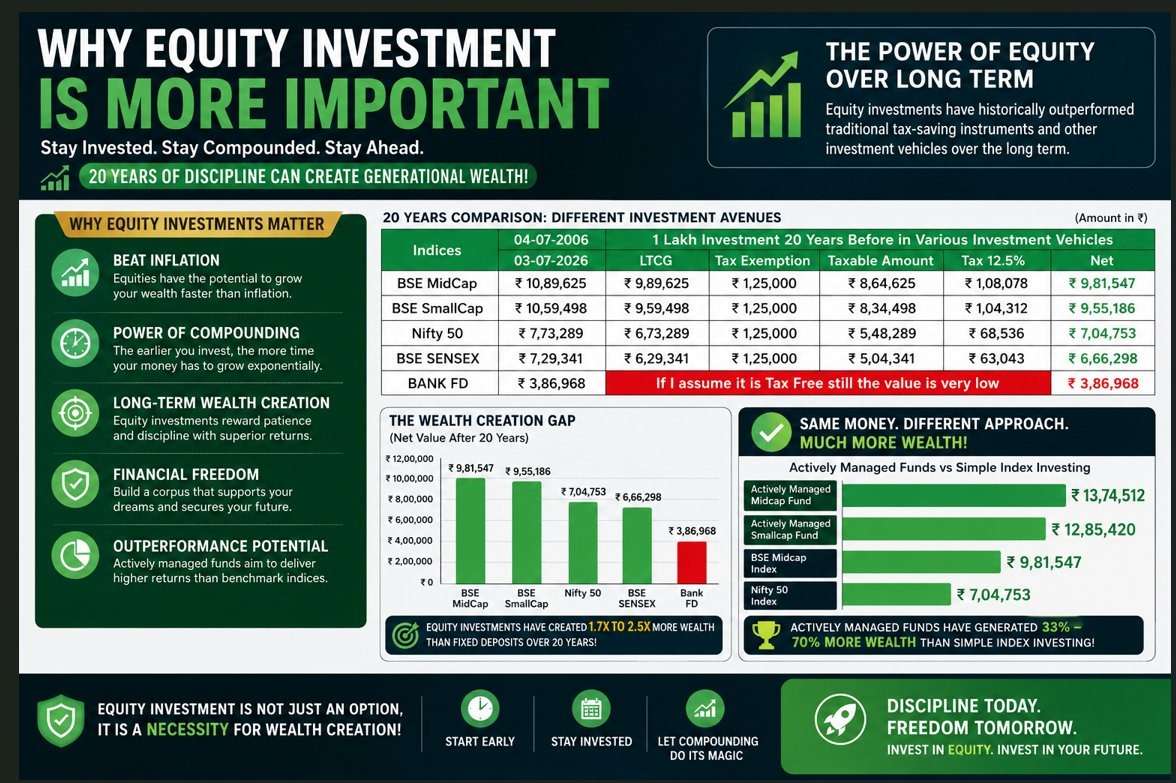
Consider a simple example. An investment of ₹1 lakh in a Fixed Deposit earning 7 per cent annually would grow to approximately ₹3.87 lakh over 20 years before taxes. However, interest earned on FDs is taxed according to an individual’s income tax slab, reducing the actual post-tax returns.
Now compare this with long-term equity investments. Despite periodic market corrections, equity has historically delivered significantly higher returns over extended periods. Even after factoring in applicable capital gains taxes, the wealth created over two decades is substantially higher.
Illustratively, ₹1 lakh invested over 20 years could potentially grow to:
- Fixed Deposit (before tax): ₹3,86,968
- BSE Sensex (after taxes): ₹6,66,298
- Nifty 50 (after taxes): ₹7,04,753
- BSE Small Cap Index (after taxes): ₹9,55,186
- BSE Mid Cap Index (after taxes): ₹9,81,547
- Average Actively Managed Small Cap Fund (after taxes): ₹12,85,420
- Average Actively Managed Mid Cap Fund (after taxes): ₹13,74,512
These figures clearly demonstrate the power of long-term compounding in equity investments. While short-term fluctuations are inevitable, patient investors have historically been rewarded with returns that significantly outperform traditional fixed-income instruments.
The lesson is straightforward. Fixed Deposits have an important role in a financial portfolio, particularly for emergency funds, short-term goals and capital preservation. However, relying exclusively on FDs for long-term wealth creation may not be the most effective strategy.
Equity investments, whether through diversified mutual funds or direct investments in quality companies, provide the opportunity to generate returns that exceed both inflation and taxes over long periods. The journey may be less predictable, but the destination has historically been far more rewarding.
Unfortunately, many middle-class investors remain hesitant to participate in equity markets because they equate temporary market declines with permanent losses. In reality, volatility is a natural feature of equity investing. Market corrections come and go, but inflation relentlessly chips away at idle or low-return savings every single year.
Successful investing, therefore, requires a shift in perspective. Rather than asking, “How can I completely avoid risk?” investors should ask, “How can I ensure my money grows faster than inflation and taxes over the long term?”
The objective of investing is not merely to preserve capital but to enhance purchasing power and achieve meaningful wealth creation. Temporary market volatility may test an investor’s patience, but inflation and taxes quietly work against wealth every day. Understanding this difference can help investors make more informed financial decisions and build a stronger financial future.



very nice article.The biggest risk for investor is loss of purchasing power over a period of time due to inflation