



For decades, Bharat’s rapid economic growth came with a strategic vulnerability—its overwhelming dependence on imported crude oil and foreign petrochemical products. Every global conflict, every supply disruption, and every spike in crude prices exposed the country’s economic fragility. That vulnerability is now being addressed with determination, one world-class project at a time.
The inauguration of the Pachpadra Greenfield Integrated Refinery-cum-Petrochemical Complex in Rajasthan is not merely another infrastructure milestone. It is a powerful statement that Bharat is steadily transforming itself from being a passive energy consumer into a confident global energy player.
Built at an investment of over ₹79,450 crore, the 9 million metric tonnes per annum (MMTPA) refinery is Bharat’s first greenfield integrated refinery-cum-petrochemical complex. More importantly, it has propelled Bharat into an exclusive club of countries possessing highly sophisticated integrated refining and petrochemical capabilities—a league dominated by energy giants such as the United States, China, Saudi Arabia and a handful of advanced economies.
This is no ordinary refinery.
Its Nelson Complexity Index (NCI) of 17 places it among the most complex refineries in the world. For perspective, the global average refinery scores between 7 and 10, while many older facilities operate below that level. A higher complexity index enables a refinery to process heavier, cheaper crude oils while producing larger quantities of premium fuels and high-value petrochemical feedstocks. In simple terms, greater complexity translates into higher profitability, improved flexibility and stronger energy resilience.
Even more significant is its petrochemical yield exceeding 26 per cent—far above that of conventional refineries that primarily focus on fuels. This reflects the global shift in refining economics. As electric mobility gradually reduces future fuel demand, petrochemicals will increasingly drive refinery revenues. Plastics, synthetic fibres, pharmaceuticals, packaging materials, electronics, medical equipment and countless industrial products all depend on petrochemical feedstocks.
Bharat has traditionally imported a substantial portion of these value-added products despite being one of the world’s largest consumers. The Pachpadra complex directly addresses that gap, reducing import dependence while strengthening domestic manufacturing under the vision of an Atmanirbhar Bharat.
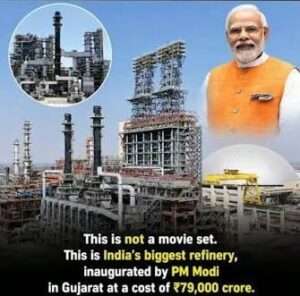
The engineering achievement itself is staggering.
Spread across nearly 32 kilometres in Rajasthan’s challenging desert terrain, the project consumed nearly 300,000 metric tonnes of steel—roughly forty times the steel used in constructing the Eiffel Tower. Thousands of engineers, technicians and workers overcame extreme temperatures, logistical hurdles and the disruptions caused by the pandemic to deliver one of independent Bharat’s most ambitious industrial projects.
Yet its true significance extends well beyond refining crude oil.
The refinery is expected to anchor the proposed Petrochemical and Plastic Park in western Rajasthan, catalysing investments across downstream industries. Thousands of direct and indirect jobs, ancillary manufacturing units, logistics networks, MSMEs and export-oriented businesses are expected to emerge around this industrial ecosystem. A region once associated largely with arid landscapes could well become one of Bharat’s fastest-growing manufacturing hubs.
Strategically, the refinery also enhances Bharat’s energy security. The country’s refining capacity has grown steadily to become one of the largest globally, enabling Bharat not only to meet domestic demand but also to emerge as a major exporter of refined petroleum products. With geopolitical uncertainties—from the Russia-Ukraine conflict to tensions in West Asia—energy resilience has become a defining element of national security. Nations that possess diversified and technologically advanced refining infrastructure enjoy far greater economic stability during global crises.
Critics often reduce such projects to political headlines or ribbon-cutting ceremonies. That misses the larger picture entirely. Infrastructure of this scale is built not for electoral cycles but for generations. Its dividends are measured in strategic autonomy, industrial competitiveness, employment and national resilience.
Bharat’s economic aspirations cannot rest solely on software parks and digital innovation. A $5 trillion economy—and eventually a developed nation—requires equally robust manufacturing and industrial foundations. World-class refineries, integrated petrochemical complexes, semiconductor plants, logistics corridors and energy infrastructure form the backbone of that transformation.
The Pachpadra refinery is therefore far more than Bharat’s 24th refinery. It symbolises the country’s growing confidence in executing mega industrial projects comparable to the world’s best. It demonstrates that Bharat is no longer content with merely participating in global supply chains—it intends to shape them.
Energy security today is national security. Industrial capability is strategic capability. And Rajasthan’s desert now stands as compelling proof that Bharat’s march towards economic self-reliance is no longer an aspiration. It is becoming an irreversible reality.


