MS Shanker
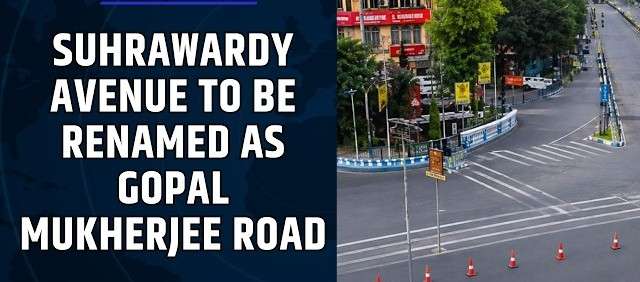
Politics is often judged by promises made during election campaigns, but history remembers governments for the promises they actually fulfil. If one were to view recent developments in West Bengal through that prism, the decision to rename Kolkata’s Suhrawardy Avenue as Gopal Mukherjee Road can be seen as more than a routine administrative exercise. It is, in many ways, an attempt to revisit an uncomfortable chapter of history and restore recognition to a figure long absent from mainstream narratives.
Street names are never mere geographical markers. They are symbols of collective memory and reflect the values that societies choose to celebrate and preserve for future generations.
The decision to honour Gopalchandra Mukhopadhyay, popularly known as Gopal Patha, signals a broader ideological shift in West Bengal’s political discourse. It also aligns with the Bharatiya Janata Party’s long-standing assertion that independent Bharat has, for decades, selectively remembered certain historical figures while overlooking others who played significant roles during moments of national crisis.
For years, one of Kolkata’s prominent roads carried the Suhrawardy name. Defenders of the old nomenclature have maintained that the avenue was named after Sir Hassan Suhrawardy, an eminent educationist and the first Muslim Vice-Chancellor of Calcutta University. Even if that explanation is accepted, the larger symbolism associated with the Suhrawardy surname has remained difficult to separate from Bengal’s turbulent history.
Many critics have pointed out that Hasan Shaheed Suhrawardy, an accomplished scholar, art critic and diplomat, migrated to Pakistan after Partition and subsequently served the newly created nation. While such a decision was undoubtedly a personal and political choice in a deeply turbulent period, critics argue that continuing to celebrate the Suhrawardy name in Kolkata, a city that suffered immense trauma during Partition, remained an uncomfortable proposition.
The larger historical context, however, goes back to one of the darkest chapters of pre-Independence India (Bharat) — 16 August 1946.
On that day, the All-India Muslim League, under the leadership of Muhammad Ali Jinnah, called for “Direct Action” to press its demand for Pakistan. In Bengal, then Chief Minister Huseyn Shaheed Suhrawardy declared a public holiday and permitted a massive rally in Kolkata.
What followed has gone down in history as the Great Calcutta Killings.
Over several days, the city descended into unprecedented communal violence. Historical accounts describe widespread attacks, arson, looting and killings that left thousands dead and many more displaced. Several historians and critics have argued that the provincial administration failed to respond decisively, allowing law and order to collapse at a critical moment.
Many contemporary accounts suggest that Hindu neighbourhoods bore the initial and significant brunt of the violence during the early phase of the riots, though retaliatory violence later engulfed multiple parts of the city, further deepening communal divisions.
When institutions fail, communities often find themselves compelled to organise for survival.
It was during this extraordinary crisis that Gopalchandra Mukhopadhyay emerged as a prominent figure. A resident of the Boubazar area and belonging to a family engaged in the meat trade on College Street, he mobilised local youths and organised defence groups to protect vulnerable neighbourhoods.
Supporters and local historical accounts credit him with helping stabilise several areas and preventing an even larger humanitarian catastrophe. His actions were not motivated by electoral ambition or a quest for political office. Rather, they stemmed from a belief that citizens had a right to defend themselves when state institutions were unable to provide protection.
Yet, despite his role during those turbulent days, Gopal Patha remained largely absent from mainstream historical narratives after Independence. While generations of survivors and local communities continued to remember him, official recognition remained limited.
That omission is now being addressed.
The renaming of Suhrawardy Avenue to Gopal Mukherjee Road is therefore not merely about replacing one name with another. It represents an effort to reopen a broader debate about how India remembers its past and whom it chooses to honour.
Critics may dismiss such decisions as symbolic politics, but symbols carry immense significance in nation-building. Roads, monuments and public institutions serve as constant reminders of a society’s values and its understanding of history.
For many supporters of this move, the decision sends a message that personalities associated with the politics surrounding Direct Action Day should no longer remain beyond historical scrutiny, while individuals who acted to protect vulnerable communities deserve overdue recognition.
At its core, this debate is not simply about a street in Kolkata. It is about historical memory, accountability and the willingness of a society to confront painful truths without selective amnesia.
Whether one agrees with the politics surrounding the decision or not, one principle remains essential: history must be examined honestly, in its entirety, and without fear of revisiting uncomfortable chapters.
By honouring Gopal Patha, West Bengal is not merely changing a signboard. It is reopening a long-postponed national conversation about memory, justice and historical recognition — a conversation that independent Bharat perhaps should have begun decades ago.