


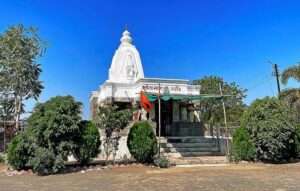
Sita Mata Temple is located in Raveri village near Ralegaon in the Yavatmal district of Maharashtra. Surrounded by the rural landscape of the Vidarbha region, the temple is one of the rare shrines in India dedicated primarily to Goddess Sita. It attracts devotees from various parts of Maharashtra who visit to seek the blessings of Janaki Mata and to honor the sacred traditions associated with her exile and the upbringing of Lava and Kusha.
The presiding deity of the temple is Goddess Sita (Janaki Mata). The shrine also reveres Lava and Kusha, the twin sons of Sita and Lord Rama. Unlike most Ramayana temples, this temple is dedicated primarily to Sita Mata, commemorating her life during exile and her role as the mother of Lava and Kusha. Devotees worship her here as the embodiment of purity, devotion, sacrifice, and motherhood.
The present temple structure has undergone renovations over time while retaining its traditional religious character. Built in a simple Maharashtrian style, the temple complex houses the sanctum of Sita Mata along with shrines associated with Lava and Kusha. The serene surroundings and devotional atmosphere make it a peaceful place for worship and meditation.
The temple has been revered by the local community for generations and is believed to be several centuries old. Although no definitive historical records establish its exact age, the shrine has long been associated with traditions connected to Sita’s exile and the childhood of Lava and Kusha. Over the years, the temple gained prominence as one of the few temples in India where Sita is worshipped as the principal deity, and it continues to be an important center of devotion in the Vidarbha region.
The sacred tradition of Raveri is connected with the later events of the Ramayana, particularly the period following the coronation of Lord Rama in Ayodhya.
According to the Valmiki Ramayana, after Lord Rama returned to Ayodhya and assumed the throne, public criticism arose regarding Sita’s stay in Lanka despite her having proven her purity through the Agni Pariksha. Bound by his duty as a king, Rama made the painful decision to send the pregnant Sita away from the royal palace. Lakshmana escorted her into the forest, where she sought refuge in the hermitage of Sage Valmiki.
The Valmiki Ramayana does not specify the exact geographical location of the sage’s ashram. However, an ancient local tradition preserved in Raveri identifies this region as part of the forested area where Sage Valmiki maintained his hermitage. According to this tradition, Sita spent a portion of her exile in these sacred surroundings under the protection and guidance of the great sage.
It is believed that Sita gave birth to the twin princes Lava and Kusha in this region. The children were raised in the peaceful environment of the ashram, where Sage Valmiki personally supervised their education. They were taught the Vedas, scriptures, warfare, archery, and the principles of dharma. Under the sage’s guidance, they grew into noble, wise, and courageous young princes.
The tradition further states that Sage Valmiki composed the Ramayana and taught the sacred epic to Lava and Kusha. The twins became the first reciters of the Ramayana and spread its teachings through their melodious narration.
Local belief also associates the region with the Ashwamedha Yajna performed by Lord Rama. During the sacrifice, the ceremonial horse is believed to have wandered into these forests. Lava and Kusha stopped the horse and challenged the royal army sent to protect it. A fierce battle followed, during which the young princes displayed extraordinary valor and defeated many renowned warriors. Eventually, their true identity as the sons of Rama and Sita was revealed, leading to the reunion of the royal family.
For generations, devotees have revered Raveri as a sacred place associated with Sita’s years of exile, motherhood, sacrifice, and unwavering adherence to dharma. Although these associations are based on longstanding local tradition rather than archaeological evidence, they remain central to the spiritual heritage of the temple and continue to inspire devotees who visit this sacred shrine.
The temple celebrates Sita Navami as its principal festival with special pujas, abhishekams, and devotional programs dedicated to Goddess Sita. Ram Navami is observed with Ramayana recitations and worship ceremonies, while Chaitra Navratri and Sharad Navratri attract large numbers of devotees. Special programs associated with Lava and Kusha are also conducted during the year, and an annual temple fair brings together pilgrims from across the Vidarbha region and other parts of Maharashtra.


