



Indian politics is witnessing a fascinating churn. The once-rigid walls separating political parties are beginning to crack, regional satraps are reassessing their equations, and cross-party defections are creating a new parliamentary arithmetic that may soon deliver what many consider long-pending structural reforms for the nation.
For the first time in years, there is a realistic possibility that the Narendra Modi government could gather enough political strength to push through a package of transformational legislations, including delimitation and women’s reservation, and perhaps even pave the way for One Nation One Election (ONOE) and the Uniform Civil Code (UCC).
The road ahead is not easy. It requires a two-thirds majority in Parliament, a formidable number by any standards. Yet, politics is the art of possibilities, and possibilities are multiplying by the day.
The BJP-led NDA today may be hovering slightly above the 300-mark, still significantly short of the 362 members required for a two-thirds majority in the Lok Sabha. But recent developments indicate that this gap is rapidly narrowing.
The political tremors began with six Aam Aadmi Party MPs reportedly choosing to join the BJP camp. Simultaneously, there are strong indications of a potential split within the Trinamool Congress, with nearly 20 MPs reportedly considering a merger with an NDA partner. Add to this the possibility of six MPs from Uddhav Thackeray’s Shiv Sena faction crossing over, and the NDA’s tally could comfortably inch towards 340.
That still leaves a shortfall of around 20 members.
However, the story may not end there.
Speculation is rife about possible fissures within other regional parties. Reports suggest that some MPs from Akhilesh Yadav’s Samajwadi Party and Sharad Pawar’s Nationalist Congress Party may also reconsider their political future. If such developments materialise, the NDA’s strength could swell beyond 350.
At that stage, parliamentary mathematics will begin to favour the government.
There is another factor many observers overlook. Constitutional amendments require a two-thirds majority of members present and voting on that particular day—not necessarily the full strength of the House. If certain regional parties choose strategic abstention, the threshold automatically comes down.
And why would they abstain?
Several parties are increasingly uncomfortable with the Congress party’s political positioning. The DMK has its own compulsions. The YSRCP under Jagan Mohan Reddy has adopted an issue-based approach. The Biju Janata Dal has historically maintained an independent line.
Should any of these parties decide not to participate in the voting process, the equation could dramatically tilt in favour of the government.
The most significant beneficiary of this changing landscape could be the long-delayed women’s reservation legislation.
Ironically, there is hardly any opposition to reserving one-third seats for women. The controversy centres around linking the reservation to delimitation. Southern states argue, not without reason, that population-based seat allocation would punish them for successfully implementing family planning measures over several decades.
Their concern deserves serious consideration.
The Modi government appears to have recognised this sensitivity. The revised constitutional formula reportedly seeks to preserve the interstate seat ratio based on the 1971 Census while using the 2011 Census only to redraw constituencies within individual states.
If implemented, this could strike a delicate balance between demographic realities and federal concerns.
India cannot indefinitely postpone necessary reforms because of political hesitation. Delimitation is not merely an administrative exercise; it is about ensuring fair representation for every citizen. Women’s reservation is not an act of charity; it is a democratic correction long overdue.
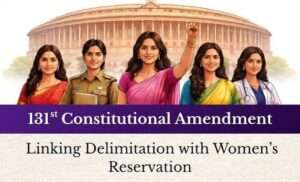
The failed attempt earlier this year to pass the Constitution (131st Amendment) Bill may soon become an insignificant footnote in history.
Politics is often unpredictable, but the signs today indicate a major realignment is underway. If the present momentum continues, India could soon witness one of the most consequential parliamentary moments since Independence.
And if the numbers finally align, it would not stop with delimitation and women’s reservation alone. One Nation One Election and the Uniform Civil Code could also move from political slogans to legislative reality.
The nation may indeed be on the verge of receiving some very good news.


An excellent perspective article and hopefully it should happen soon.
Well presented