



In the luminous cadence of the Rigveda, where sound itself becomes a vehicle of cosmic order, the sages envisioned a realm in which the divine and the elemental converge through the discipline of mantra and metre. The Trishtubh chandas, with its measured rhythm and expansive breath, was not merely a poetic form but a structure reflecting the pulsation of the universe, aligning human utterance with celestial harmony. Within this sacred vibration, the deities themselves were perceived as both the recipients and the chanters of hymns, revealing a profound unity between the worshipper and the worshipped, where invocation becomes participation in the cosmic process.
The Maruts, radiant and ever youthful, were conceived as forces of atmospheric dynamism, dwelling in a shared domain of movement and vitality. Their presence, though veiled from ordinary perception, manifests in the stirring of winds, the gathering of clouds, and the life-giving descent of rain. From a scientific perspective, they symbolize the energetic interplay within the atmosphere, where pressure, motion, and electrical charge converge to produce storms and renewal. Their minds, inscrutable to common understanding, reflect the unpredictability of natural systems, while their origin suggests the boundless expanse of the sky, the intermediate realm between earth and the higher heavens.
In the sacrificial ground of yajna, where human intention meets cosmic law, the question arises as to how one may approach such forces and draw their benevolence. The strength to pray is not merely physical or material; it arises from inner alignment, discipline, and clarity of purpose. The Maruts, in their prime, receive oblations not as passive recipients but as active participants in the cycle of exchange between nature and humanity. Like eagles traversing the vast sky, their movement is swift and commanding, and none can disregard their influence, for they embody both awe and necessity.
The dialogue between Indra and the Maruts unfolds as a symbolic interplay between individual power and collective power. Indra, the wielder of the thunderbolt, speaks with the authority of concentrated force, asserting that all oblations ultimately converge toward him, as he represents the decisive energy that breaks obstruction, much like the release of pent-up atmospheric energy in the form of rain. His declaration reflects a principle of centralized energy, where focused force transforms potential into action. His vehicle, the swift horses Hari, signifies the movement of energy across space, carrying intention toward fulfillment within the sanctified precincts of yajna.
The Maruts respond not in subordination but in harmony, acknowledging Indra’s greatness while affirming their own role as co-creators of action and vitality. They speak as embodiments of distributed power, the many forces that together generate momentum and transformation. Their luminosity, ornamentation, and readiness with powerful steeds symbolize the manifold expressions of natural energy, coordinated yet diverse. They invite Indra not as a solitary force but as a companion within the larger orchestration of cosmic activity, where cooperation yields abundance and balance.
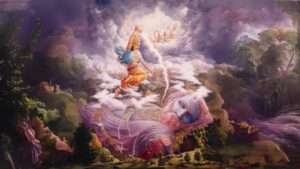
The memory of the battle with Vritra stands as a metaphor of release and renewal, where obstruction is overcome and the waters, long withheld, are set free. Indra’s assertion of his might reflects the principle of decisive intervention, the moment when accumulated energy surpasses resistance. Yet the Maruts remind him that such victories are seldom solitary; they arise from the convergence of many forces, each contributing to the unfolding of a greater outcome. Thus, the hymn becomes a reflection on interdependence, where individual power and collective energy are inseparable.
Indra’s proclamation of his unparalleled strength and omnipresence reveals the self-awareness of power, an understanding that transcends limitation. He speaks as the embodiment of sovereignty over natural forces, yet his acknowledgment of the Maruts’ praise and companionship introduces a subtle balance between authority and reciprocity. The golden radiance of the Maruts, their nourishment of Indra through offerings, and their amplification of his glory signify the feedback loop inherent in natural and spiritual systems, where energy circulates, transforms, and sustains itself through continuous exchange.
Finally, the sage Agastya enters the vision, bridging the divine dialogue with human aspiration. His invocation calls the Maruts toward all people, emphasizing that the forces of nature are not distant abstractions but accessible through knowledge, reverence, and right action. He recognizes the patrons of yajna as gentle and wise, capable of invoking these energies through disciplined chant and an understanding of ritual. The hymns, composed with insight and devotion, are not mere words but structured vibrations intended to strengthen both the physical and subtle realms, fostering nourishment, longevity, prosperity, and harmony.
Thus, the narrative unfolds as a profound synthesis of spirituality and observation, where the Vedic seers encoded within poetic dialogue an early understanding of natural processes alongside a vision of cosmic unity. The interplay of Indra and the Maruts becomes not only a mythic account but also a reflection of how power, cooperation, and awareness shape both the external world and the inner life. In this vision, the chant, the storm, and the seeker are bound together in a single continuum of existence, where knowledge and reverence guide humanity toward alignment with the rhythms of the universe.

