Upadhyayula Lakshman Rao
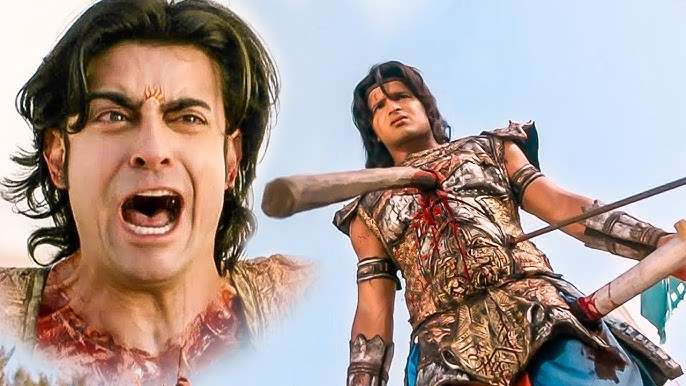
Vrushasena entered the battlefield with grand pomp, his arrival announced by the thunder of drums, the blare of trumpets, bugles, and conches, stirring curiosity even among the enemy ranks. Without delay, he unleashed a relentless volley of arrows upon the Pandava forces, halting the fierce advance of the twin warriors Nakula and Sahadeva. The battlefield soon transformed into a scene of terror, with heaps of fallen elephants and horses crushed beneath their immense weight. The limbs of men and beasts lay entangled, dissolving the thin line between human and animal, while streams of blood carried this grim mixture across the ground. Countless foot soldiers lay scattered in vivid garments and ornate armor, their varied weapons strewn about, creating a haunting spectacle that resembled a grotesque exhibition of lifeless forms, as if spirits had claimed every fallen body.
Vrushasena, the son of Karna, surged deeper into the enemy ranks, harassing and unsettling the Pandava warriors. He was soon confronted by Sataneeka, the son of Nakula, and a fierce clash erupted between their supporting forces. Sataneeka struck first, piercing Vrushasena with sharp arrows, but the latter retaliated with equal ferocity, breaking his opponent’s bow and striking down his banner. The sons of Draupadi then entered the fray with loud war cries, surrounding Vrushasena and intensifying the pressure upon him. At the same time, the Kaurava forces, guarded by Ashwatthama, rained arrows upon the young Pandava warriors, enclosing them in a tightening circle of danger.
The situation grew tense, and at Dharmaraja’s command, the armies of Kekaya, Panchala, and Matsya rushed in to support their comrades. The battlefield became a dynamic storm of combat, where Bhima, Karna, Kripa, Drona, Ashwatthama, Drishtadyumna, and Virata shone with valor and relentless courage. Their brilliance in combat gave the impression that the sun itself had descended upon the earth in many forms. Yet, the growing strength of the Pandavas caused unease among the Kaurava forces. Witnessing his troops falter, Drona grew fierce and addressed his charioteer with urgency, declaring that the only way to break the enemy’s spirit was to subdue Dharmaraja, whose presence inspired unyielding confidence among his soldiers.
With renewed determination, Drona drove forward like a raging force of nature. He declared that defeating Dharmaraja, Bhima, Satyaki, Virata, and Drupada was well within his power, reminding himself of the mastery he had imparted to Arjuna. Casting aside concern for his own safety, he urged his charioteer to advance swiftly, eager to engage until his warrior’s spirit was fully satisfied. The charioteer, filled with pride, maneuvered the chariot skillfully, while the Pandava warriors, noticing Drona’s unstoppable advance, rushed to intercept him before he could reach Dharmaraja.
Drona fought like a wild elephant, fierce and unstoppable, filling the sky with a dense shower of arrows. He struck Dharmaraja with great speed, breaking his bow and closing in rapidly. Like a surging ocean, he advanced, but Sukumara, the wheel guard of Dharmaraja, stood firm like a shoreline, momentarily halting his momentum. The Pandava forces quickly gathered to defend their king, yet Drona, blazing like fire, cut down Sukumara and pressed forward again. Surrounded by Pandava warriors, he fought with unmatched intensity, striking Nakula, Sahadeva, Virata, Satyaki, and others with precise and powerful arrows, gradually asserting control over the battlefield.
He continued his assault, wounding the sons of Draupadi, weakening Uttamauja, and restraining the ferocity of Sikhandi and Dharmaraja. In the midst of this chaos, the warrior Yugandhara charged at Drona but was swiftly slain by a single, devastating arrow. Soon after, the Kekaya kings, along with Drupada, Simhasena, Suradatta, and Vyagradatta, surrounded Drona, attempting to curb his destructive momentum. They attacked him from all sides, but Drona, confident in his mastery, responded with lethal precision, severing the heads of Simhasena and Vyagradatta, scattering the opposing forces once more.
As Drona advanced beyond resistance, nearing Dharmaraja again, panic spread through the Pandava ranks. Cries arose that Dharmaraja had been captured by the relentless Dronacharya. The Kaurava side anticipated a moment of triumph, imagining Dharmaraja being taken captive to Hastinapura. Fear gripped the Pandava soldiers, and for a brief moment, they seemed frozen, watching events unfold without resistance.
At that critical instant, the ground trembled and the winds roared as Arjuna arrived like a storm. His chariot surged forward with unstoppable force, cutting through the battlefield and shifting the momentum entirely. The twang of his bowstring echoed like thunder, and his advance resembled the march of death itself. Bodies fell, blood flowed in streams mixed with dust and shattered remains, and the sky darkened under the storm of his assault. Confusion spread among the Kaurava forces, who, unable to distinguish friend from foe, struck at their own in the chaos.
Recognizing the onset of dusk and the devastation caused by Arjuna, Drona and Duryodhana ordered a withdrawal. Both armies retreated to their respective camps, carrying with them the weight of the day’s destruction. As night fell, thoughts of the havoc unleashed and the uncertainties of the coming day lingered in every mind before exhaustion finally brought uneasy sleep.
Thus, the second day of Drona’s command raged like a tempest. His ambition to capture Dharmaraja was ultimately thwarted by Arjuna’s timely arrival, which turned the tide and brought ruin upon the Kaurava forces, leaving Duryodhana and his allies deeply disheartened, as Sanjaya faithfully reported.