


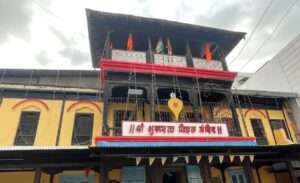
Gurudevdatt Vitthal Mandir is located in the Ghaspura locality of Khandwa city in Madhya Pradesh.The temple is one of the most revered centers of Vitthal worship in the Nimar region and attracts devotees from Madhya Pradesh, Maharashtra, and neighboring states.
The presiding deities of the temple are Lord Vitthal (Vithoba) and Goddess Rukmini. The temple is also closely associated with Lord Dattatreya, making it a unique center of both Vitthal and Datta worship. Devotees believe that worship at this sacred shrine brings the combined blessings of Lord Vitthal, Goddess Rukmini, and Lord Dattatreya.
The temple is housed within a large traditional structure influenced by Maratha architectural style. The building features carved wooden pillars, balconies, spacious halls, and an open courtyard designed for devotional gatherings and religious events. The sanctum enshrines beautifully decorated idols of Lord Vitthal and Goddess Rukmini beneath a silver canopy. The complex also contains shrines dedicated to Lord Dattatreya, Lord Krishna, Lakshmi-Narayana, Ambabai, Renuka Devi, Mahalakshmi, Lord Shiva, Goddess Parvati, and Lord Ganesha.
The temple was established around 1850 by Guru Maharaj Sachchidanand Swami, also known as Datt Maharaj. Born in 1780 at Mahur in present-day Maharashtra, he renounced worldly life and dedicated himself to spiritual pursuits. After years of penance and pilgrimage, he arrived in Khandwa and established the worship of Lord Vitthal and Goddess Rukmini.
Under his guidance, the temple became an important center of devotion and spiritual learning. In 1860, he entrusted the temple’s service to his disciple Nana Maharaj. The temple later came under the care of the Ashtekar family, whose descendants continue to preserve its traditions and heritage.
The sacred tradition of this temple begins with Guru Maharaj Sachchidanand Swami’s intense spiritual practices at Mahur, one of the holiest centers associated with Lord Dattatreya and Goddess Renuka. According to long-standing temple traditions, the saint spent many years in deep meditation, austerities, and devotion seeking divine realization.
Pleased with his unwavering faith, Lord Dattatreya is believed to have appeared before him in a divine vision and blessed him. During this sacred experience, the Lord entrusted him with the mission of spreading devotion, righteousness, and the remembrance of God’s name among ordinary people. The saint was also blessed with sacred padukas and spiritual authority to guide devotees on the path of bhakti.
Obeying this divine command, Sachchidanand Swami traveled across several regions before reaching Khandwa. Local traditions identify the region with the ancient Khandav forest mentioned in the Mahabharata. Recognizing the spiritual potential of the place, the saint established a shrine dedicated to Lord Vitthal and Goddess Rukmini so that devotees could experience the grace of Pandharpur’s beloved deity without undertaking the long pilgrimage to Maharashtra.
A major milestone in the temple’s history occurred in 1882 when devotees brought a rare marble idol of Lord Dattatreya from Jaipur. The idol, depicting the deity with three heads and six arms, symbolized the unified powers of Brahma, Vishnu, and Shiva. Despite his advanced age, Guru Maharaj Sachchidanand Swami personally consecrated the idol. From that time onward, the temple became renowned as Gurudevdatt Vitthal Mandir and evolved into a unique center where the traditions of Lord Vitthal and Lord Dattatreya are worshipped together.
The temple is also known for preserving an extraordinary devotional tradition. For more than 150 years, devotees have continuously maintained the practice of Harinam, bhajans, kirtans, and collective worship. This uninterrupted tradition is one of the temple’s greatest distinctions and has transformed it into a living center of Bhakti, where generations of devotees continue to gather in devotion and remembrance of the Divine Name.
Devshayani Ekadashi is the temple’s most important festival and marks the beginning of the annual Harinam Saptah. Other major celebrations include Ashadhi Ekadashi, Kartiki Ekadashi, Datt Jayanti, and Guru Purnima, which are observed with special prayers, bhajans, kirtans, and devotional processions.


