
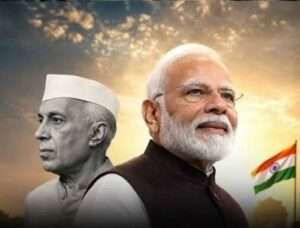
For days now, television studios and social media platforms have been consumed by an unnecessary and often absurd debate over who deserves the distinction of being Bharat’s longest-serving elected Prime Minister. Instead of being a factual discussion, it has predictably descended into a political slugfest between supporters of Prime Minister Narendra Modi and those seeking to preserve the legacy of Bharat’s first Prime Minister, Jawaharlal Nehru.
At the heart of this debate lies a much larger question: What truly defines political legitimacy in modern Bharat – dynastic entitlement or electoral endorsement?
The Congress party has long been accused by its critics of placing loyalty to the Nehru-Gandhi family above individual merit and competence. Interestingly, one of the most candid observations on this subject came not from the BJP but from veteran Congressman Manishankar Aiyar himself.
Few Congress leaders can claim a longer association with the party or greater loyalty to the Gandhi family than Aiyar. Over the years, he became one of Narendra Modi’s fiercest critics, often employing controversial remarks and personal attacks. Yet, despite his unwavering loyalty, Aiyar openly acknowledged the dominance of dynastic politics within the Congress and suggested that questioning succession within the party was virtually impossible.
That statement alone highlights a fundamental distinction between the Congress and the BJP.
Recent developments in Kerala offered a rare exception to Congress’s usual style of functioning. The elevation of K. Muralidharan as Chief Minister, after the Congress emerged as the single largest party in the UDF alliance, reportedly came after strong pressure from allies, particularly the Indian Union Muslim League. It was an unusual instance where local political realities appeared to outweigh the preferences of the party high command.
However, such examples remain exceptions rather than the rule.
One only has to look at neighboring Karnataka to understand the larger pattern. Veteran leader Siddaramaiah had to eventually make way for D.K. Shivakumar under a leadership arrangement supervised by the Congress high command. The transition subsequently triggered intense competition over portfolios and influence within the government.
Critics argue that this phenomenon reflects a deeper culture within the Congress, where proximity to the central leadership often carries greater weight than independent political stature. As elections draw closer, control over key ministries inevitably becomes a matter of both political survival and electoral strategy.
The BJP, on the other hand, presents an entirely different model.
For the BJP and its ideological parent, the RSS, Narendra Modi’s rise has been rooted in a long electoral journey rather than hereditary succession. Before becoming Prime Minister in 2014, Modi served for over a decade as Chief Minister of Gujarat and transformed himself into a national political figure through successive electoral victories.
Since then, he has led the BJP to three consecutive Lok Sabha victories – 2014, 2019 and 2024 – an achievement unmatched by any non-Congress leader in independent Bharat.
This is precisely why many BJP supporters argue that Narendra Modi deserves recognition as Bharat’s longest-serving elected leader.
I endorse this straightforward argument as a karyakarta of the world biggest political entity. Jawaharlal Nehru became Prime Minister in 1947 at Independence, but Bharat’s first general election took place only in 1951-52. Modi, by contrast, has repeatedly secured fresh mandates through direct electoral contests, both as Gujarat Chief Minister and later as Prime Minister.
Viewed collectively, his uninterrupted electoral journey at both state and national levels is indeed extraordinary.
Beyond domestic politics, Modi’s supporters also point to his growing international stature.
No Bharateeyan Prime Minister has received as many foreign civilian honours from various countries as Narendra Modi. His diplomatic outreach has significantly expanded Bharat’s global profile. Nations that were once cautious or even strained in their engagement with Bharat have sought renewed partnerships.
Canada’s leadership has recently shown interest in rebuilding ties. European nations are strengthening strategic engagements. The United Kingdom continues expanding its economic partnership with Bharat. Even China has adopted a relatively measured approach in pursuing dialogue.
Perhaps the biggest indication of Bharat’s enhanced global standing is that world leaders increasingly recognise Bharat as an indispensable geopolitical player in addressing global challenges.
Of course, Bharat’s foreign policy successes cannot be attributed to one individual alone; they are also a product of institutional continuity and Bharat’s growing economic strength. Nevertheless, Narendra Modi’s personal diplomacy has undeniably become one of the defining features of Bharat’s global engagement.
Ultimately, the current debate over who is Bharat’s longest-serving elected Prime Minister misses the larger picture.
The real comparison is not between Modi and Nehru as individuals. It is between two contrasting political cultures – one built around dynastic inheritance and the other around sustained electoral validation.
History will eventually settle the statistics.
But what cannot be denied is that Narendra Modi has created a political phenomenon unprecedented in post-Independence Bharat. Whether one admires him or opposes him, his longevity, electoral success and global visibility have reshaped Bharat’s political landscape in ways few leaders have managed.
Reducing that achievement to a partisan argument on television studios only trivialises a much bigger political transformation unfolding before our eyes.