By MS Sparsha
In the late 1890s, inside a bustling laboratory on Bowbazar Street in Calcutta, a young Indian medical student sat in complete darkness, his eyes heavily bandaged after a horrific acid explosion had abruptly ended his medical career. Rather than surrendering to despair, he turned his heightened senses of smell and sound into instruments of innovation. What followed was extraordinary: he built a parallel industrial empire, invented a legendary hair elixir that inspired the first science-fiction story in the Bengali language, and established a homemade recording studio that preserved the voices of India’s awakening long before the West had fully commercialised sound recording.
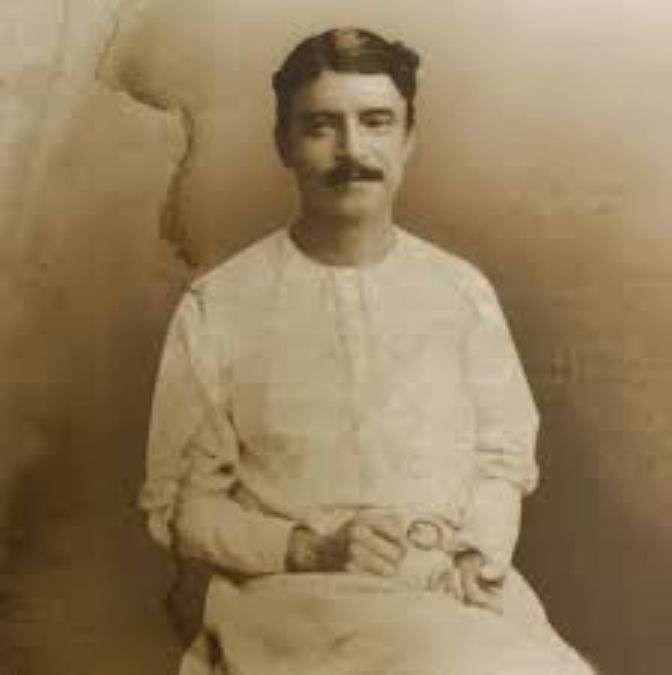
The history of early Indian consumer enterprise has few figures as cinematic as Hemendra Mohan Bose, popularly known as H. Bose. After the tragic accident forced him out of medical college, Bose redirected his energies towards organic chemistry and perfumery. In 1894, he formulated Kuntaline Hair Oil, a non-greasy, deeply aromatic hair tonic infused with natural extracts.
But Bose was far more than a chemist. He was perhaps one of the most brilliant, eccentric and avant-garde marketing minds colonial India had ever seen.
To promote his Swadeshi hair oil against deeply entrenched British competitors, Bose devised a masterstroke of product placement. He instituted the Kuntalin Puraskar (Kuntaline Awards), inviting writers from across Bengal to submit short stories. The prize money was substantial, but there was one ingenious catch: the narrative had to seamlessly incorporate Kuntaline Hair Oil or his Delkhosh perfume into the storyline without appearing to be an overt advertisement.
In 1896, an anonymous entry won the inaugural Kuntalin Puraskar. Titled Nirrudesher Kahini (The Story of the Untraceable), it described a terrifying cyclone threatening to annihilate Calcutta. In a desperate attempt to save his ship from monstrous waves, the protagonist recalls a scientific theory about oil calming turbulent waters and empties his cargo of Kuntaline Hair Oil into the sea, smoothing the waves and saving the city.
The anonymous author behind this unusual exercise in literary product placement was none other than the legendary physicist Sir Jagadish Chandra Bose. Today, the story is widely recognised as the first science-fiction story written in the Bengali language.
Years later, a young and relatively unknown writer named Sarat Chandra Chattopadhyay also won the same award, providing an early boost to a literary career that would eventually become historic.
Yet H. Bose’s audacity extended far beyond the printed page.
In 1900, he imported an early Edison phonograph to record his friends and associates. At a time when British recording companies were charging exorbitant prices to press records of Indian musicians, Bose decided to build an indigenous alternative. By 1907, he had begun manufacturing his own wax recording cylinders under the banner of H. Bose Swadeshi Records.
From his workshop, he painstakingly captured and preserved the voices of India’s intellectual and cultural titans. It was inside H. Bose’s studio that Rabindranath Tagore recorded one of the earliest known renditions of Bande Mataram.
When British authorities increasingly suppressed nationalist expressions and discouraged the public singing of patriotic songs, Bose reportedly duplicated his Swadeshi cylinders and distributed them across the country, sometimes concealed within boxes of Kuntaline Hair Oil.
His legacy would extend to the next generation. His son, Nitin Bose, trained in his father’s improvised laboratories, went on to become one of the pioneers of Indian cinema, helping introduce the technique of playback singing at New Theatres.
Yet today, in an era dominated by digital music platforms and global cosmetics giants, the name of the chemist who helped preserve the soundscape of India’s freedom movement is almost entirely forgotten.
Modern entertainment and beauty industries are powered by billion-dollar streaming algorithms and synthetic grooming formulas backed by global corporate capital. Yet every time an artist steps before a microphone to record a song of resistance, or a writer creates a world from raw imagination, the rhythmic ghost of H. Bose’s wax cylinders still seems to spin quietly in the dark.
His life remains a powerful reminder that while an empire may attempt to silence a nation, it can never extinguish the sound, scent and spirit of its freedom.