


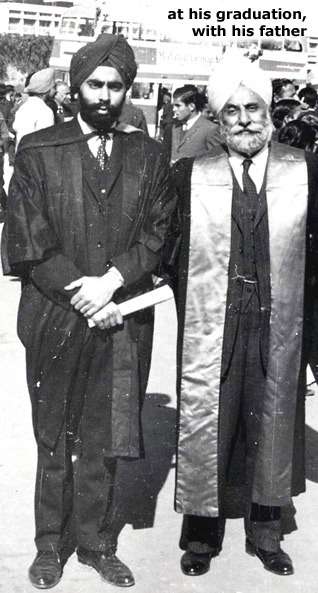
Dr. Inderjit Singh Anand’s remarkable journey from PGIMER to Siachen and the frontiers of heart-failure research
MS Sparsha
What happens to the human heart when the body is pushed to the very limits of survival?
For most doctors, the question might belong in a laboratory. For Dr. Inderjit Singh Anand, it meant carrying sophisticated cardiac equipment into some of the most inhospitable places on Earth—from the high-altitude battlefields of Ladakh and Siachen to the mountains of Tibet and Bolivia—to discover how the human heart responds when oxygen itself becomes scarce.
His work helped transform understanding of altitude-related illness and heart failure. Yet, despite a career spanning India, Britain and the United States, Dr. Anand remains one of those remarkable medical pioneers whose achievements are far better known within scientific circles than among the wider public.
Born into a distinguished medical family, Anand followed in the footsteps of his father, Dr. Santokh Singh Anand, a celebrated Indian surgeon and one of the visionary figures associated with the establishment of the Postgraduate Institute of Medical Education and Research (PGIMER), Chandigarh.
The younger Anand soon demonstrated that he intended to build a scientific legacy of his own. In 1966, he won a prestigious Rhodes Scholarship to pursue doctoral research in cardiovascular physiology at Oxford. His cohort included a young Bill Clinton.
After extensive clinical training in Britain, including at leading institutions such as the National Heart and Lung Institute and King’s College Hospital, Anand returned to India in 1976 and joined PGIMER. There, he became an early pioneer of interventional cardiology while simultaneously embarking on two scientific frontiers that would define his career: congestive heart failure and cardiovascular adaptation to extreme altitude.
His fascination with altitude medicine had deep roots. As a medical student during the 1962 Sino-Indian War, he had seen how poorly understood altitude-related illnesses could devastate otherwise healthy soldiers deployed to Himalayan posts. Breathlessness, pulmonary complications and sudden deterioration could turn extreme altitude into a deadly adversary.
Anand decided to investigate the problem where it mattered most—in the field.
His research involved direct cardiac catheterisation and physiological measurements among soldiers serving at high altitude in Ladakh. His work demonstrated how severe oxygen deprivation could cause intense constriction of the pulmonary blood vessels, driving pulmonary artery pressures sharply upward even when pressures on the left side of the heart remained normal.
The implications were profound.
During studies involving troops deployed at extraordinary elevations, including the Siachen region, Anand and his colleagues identified Adult Subacute Mountain Sickness, helping deepen medical understanding of the consequences of prolonged exposure to extreme altitude. The research had practical implications for military deployment and the health management of soldiers serving in some of the world’s harshest environments.
His investigations also crossed national boundaries. Research in Tibet and elsewhere helped advance understanding of high-altitude pulmonary oedema (HAPE) and contributed to the exploration of inhaled nitric oxide as a means of rapidly relaxing constricted pulmonary blood vessels.
Perhaps even more fascinating was his search for the answer to a deceptively simple question: why can indigenous high-altitude populations survive where lowlanders can become critically ill?
His studies helped illuminate the physiological adaptations that allow native highlanders—and even animals such as yaks—to live at elevations where unacclimatised humans may develop life-threatening pulmonary hypertension.
But altitude was only one side of Anand’s scientific journey.
His foundational work in heart failure also examined one of medicine’s most persistent puzzles: why patients with failing hearts retain salt and water. His research helped establish the importance of the body’s perception of inadequate arterial circulation in triggering fluid-retaining mechanisms across different forms of congestive heart failure.
By the late 1980s, Anand had become a senior academic figure at PGIMER. Yet he increasingly confronted a familiar problem in Indian public institutions: bureaucracy and institutional constraints could limit scientific ambition.
In 1991, he moved to the United States, joining the University of Minnesota and the Minneapolis VA Medical Center. There, he built a distinguished career in heart-failure research and clinical trials, ultimately becoming a leading authority in the field. His work included major international studies such as the landmark Val-HeFT heart-failure trial.
Today, Dr. Inderjit Singh Anand’s career stands as a powerful reminder that scientific greatness is not always accompanied by public fame. His laboratory was sometimes a modern hospital, but at other times it was a frozen Himalayan outpost where every measurement could mean the difference between theory and life-saving knowledge.
From cardiac catheters in Ladakh to major heart-failure trials in Minnesota, Anand followed the evidence wherever it led.
His story is therefore not merely about a cardiologist who crossed continents. It is about a physician who crossed the boundaries of conventional medicine—taking the study of the human heart to places where few researchers would dare to work.
That is precisely what makes Dr. Inderjit Singh Anand an unsung hero of modern Indian medical science.


Not unsung in the eyes of God for his exemplary service. Qualities of a true doctor. My respects to this awesome personality