


Rammohan Pothuri
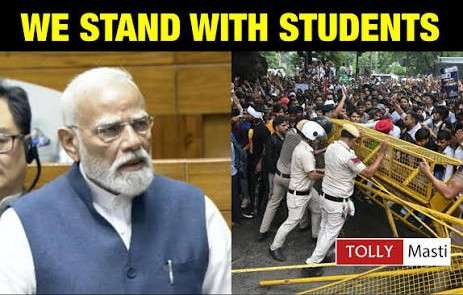
Whenever students take to the streets over a genuine grievance, society instinctively sympathizes with them. We applaud their courage, express solidarity on social media, and lament the state of affairs. Yet, when the time comes to stand beside them in their struggle for justice, they are often left to fight alone.
That is the tragedy of our times.
The most accomplished minds of the country—the IAS, IFS and IRS officers, eminent members of the legal fraternity, intellectuals and policy experts—seldom participate even in meaningful public debates on burning issues affecting students, let alone actively support them. Their silence is often justified in the name of institutional propriety or professional restraint.
India’s leading industrialists and business leaders, who regularly speak about demographic dividends and the country’s future workforce, rarely involve themselves in issues that do not directly affect their commercial interests. The future of millions of students seldom finds a place in their boardrooms.
Government employees, including those in the Central and State governments, public sector undertakings and scheduled banks, understandably choose to remain distant from politically sensitive issues. A secure career, an unblemished service record and a peaceful retirement become compelling reasons to avoid controversy.
Our farmers, who form the backbone of the nation, remain largely disconnected from mainstream debates on education and youth-related concerns, often because of limitations of communication, access and engagement. They have battles of their own to fight.
Who then remains to support our students?
University professors and lecturers, who ought to be the natural guardians of academic interests, are themselves not entirely insulated from institutional compulsions, professional ambitions and vested interests. Not all, certainly, but enough to dilute collective resistance when it matters the most.
Even students are divided. Economic disparities, caste identities, regional affiliations and political loyalties have fragmented what should have been their greatest strength—unity. The student community today is perhaps more polarized than ever before.
The worst sufferers are those from middle- and lower-middle-income families. They neither possess influence nor privilege. They carry the burden of their parents’ sacrifices on their shoulders—the mother’s jewellery sold to pay fees, the father’s lifetime savings spent on education, and countless compromises made at home in the hope that their children will build a better future.
These students cannot afford prolonged agitations or endless uncertainty. They worry less about themselves and more about disappointing their parents.
In a country where the politics of power dominates almost every subject, sincere debate is increasingly reduced to political spectacle. Political parties infiltrate student movements, not always to resolve problems, but often to exploit opportunities. Genuine concerns are buried under slogans, calculations and electoral arithmetic.
Ironically, individuals who may or may not survive a five-year political term frequently dictate policies that determine the forty-year careers of our youth.
That is the greatest paradox of our democracy.
Education has become political. Institutions have become political. Even merit and opportunity are increasingly viewed through political lenses. Somewhere along the way, we have forgotten that students are not merely voters-in-waiting—they are the future custodians of this nation.
When students are denied a fair hearing, it is not merely their careers that are jeopardized. The nation mortgages its own future. A country that fails to protect the aspirations of its youth ultimately weakens its own sovereignty and social fabric.
The question therefore remains: who will stand with our students?
The answer cannot be “the students alone.”
An awakening must come—and it must come soon. Society at large must rediscover its moral responsibility towards its young minds. Silence may be convenient today, but its consequences will be unforgiving tomorrow.
For when the future cries for support, indifference is not neutrality—it is complicity.




very truly show cases the genuine grass root level problems of students ultimately the parents are penalised and slip to mental trauma and some let it go some over thinks fall into prey of fraudsters or die out of agony it also results with student ending thier life being fed up thinking where to bell the cat? again sufferers are students and parents particularly middle class sectors who live dividing thier earnings to different family commitment. they say students are future of the country and that future of students are not taken care off in d present.they r dragged into political protest scenario unwantedly and given students agitation tag