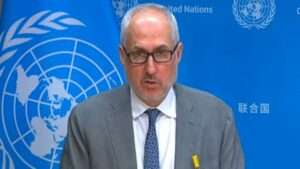
The United Nations once again seems to have discovered its voice when it comes to Bharat. It has expressed concern over student protests in New Delhi, reminding the world that peaceful protesters must be allowed to exercise their democratic rights without fear of harassment, arrest or injury. There is nothing objectionable about that principle. Democracies must always uphold the right to dissent. The question, however, is whether the United Nations believes in that principle universally or only selectively. If the UN could take cognisance of students protesting in India’s national capital, why has it remained conspicuously silent when innocent civilians in Pakistan-occupied Kashmir and Balochistan have taken to the streets seeking their fundamental rights? Why has the same moral outrage been missing when peaceful protesters are allegedly met with bullets, arbitrary arrests and military excesses? Silence, too, is a statement. Stephane Dujarric, spokesman for UN Secretary-General Antonio Guterres, rightly observed that security forces everywhere have a responsibility to protect the rights of peaceful protesters. The emphasis here is “everywhere.” Does “everywhere” exclude Pakistan-occupied Kashmir? Does it exclude Balochistan? Or is the definition of human rights contingent upon geopolitical convenience? Reports and videos emerging over the years from Pakistan-occupied Kashmir and Balochistan have painted a disturbing picture of widespread unrest and allegations of human rights abuses. Protesters demanding affordable electricity, basic governance and political rights have repeatedly complained of excessive use of force. Even parliamentarians in the United Kingdom have expressed concerns over the deteriorating situation in these regions. Yet, the United Nations has chosen to look the other way. Why this selective sensitivity? The answer perhaps lies not merely in diplomatic compulsions but in the larger malaise that has afflicted the United Nations for decades—its inability to rise above the political and strategic interests of powerful nations. International institutions were created to uphold universal principles, not selectively invoke them depending upon who sits across the negotiating table. This is hardly the first instance of what many in Bharat perceive as the UN’s double standards. Following the barbaric terrorist attack in Pahalgam that claimed the lives of innocent tourists, many expected an unequivocal and forceful condemnation from the international community against Pakistan-sponsored terrorism.
The responses, however, fell short of what the victims deserved. Cross-border terrorism directed against Bharat has continued for decades, yet the international discourse often prefers carefully crafted diplomatic language over moral clarity. Bharat has consistently raised these concerns at international forums. Unfortunately, they are too often acknowledged politely and forgotten conveniently. The uncomfortable truth is that the United Nations today faces a serious crisis of credibility. An institution created in the aftermath of World War II cannot continue functioning as though the world has remained frozen in 1945. Political realities have changed. Economic realities have changed. Strategic realities have changed. The United Nations, regrettably, has not. Meaningful reforms are no longer desirable—they are indispensable. The continued dominance of a handful of nations over global decision-making has created perceptions of bias and selective morality. The Global South deserves not merely a seat at the table but an equal voice in shaping international consensus. Bharat, which today represents one-sixth of humanity and stands among the world’s leading economies, deserves permanent representation in the Security Council. So do deserving nations from Africa that have remained underrepresented for far too long. Human rights cannot have geographical preferences. Terrorism cannot have political exemptions. Democratic rights cannot have selective beneficiaries. The United Nations cannot afford to become an institution that speaks loudly when it is convenient and whispers when it is uncomfortable. Its credibility depends not on whom it chooses to criticise but on whether it applies the same standards to all nations. A confident and resurgent Bharat need not seek anyone’s approval to expose such inconsistencies. If China can unapologetically pursue its national interests on the global stage, Bharat has every right—and indeed an obligation—to speak for itself and for millions across the developing world whose voices remain unheard. Enough of selective amnesia. The world deserves a United Nations that is principled, not partisan.