

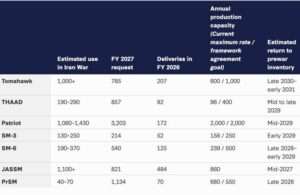
For decades, the United States symbolised unmatched military dominance. Its weapons inventory was considered virtually inexhaustible. From the Gulf War to Afghanistan and Iraq, Washington fought conflicts thousands of miles away without ever appearing worried about ammunition depletion. Today, that illusion is cracking. The ongoing West Asian conflict has exposed an uncomfortable reality: even the world’s biggest military power cannot endlessly sustain modern missile warfare without draining its stockpiles at an alarming rate. That perhaps explains the sudden American urgency to calm tensions with Iran despite launching aggressive strikes earlier. War may begin with bravado, but it eventually collides with industrial capacity. And America’s industrial base is no longer what it was during World War II. Reports emerging from Washington reveal that the US inventory of high-end missile interceptors like THAAD and Patriot systems has been significantly depleted due to the Middle East conflict. According to strategic assessments, replenishing these stocks could take anywhere between one and four years. The Pentagon itself is worried about what experts are calling a “strategic inventory shock.” This is not merely about missiles fired. It is about manufacturing ecosystems collapsing under the burden of prolonged modern warfare. The US defence industry, despite its sophistication, cannot rapidly replace expensive precision interceptors consumed in large-scale engagements. Lockheed Martin is now rushing to expand missile production facilities in Alabama, with plans to drastically increase THAAD and Patriot missile output. That alone tells the story. The American military-industrial complex, once feared for its limitless capacity, is discovering that prolonged conflicts against determined adversaries can melt inventories faster than factories can replenish them. Even Washington’s allies in the Indo-Pacific are reportedly facing delayed deliveries because America is preserving whatever reserves it still has. And herein lies the larger geopolitical shift. While traditional powers are struggling with inventory exhaustion, India is quietly transforming itself from one of the world’s largest arms importers into a rapidly rising defence manufacturing and export hub. The contrast could not be sharper.
Barely a decade ago, India’s defence exports were insignificant. Today, they have crossed a record ₹38,424 crore in FY 2025-26, registering a stunning 62 percent growth in just one year. Defence exports, which stood below ₹1,000 crore a decade ago, have now multiplied many times over under the push for indigenous manufacturing and strategic self-reliance. This is no longer symbolic nationalism. It is hard economics and harder geopolitics. Indian companies are increasingly becoming part of global defence supply chains. American giants like Boeing and Lockheed Martin themselves are sourcing aircraft components and defence systems from India. Subcontracting, localisation and indigenous manufacturing are no longer buzzwords. They are now strategic necessities for a world facing supply disruptions and war-driven shortages. More importantly, India is entering the market at the perfect time. Global conflicts — from Ukraine to West Asia and rising tensions around Taiwan — are forcing nations to urgently diversify defence procurement. Countries no longer want to depend entirely on Western suppliers whose inventories are overstretched and delivery schedules uncertain. India offers a cheaper, reliable, and politically balanced alternative. Systems like BrahMos missiles, Akash air defence platforms, Pinaka rocket systems, radars, drones, and aerospace components are steadily finding international buyers. With two defence industrial corridors, growing private sector participation, and over 16,000 MSMEs entering the defence ecosystem, India’s manufacturing backbone is expanding at remarkable speed. Can India cross ₹1 lakh crore in defence exports within the next two to three years? At the current growth trajectory, it no longer sounds unrealistic. Of course, India is not alone in this race. China remains a formidable competitor with massive scale and state-backed manufacturing aggression. Beijing has already emerged as a dominant supplier to several developing nations. But Chinese weapons still carry trust deficits in many markets because of geopolitical concerns and quality perceptions. India, on the other hand, is positioning itself as a democratic, dependable, and cost-effective manufacturing partner. The lesson from the Iran conflict is brutal but simple: wars are no longer won merely by technology. They are won by production capacity, supply chains, and industrial endurance. America has discovered that even superpowers can run short of missiles. India has discovered that self-reliance in defence is no longer optional — it is strategic survival. And perhaps for the first time in modern history, the world is beginning to notice that while one arsenal is evaporating, another manufacturing giant is quietly rising.