



The dreadful conflict between Bhima and Karna had risen to its fiercest height. Inflamed with wrath and eager to crush his adversary, Bhīmasena leapt upon Karṇa’s chariot like a tempest descending upon a mountain peak. Yet Karṇa, perceiving the terrible fury of the son of Vāyu, concealed himself within the secret chamber beneath the lofty standard of his chariot and waited silently for a favourable moment. Bhīma searched in every direction, unable to discover him, and for a while imagined that Karṇa had hidden himself beneath the wheels of the chariot. Resolving to drag him forth by force, he prepared to descend. At that instant Karṇa, perceiving the opportunity, suddenly emerged and discharged a furious shower of arrows with unrestrained violence. Bhīma realised that his attempt had failed, yet remained immovable in courage and fought on with dreadful determination, taking shelter behind the heaps of elephants and horses that had earlier been slain by Arjuna.
Karṇa attacked from many directions at once, covering the field with sharp and relentless shafts. The ceaseless assault tormented Bhīma greatly; his mighty arms and broad shoulders became weary and pierced with pain. Seeing Bhīma deprived of chariot and weapons, exhausted by his long struggle against the fourfold divisions of the army as well as against himself, Karṇa recollected the pledge he had once given unto Kunti. Smiling with cruel ridicule, he approached Bhīma and struck him lightly upon the stomach. Then, with words polluted by envy and long-nourished resentment, he mocked him bitterly, saying that war was not suited to one whose chief delight was food and feasting. He derided Bhīma as a glutton fit only for kitchens and forest hermitages, declaring that roots and wild fruits were more fitting for him than the clash of kings upon the battlefield. He urged him to abandon pride, forsake ambition, and return peacefully to the forests. Karṇa further proclaimed that Bhīma lacked the stature to confront a warrior such as himself and advised him instead to seek refuge in Nara-Narayana. Thus did Karṇa pour forth the venom of jealousy and hatred for which he had long been known among men.
While Bhīma stood burning with humiliation, Krishna, perceiving the anguish of the son of Pāṇḍu, directed Arjuna toward Karṇa. Instantly Arjuna released a terrible volley of arrows that drove Karṇa backward and rescued Bhīma from the grief of disgrace. Arjuna then hurled five mighty and razor-edged shafts against Karṇa, but those arrows were swiftly neutralised by Ashwatthama, the proud son of the preceptor Dronacharya. Inflamed with arrogance born of his divine prowess, Aśvatthāma discharged sixty-six arrows against Arjuna and harassed him fiercely. Arjuna, however, calmly warned him to remain watchful and prepared for destruction. Soon thereafter Aśvatthāma plunged violently into the herds of elephants that roamed amidst the confusion of battle.
Meanwhile, Viśoka, the faithful charioteer of Bhīma, swiftly prepared another chariot for his master. Mounting it once again, Bhīmasena hastened toward Arjuna. At the same time Satyaki, radiant with pride after routing numerous Kaurava warriors, advanced to join them. Hearing these events narrated by Sanjaya, the aged monarch Dhritarashtra was overcome with sorrow and reflection. He lamented that enmity with the mighty Pāṇḍavas could never bring prosperity. Whatever way the matter was considered, he declared, it would have been wiser to grant the sons of Pāṇḍu their rightful share of the kingdom, for otherwise both wealth and fame would dissolve into nothingness. He confessed that in the mortal world the weak must often bow before the strong in order to preserve life itself, whereas futile conflict yields neither worldly gain nor heavenly merit. Yet he mourned that his foolish son Duryodhana, blinded by prejudice and arrogance, refused to heed wisdom or understand the practical ways by which life and kingdoms are preserved. Despairingly, Dhṛtarāṣṭra resigned himself to fate, saying that events must now follow their destined course.
Sañjaya continued his narration, declaring that Arjuna had pierced through the mighty formations guarded by Droṇācārya and penetrated deep into the Kaurava host, causing the hopes of the Kauravas to fade into darkness. The invincible Bhīma and Sātyaki had joined him, and thus the doom of Jayadratha appeared certain. As Sātyaki advanced toward the sons of Kuntī, he was confronted by the renowned king Alambusha, fierce in strength and dreadful in battle. The two heroes shattered each other’s bows, tore apart their armour, and pierced one another’s chest and shoulders with deadly shafts. Their combat astonished both the beings of earth and the celestials who watched from the heavens above. At length Sātyaki slew Alambuṣa’s horses, cut down his charioteer, and finally severed the king’s head, adorned with glittering earrings and ornaments, which fell upon the ground like a blazing star cast from the sky.
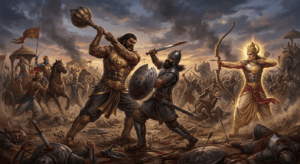
Victorious and filled with fierce joy, Sātyaki pressed onward, but soon Dushasana confronted him. With effortless skill Sātyaki slew the horses of Duḥśāsana and prepared to destroy his chariot as well. Then the warriors of Trigarta rushed forth to halt his advance, yet fifty accomplished heroes among them were slain by Sātyaki in rapid succession. The remaining soldiers scattered in terror while Sātyaki flashed across the battlefield like lightning coursing through dark storm clouds. Thereafter the warriors of Śūrasena attacked him, but he drove them away; the mighty Kalingas too offered stubborn resistance, yet he subdued them utterly. Emerging safely from those dangers like a mighty elephant rising from a troubled lake, Sātyaki at last reached the side of Kṛṣṇa and Arjuna.
Beholding him, Śrī Kṛṣṇa spoke with admiration unto Arjuna and praised the immeasurable strength and splendour of his disciple. He declared that there was no need even to speak of warriors such as Kritavarma and others, for Sātyaki alone had restrained the inexhaustible energy of Droṇācārya himself. Obeying the command of Yudhishthira and moved by reverence toward Arjuna, he had fought through innumerable dangers to reach them, and therefore his arrival brought delight to both Kṛṣṇa and the Pāṇḍava hero.
Arjuna, however, remained troubled in heart. He declared that he could not rejoice fully at Sātyaki’s arrival, for the condition of King Yudhiṣṭhira in his absence was unknown. Droṇācārya remained steadfast in his terrible vow, and still Jayadratha had not been slain while the sun steadily descended toward the horizon. Arjuna observed that Sātyaki had already fought against Droṇa, Kṛtavarma, and many others, and was now exhausted, thirsty, and worn from battle, while even his horses were overcome with fatigue. Before they could grant him rest, another mighty danger approached, for the tireless war hero Bhurishrava advanced against them with a vast army. Arjuna described Bhūriśravā as a lion among the Kurus, unmatched in strength, courage, skill, and mastery of archery, and wondered anxiously why Dharmarāja had allowed Sātyaki to come so far while Droṇa waited hungrily for his prey like an eagle circling above flesh.
Soon Bhūriśravā, the son of Somadatta, confronted Sātyaki directly. Sātyaki declared proudly that he had upheld the trust placed in him by Yudhiṣṭhira and had already shattered the armies that stood in his path. He proclaimed that Bhūriśravā’s pledge to Duryodhana and the Kauravas would end in failure. Before Kṛṣṇa and to the satisfaction of Arjuna, he vowed to break Bhūriśravā’s weapons, destroy his horses, drench him in blood, and tear him to pieces so that he would resemble a crimson mountain upon the field of slaughter. Bhūriśravā merely smiled at these fierce words and replied that he rejoiced to face a worthy warrior in combat. He arrogantly declared himself the destroyer of the very roots of the Pāṇḍavas and all their allies.
Sātyaki, burning with wrath, answered sharply that Bhūriśravā stood at a distance only because fear prevented him from approaching openly upon the battlefield. He mocked him for muttering empty boasts and threatened to cut out his tongue if he continued his futile speech. Thus, amidst fierce words and swelling fury, the two mighty warriors prepared for one of the most dreadful encounters upon the sacred field of Kurukṣetra, while Sañjaya continued to narrate these momentous events unto the sorrow-stricken king Dhṛtarāṣṭra.

