



Dronacharya, beholding the peril that pressed upon Duryodhana, raised his commanding voice and declared that the prince stood within the fierce sight of Abhimanyu. He urged the assembled warriors to hasten without delay, to support their lord with unwavering skill, and to restrain the youthful hero by every means at their command. He enjoined them to prove their valour by releasing unceasing volleys of shafts. For, in moments when a leader is seized by sudden peril and the enemy advances with unlooked-for force, it becomes the sacred duty of commanders to secure his safety, heedless of method or restraint. Such indeed was the principle that revealed itself in the mandate of the Kaurava commander.
At that summons, mighty warriors—Kripa, Karna, Bhurishrava, Shalya, the king of the Kauravas, Vrishasena, and many other princes of renowned prowess—gathered together and advanced against Abhimanyu. Drona himself turned his chariot toward the tumultuous centre of danger. Soon the field was thronged with seasoned fighters who placed themselves between Duryodhana and the advancing youth. Yet Abhimanyu, like a wild tiger enraged at having its prey snatched away, grew terrible in wrath and scattered that disciplined host. He drove them as a lion drives herds of trembling deer, breaking their ranks and casting them into confusion.
Perceiving that the Kaurava forces could not restrain this youthful warrior, Drona devised a stratagem and advanced to confront him. Others, gathering in clusters, joined the assault and encircled their formidable target. Meanwhile Abhimanyu, with sportive mastery, wielded his bow—striking down adversaries, shattering their weapons mid-flight, breaking their bows, and piercing their bodies with swift and unerring shafts. His manner of combat appeared wondrous, as though the science of war itself had taken living form in him.
At a fierce signal from Duryodhana, the Kaurava soldiers surged forward like the swelling waves of the ocean, yet their advance was checked as waves are broken upon the steadfast shore. Duryodhana, Kripa, and Bhurishrava each discharged three arrows; Drona, with unerring aim, sent forth seventeen shafts; Vivimsati loosed twenty; and Ashwatthama, Brihadbala, Shalya, Kritavarma, Shakuni, Dussasana, and Dussaha poured forth a relentless storm of missiles upon the solitary hero.
Unshaken by that onslaught, Abhimanyu answered with fierce energy, tormenting them all with his shafts. When the Asmaka prince rushed upon him in pride, Abhimanyu swiftly shattered his chariot, slew his steeds and charioteer, tore down his banner, and laid him low. Though Drona and others rallied the Asmaka forces and hurled diverse weapons with furious intent, Abhimanyu countered them with effortless skill, troubling the entire host.
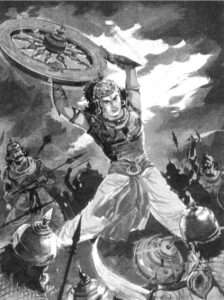
He next assailed Karna, piercing his armour so that blood flowed freely, and the great warrior sank senseless. Many Kauravas, including the sons of Duryodhana, were driven back by his irresistible might. Even Shalya, the king of Madra, who sought to check his pride, was struck down and rendered unconscious by Abhimanyu’s powerful shafts. The Kaurava forces, shaken and disordered by these grievous reverses, scattered in dismay, while Abhimanyu blazed among them like a consuming fire.
The rallying call of Drona dissolved into the fearful retreat of the army. Abhimanyu’s triumph drew admiration even from the ranks of his foes, and celestial beings themselves seemed to unite in praise of his unmatched valour. Amid that tumult, the brother of Shalya advanced against him, but was swiftly overpowered—his steeds, banner, and charioteer destroyed, his arms severed before he could discharge an arrow, and at last his head struck down. At this dreadful sight, princes fled in terror, seeking only the preservation of their lives.
Thus thrown into confusion, the Kauravas found themselves in grievous doubt. Yet their foremost warriors, calling one another by name, gathered courage, reassembled their forces, and advanced again with the blare of conches, the thunder of drums, and the clash of cymbals that filled the air. Surrounding Abhimanyu once more, they sought to subdue him. But the young hero, radiant in resolve, stood firm upon the field, his bowstring’s twang and the whistling of arrows overpowering all other sounds, even as cries of distress rose from the afflicted Kauravas.
Drona, beholding the devastation wrought upon his ranks, reflected that the ruin resembled the repeated stroke of thunderbolts. For a moment, he stood as one suspended between thought and action. Meanwhile, Dhritarashtra, hearing Sanjaya’s narration, spoke with mingled joy and sorrow—rejoicing in the extraordinary prowess of his grandson, yet grieving that his own armies were harried by a single youth. A question lingered in his mind: why had the mighty Pandavas not yet come to his aid?
Sanjaya, perceiving the king’s unspoken concern, continued in measured tones. He described how Abhimanyu, after scattering the enemy, circled them with swift precision, preventing their escape, and striking them relentlessly with shafts and weapons that inspired terror. Wherever he moved, fear followed; and like a blazing brand whirled in all directions, he left behind heaps of fallen warriors.
Drona then spoke aloud, as if to stir the spirit of Duryodhana, yet with genuine admiration beneath his words. He lamented that kinsmen, allies, and warriors—elephants, horses, and chariots alike—had been laid low in great numbers by a single hero of extraordinary might. Though his speech bore the tone of provocation, it carried within it the truth of deep appreciation, for none had ever before cast such dread among seasoned warriors as did Abhimanyu on that fateful field.
Thus Sanjaya, with deliberate calmness, continued his narration, seeking to ease the turmoil within the heart of the blind king.

