



Dhṛtarāṣṭra, his heart consumed by anxiety and foreboding, addressed Sanjaya in a voice burdened with sorrow. “The fire of grief arising from the death of Abhimanyu now surrounds Arjuna like the very flames of destruction, and his wrath against the Saindhava burns with the fury of Yama himself. Who among the Kauravas can withstand such a storm? Throughout the kingdom, sudden cries of anguish have arisen, though none can discern from what unseen calamity they spring. Bitter lamentations echo through every quarter, yet above them all resounds the grief-stricken wailing issuing from the palace of the Saindhava. My son Duryodhana would never heed my counsel. Bhīṣma and Droṇa strove with all their wisdom to restrain him, yet he cast aside even the sacred guidance of Lord Śrī Kṛṣṇa. Karṇa, Duḥśāsana, and Śakuni shattered every hope of peace and became the cause of countless deaths. Arjuna alone once stood against Lord Śiva in dreadful combat; how then can men dare to underestimate him? He alone possesses the might to consume all worlds, and to such a warrior the Supreme Lord Himself has become charioteer. Why then did envy arise against them?”
The blind monarch continued in deep despair. “In every manner we sought to persuade my son to abandon his attachment to land and wealth and to accept peaceful settlement with his cousins, yet he rejected every righteous path and remained fixed upon destruction. What power had I to alter his course? Yet lamentation now serves no purpose. Tell me, when Arjuna advanced in pursuit of the Kauravas, what actions did my warriors undertake? Conceal nothing from me, even if their conduct strayed from righteousness. I perceive that some hidden and desperate design is moving within the hearts of my son and his commanders. Therefore speak plainly, without adorning harsh events with pleasing words.”
Then Sanjaya, faithful in truth, replied with grave composure. “O King, I shall narrate the events precisely as they unfolded, for there is no profit in attempting remedies when ruin has already descended, just as it is useless to lock the stable after the horses have fled. You did not prevent the deceitful game of dice, nor did you sincerely establish peace between the cousins. The people of the kingdom accuse you of greed and injustice. King Pāṇḍu ruled this realm in righteousness, yet, unable to endure the prosperity of the Pāṇḍavas, you denied them even their rightful share. Now, seeking refuge in cunning morality, you place all blame upon your son, though the fruits of these deeds shall shortly ripen before your eyes, and none shall escape their consequence.”
Sanjaya continued, “The thunder of the Gandīva and the reverberation of the Pāñcajanya are sounds unbearable even to celestial hosts; nevertheless, though the gods themselves honour Kṛṣṇa and Arjuna, the Kauravas chose war against the sons of Pāṇḍu. Therefore cast aside grief and hear attentively the unfolding phases of battle. At the break of dawn, Droṇācārya, aflame with martial zeal, advanced through the ranks and sounded his conch with terrible force. He moved through every division of the army, inspiring warriors to battle. Then the Kaurava heroes swung their swords, proclaimed their names and lineages, and challenged the enemy with loud cries, roaring like lions while twanging the strings of their bows in fierce delight. They shouted repeatedly, ‘Where is Arjuna? Why does he delay?’”
Thereafter Droṇa addressed the principal warriors, saying, “You, O Saindhava, together with Bhūriśravā, Karṇa, Śalya, Aśvatthāma, Vṛṣasena, and Kṛpācārya, remain united and guard one another in battle. Assemble immediately the choicest divisions of our strength—fourteen thousand elephants, sixty thousand chariots, one hundred thousand horses, and ten hundred thousand foot soldiers. Withdraw to the farthest extremity of our formation, for within this arrangement even the gods themselves shall fail to reach you. How then shall the Pāṇḍavas penetrate it?” These words brought immense relief to Jayadratha, who, surrounded by mighty charioteers, moved toward the most distant quarter of the army.
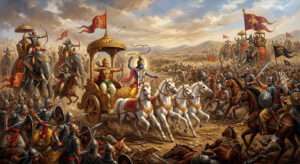
Droṇa then arranged the vast Śakata-vyūha, stretching wide and deep like an unconquerable ocean of steel. On the western flank he established the Padma-vyūha, while within its heart he concealed the needle-like Suchi-vyūha. Kṛtavarmā guarded the front, and Duryodhana, surrounded by one hundred thousand armed warriors, protected the rear. In the centre of the Suchi-vyūha stood the Saindhava himself. This magnificent and terrible formation drew the admiration of celestial beings and warriors alike, who praised the strategic genius of Droṇa.
At that moment King Durmarṣaṇa, intoxicated by pride and unwilling to remain confined within the defensive arrangement, boldly proclaimed that he alone would slay Arjuna. Accompanied by his fourfold army, he advanced with loud cries of enthusiasm. Jayadratha was stationed at a distance measured by nearly fifteen hundred bow-lengths, while Duḥśāsana and Vikarna moved near him with their respective divisions to ensure his protection. Droṇa himself, having completed the Śakata-vyūha, shone resplendent in white armour, white garments, and a radiant turban. His chariot, yoked with red horses and crowned by a lofty banner, bore deadly bows and arrows, making him appear like Death incarnate striding across the battlefield. The Kaurava host resembled a colossal demon with a gaping mouth prepared to swallow forests and mountains in a single gulp. Duryodhana and his allies rejoiced greatly, believing the formation impregnable.
Then Arjuna entered the field. His eyes blazed with fierce splendour, and upon his banner Hanumān fluttered majestically in the wind. The mere sight of his arrival struck terror into the hearts of the enemy. Beside him stood the divine Kṛṣṇa, while mighty warriors such as Dhṛṣṭadyumna, son of Drupada, and Śatānīka, son of Nakula, advanced in ordered ranks. Conches and trumpets thundered across the earth. Calm yet terrible in restrained fury, Arjuna confronted the enemy host. When the Devadatta and Pāñcajanya sounded together, the minds of the Kaurava warriors became overwhelmed with dread and heaviness, as though their spirits themselves had begun to tremble.
Sanjaya then declared, “O King, at the entrance of the divine pair, Kṛṣṇa and Arjuna, our forces became seized with fear. Pebbles rained upon the army, meteors fell from the heavens, thunderbolts crashed upon every side, and ominous sounds vibrated through the ranks. Then both armies surged forward with violent energy. Like a mighty embankment restraining the ocean, Durmarṣaṇa stood against the advancing Pāṇḍava tide. Arjuna then spoke unto Kṛṣṇa, saying, ‘Drive my chariot toward the force of Durmarṣaṇa, for he shall become the first oblation offered unto the Lord of Death this day.’”
At once Arjuna covered the elephant divisions with relentless showers of arrows. Believing him isolated, the Kaurava warriors surrounded him from all sides. Yet Arjuna, with effortless mastery, began severing the heads of soldiers in ceaseless succession. The earth appeared like a vast crimson lake adorned with fully blossomed red lotuses, formed from the scattered heads of fallen warriors. Herds of elephants collapsed like shattered mountains drifting through rivers of blood. Clouds of dust gathered thickly together, while flashes of steel and arrows burst forth between them like lightning amidst storm clouds.
As Arjuna raged through the Kaurava host, cutting down warriors without pause, the enemy armies released torrents of arrows upon him. Amid the confusion, many shouted desperately, “Where is Arjuna? Where has he vanished? Pursue him! Capture him!” The battle grew increasingly dreadful. Severed trunks and heads fell unceasingly upon the blood-soaked earth, yet the Kauravas still fought with remarkable courage and stubborn resolve. At length, Arjuna, angered by their defiant cries, unleashed another devastating storm of arrows that shattered the Kaurava formations entirely. Unable to withstand his terrible assault, the soldiers abandoned the field and fled toward Droṇa, seeking refuge from the irresistible fury of Arjuna. Thus, Sanjaya narrated the fearful events unto the sorrow-stricken monarch Dhṛtarāṣṭra.