



Kuteti Devi Temple is situated on Hari Parvat, on the western bank of the sacred Bhagirathi River, about 2 km from the Kashi Vishwanath Temple in Uttarkashi, Uttarakhand. Perched on a serene hill overlooking the town, the temple offers panoramic views of the Bhagirathi valley. It is one of the most revered Shakti shrines in Uttarkashi and is regarded by many local Garhwali families as their Kuldevi (family deity).
The exact date of the temple’s origin is not known. Historical records and local traditions indicate that the shrine has existed for several centuries. The present structure has undergone renovations over time, while the sacred site and the traditional mode of worship have been preserved. The temple has been served by the same hereditary priestly lineage for many generations.
The presiding deity is Goddess Kuteti Devi, worshipped as a manifestation of Adi Shakti, Durga, and Rajarajeshwari. Unlike many temples that house sculpted idols, the sanctum enshrines three sacred natural stones (Shilas), which are revered as the self-manifested presence of the Goddess. Devotees seek her blessings for protection, prosperity, family welfare, and success in important undertakings.
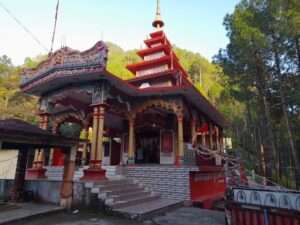
The temple reflects the traditional Garhwali Himalayan style of architecture. Constructed primarily of stone with a sloping roof suitable for the mountain climate, the shrine is simple yet spiritually significant. The peaceful surroundings and elevated location overlooking Uttarkashi enhance its sacred atmosphere, making it a place of prayer and meditation.
The temple’s history is closely linked with the royal family of Kota in Rajasthan. According to the tradition preserved by the temple and recorded by the Uttarkashi District Administration, the Maharaja of Kota was on a pilgrimage to Gangotri when he misplaced a bag containing his wealth near Uttarkashi. Distressed, he prayed at the Kashi Vishwanath Temple and vowed that if his belongings were recovered, he would marry his only daughter to a worthy young man from Uttarkashi.
Soon afterwards, the lost bag was found intact by the priest of the Kashi Vishwanath Temple. Honouring his vow, the Maharaja requested the priest to find a suitable groom, and his daughter was married into a respected family of Uttarkashi. This royal connection forms the historical foundation of the Kuteti Devi Temple.
The Sthalapurana of Kuteti Devi is preserved through an ancient local tradition and is officially documented by the Uttarkashi District Administration.
After her marriage, the princess from Kota settled in Uttarkashi. Although she embraced her new life, she constantly longed for the presence of her Kuldevi, whom she had worshipped since childhood. Every day she prayed with deep devotion, seeking the Goddess’s blessings and wishing that her beloved deity would remain with her.
Moved by the princess’s unwavering devotion, Goddess Kuteti Devi appeared in the dreams of both the princess and her husband. The Goddess instructed them to search their agricultural field, assuring them that she had chosen Uttarkashi as her new abode and would manifest herself there.
The following morning, the couple searched the field and discovered three sacred stones unlike any ordinary rocks. Recognising them as the divine manifestation of the Goddess, they informed the local priests and elders. After performing Vedic rituals, the sacred stones were ceremonially installed on Hari Parvat, where a shrine was constructed for their worship.
From that day onward, the Goddess became known as Kuteti Devi and has been revered as the divine protector of the region. The three sacred stones remain the principal objects of worship inside the sanctum, symbolising the eternal presence of Adi Shakti. For generations, devotees have believed that the Goddess safeguards Uttarkashi, blesses families with peace and prosperity, and protects pilgrims travelling to Gangotri and the Char Dham. Many local families continue the tradition of offering prayers at this temple before major family ceremonies and important religious journeys.
Chaitra Navaratri and Sharad Navaratri are the most important festivals celebrated at the temple. During these occasions, special pujas, recitations of the Durga Saptashati, devotional bhajans, and cultural programmes are conducted with great devotion. Durga Ashtami and Vijayadashami are also observed with traditional rituals, attracting devotees from Uttarkashi and neighbouring villages who come to seek the blessings of Goddess Kuteti Devi.


