M Jaishree
The Upanishads are rays of eternal light that pierce the darkness of ignorance and illuminate the path of humanity. They are not merely ancient philosophical writings but living fountains of wisdom, born from deep meditation, self-discipline, and spiritual realization. Every verse is the distilled essence of countless years of contemplation by enlightened sages who sought nothing for themselves but everything for the welfare of the world. Their vision transcended time, offering guidance that remains as relevant today as it was in the distant past.
The creation of the Upanishads was not the work of a single thinker or a single generation. They emerged through the uninterrupted intellectual and spiritual efforts of seers who dedicated their lives to discovering truth. Their knowledge flowed like a sacred river, enriched by experience, reason, observation, and profound inner realization. Like a celestial shower of flowers blooming from the enlightened minds of the ancient Bhargava sages, this wisdom spread fragrance across generations, nurturing civilizations with faith, ethics, and knowledge.
A sage is never defined by caste, sect, birth, or social identity. A true sage is recognized by purity of thought, clarity of vision, and compassion for all living beings. Such an elevated soul dispels the darkness that clouds the human mind and awakens the light of discernment. The sage represents continuity rather than individuality, becoming a living link in the timeless chain of wisdom that preserves truth from one generation to the next. Their greatest inheritance is not wealth or power but knowledge that liberates humanity from fear, confusion, and suffering.
The truths preserved in the Vedic tradition have endured because they have been tested repeatedly in the laboratory of human life. Their principles have guided countless generations through prosperity and adversity alike. While societies evolve and technologies advance, the eternal truths concerning righteousness, compassion, self-control, and the nature of consciousness remain unchanged. Truth does not depend upon popular opinion or changing circumstances. It reveals itself as the expression of the Divine Will, eternal and self-luminous, inviting every sincere seeker to experience it directly.
The sages possessed an extraordinary ability to express profound spiritual insights through concise mantras, symbolic stories, and memorable dialogues. Their teachings were designed not merely for scholars but for ordinary people seeking meaningful lives. Every mantra carries layers of psychological, ethical, and spiritual significance. Every narrative becomes a mirror reflecting the struggles, aspirations, and possibilities within the human mind. This remarkable simplicity enabled profound wisdom to travel across centuries without losing its essence.
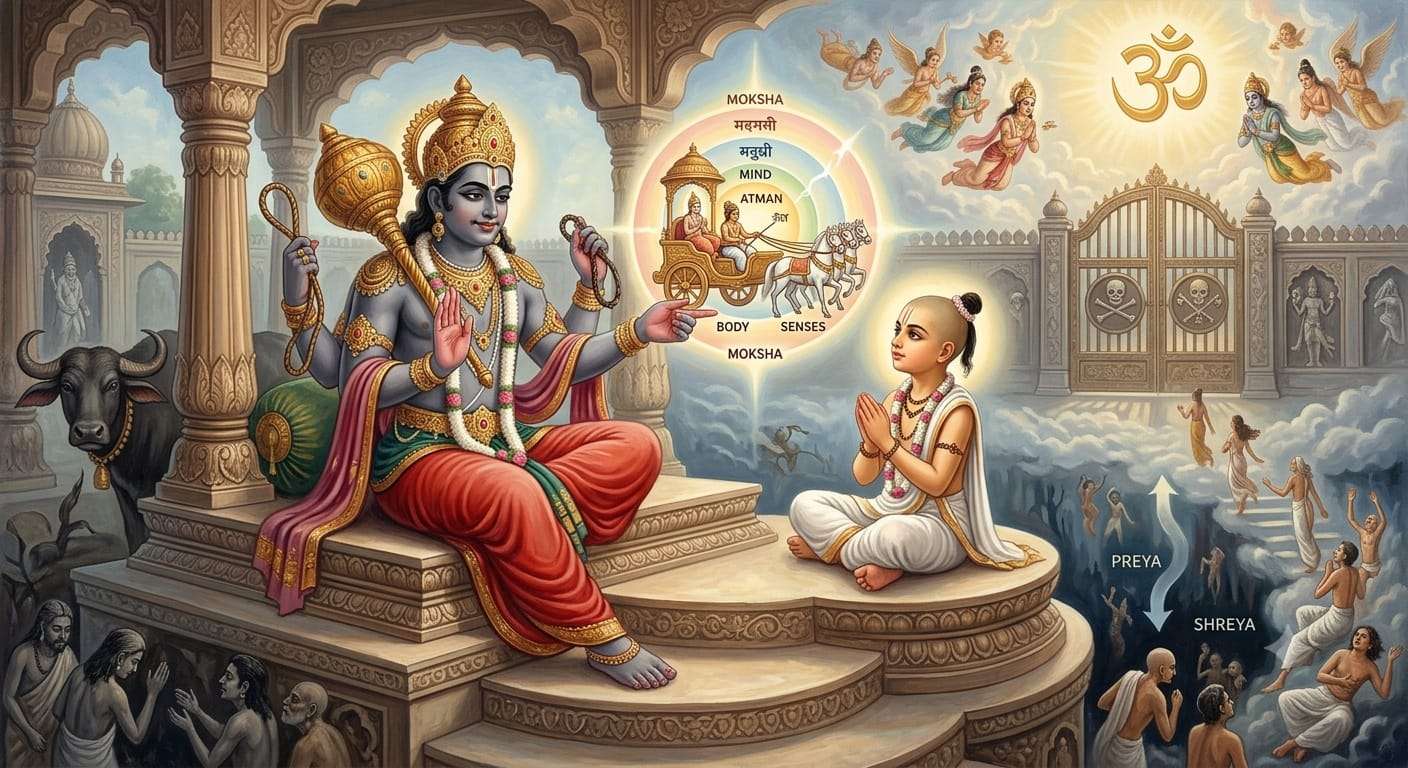
Among these immortal treasures, the Katha Upanishad shines with exceptional brilliance. The dialogue between the young seeker Nachiketa and Yama, the Lord of Dharma and Death, stands as one of the greatest philosophical conversations in world literature. Nachiketa represents unwavering virtue, truthfulness, courage, and obedience to his father’s word, while Yama embodies justice, moral order, and the ultimate reality that governs existence. Their conversation rises above the fear of death and explores the deeper purpose of life, revealing that the highest knowledge belongs to those who choose the eternal over the temporary, wisdom over pleasure, and truth over illusion.
The teachings of the sages combine spiritual realization with remarkable scientific temperament. They encouraged inquiry rather than blind acceptance, experience rather than mere belief, and disciplined observation rather than superstition. The Upanishadic method resembles the spirit of scientific investigation, where questions are welcomed, assumptions are examined, and truth is discovered through direct realization. Their exploration extended beyond the external universe into the vast inner universe of consciousness, demonstrating that self-knowledge and rational inquiry can coexist harmoniously.
From a social perspective, the Upanishads envision a civilization founded upon harmony, cooperation, and universal goodwill. Their prayers are never confined to individual prosperity but embrace the welfare of the entire world. They aspire for every human being to enjoy peace, dignity, abundance, and security. Their vision rejects division and celebrates the interconnectedness of all existence. Such ideals remain the strongest foundation for building compassionate societies where justice and empathy flourish together.
Psychologically, these teachings provide remarkable insight into the human condition. They recognize that fear, greed, anger, and attachment disturb the mind, while truthfulness, self-restraint, compassion, and wisdom bring lasting peace. The Upanishads encourage individuals to cultivate inner stability rather than depend solely upon external circumstances. They remind humanity that lasting happiness arises from self-mastery, clear understanding, and harmony between thought, word, and action. In this way, they continue to offer timeless guidance for emotional resilience and mental well-being.
The Vedic prayers echo with universal aspirations. May every being be peaceful. May every heart be radiant. May every individual throughout the universe live with comfort and dignity. May abundance bless all people. May grief disappear from every home. Just as the sun rises unfailingly in the east to nourish life without discrimination, may knowledge, compassion, and righteousness shine equally upon all. These prayers express humanity’s highest ideals, where personal welfare is inseparable from the welfare of the world.
The repeated invocation of a hundred years of life carries profound symbolic significance. It is not merely a wish for longevity but a complete vision of fulfilled existence. The sages prayed that every individual should live a full span blessed with health, strength, prosperity, noble speech, peaceful hearing, clear vision, and unwavering vitality. A hundred years represents completeness, where life is enriched by wisdom, purposeful action, and harmonious relationships rather than measured simply by the passage of time.
The Upanishads continue to stand as timeless beacons, inviting humanity to unite reason with spirituality, knowledge with humility, and individual progress with universal welfare. Their enduring message is that the highest achievement of human life is not domination over others but mastery over oneself, not accumulation but realization, not division but unity. As long as humanity seeks truth, justice, peace, and inner illumination, the voice of the sages will continue to resonate across the ages, guiding every sincere seeker from darkness to light, from ignorance to wisdom, and from restlessness to eternal peace.
Om Shanti, Shanti, Shanti.