Upadhyayula Lakshman Rao
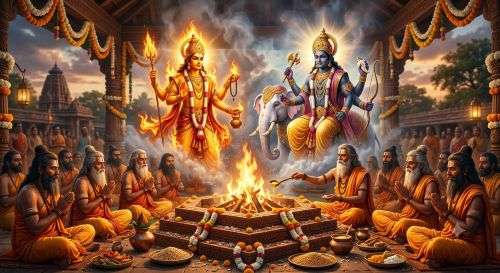
The sage Deerghatama, immersed in contemplative vision, invokes Agni in the measured cadence of Jagathi and Trishtup metres, revealing both devotion and disciplined insight. Upon the northern altar of the yajna, the priests, with reverent precision and affectionate intent, prepare a sacred seat for the divine fire. The altar shines in many hues, symbolizing the manifold expressions of energy, and stands as a radiant force dispelling darkness. It is sanctified with clarified butter, adorned with sacred kusa grass, and veiled in pure silken cloth, signifying both material refinement and inner purity. In this sacred preparation lies not merely ritual action but a profound understanding that order, beauty, and intention are essential to invoking higher forces.
Agni is born from the union of the two Aranis, the upper and lower wooden sticks, whose friction generates first smoke and then flame. This process reflects both a spiritual metaphor and a scientific observation, where latent energy emerges through disciplined effort. The Aranis are revered as the two mothers, the patron as the father, and Agni as the divine child born of their union. This triadic relationship reveals an early comprehension of causality, transformation, and interdependence. The first spark, delicate yet potent, grows into a blazing tongue of fire, symbolizing consciousness emerging from inertia and illumination arising from obscurity.
The offerings made to Agni—parched rice cakes, clarified butter, and soma—represent nourishment at different levels, physical, vital, and spiritual. As Agni consumes these, he transforms them into subtle energies, carrying them upward as offerings to the celestial realms. The priest’s act of feeding the fire is thus both symbolic and functional, mirroring the law of conservation and transformation of energy. The nourishment received by the patron through these rituals sustains life and prosperity, extending across cycles of time, including a year. Agni, in return, becomes the mediator who releases rain, ensuring fertility and continuity of life.
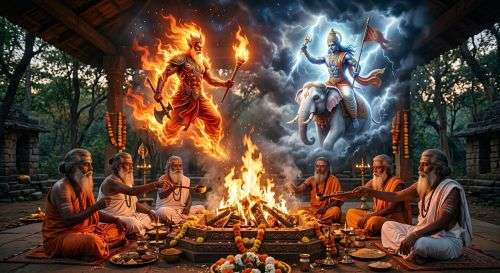
In his dynamic form, Agni assumes the power of wildfire, spreading swiftly across forests, consuming and transforming all in his path. This portrayal is not merely destructive but deeply regenerative, as fire clears decay and prepares the ground for renewal. The sages observed that fire, though fierce, is governed by laws—it spreads with wind, feeds on dryness, and subsides when deprived of fuel. This reflects a keen awareness of natural forces and their patterns. Agni’s roaring sound, his sparks flying like luminous seeds, and his unstoppable flow evoke both awe and understanding of energy in motion.
Agni’s nature is described as childlike, controllable, and benevolent when guided, yet formidable when left unchecked. This duality reflects the human relationship with natural forces—capable of both creation and destruction. The priests, through knowledge and discipline, generate and sustain Agni, ensuring that his power is harnessed for auspicious purposes. In this, the Vedic tradition reveals an early scientific temperament, where observation, experimentation, and control of natural elements are harmonized with spiritual intention.
The flames of Agni are likened to the horns of a fierce beast, rising upward with intensity, while his smoke stretches like dark fingers embracing the sky. The imagery conveys both the physical behavior of fire and its symbolic reach between earth and heaven. As Agni moves through herbs, grasses, and trees, he absorbs their essence, transforming green vitality into ash and coal. This process, though seemingly destructive, is part of a larger cycle where matter is reduced and returned, enabling future growth. The sages recognized this cyclic transformation as essential to the balance of nature.
Agni’s presence is not confined to the altar alone; he exists in the lush herbs, in the rising sun, and in the dawn that awakens life. His brilliance illuminates both the earthly and the celestial realms, bridging the visible and the invisible. The crackling of burning wood, likened to the bellowing of an ox, reflects the vitality and rhythm of life itself. Even as he chases animals through the forest, he paradoxically sustains life by preparing the ground for fresh nourishment. This understanding reveals a holistic vision where destruction and sustenance are not opposites but complementary aspects of existence.
The ritual culminates in a prayer for harmony and abundance. The fire kindled by human effort, nourished with offerings, is entreated to become dear to the divine. Agni is invoked to grant wealth, symbolized by radiant gems, and to guide the patron across the metaphorical river of life, like a well-steered ship. The ladles used in offering are compared to oars, emphasizing that ritual itself is a journey requiring direction and effort. The aspiration extends beyond material prosperity to include progeny, continuity, and well-being across generations.
Finally, the sage envisions a cosmos in balance, where heaven and earth unite to release rain, crops flourish, cows yield milk, and nourishment abound. The red glow of dawn and the gentle light of morning are invoked as sources of sustenance and renewal. The prayer seeks not isolated gain but an elevated share of abundance earned through rightful action and divine alignment. In this narrative, Agni stands as the central principle of transformation, embodying both spiritual aspiration and empirical observation, a bridge between ritual and reason, and a timeless symbol of humanity’s quest to understand and harmonize with the forces of the universe.