


King Yudhishthira, the embodiment of righteousness, stood consumed by anguish. His eyes, reddened with grief and indignation, were fixed upon Arjuna with a gaze that pierced deeper than any weapon. His words, born from humiliation rather than hatred, flowed with the weight of unbearable disappointment. “If your resolve has come to this,” he declared, “then cease your persistence in seeking battle. Had I known, during our exile in Dwaitavana, that even with your celebrated prowess you would hesitate before the mighty Karna, I would never have cherished the hope of reclaiming this kingdom. The unworthy do not aspire to rule, nor do they kindle the expectations of others only to abandon them in the hour of destiny.”
The king continued with sorrow that had ripened into reproach. “You vowed before the world that Karna would fall by your hand. Trusting that solemn pledge, I entered this dreadful war, endured immeasurable suffering, and brought countless kings and kinsmen into this conflict. Yet today, after making me believe in your promise, you have left me humiliated before friend and foe alike. You raised my hopes only to cast them down. Tell me, where did you learn such fruitless heroism that begins with lofty declarations and ends in retreat?”
Yudhishthira recalled the sacred memories surrounding Arjuna’s birth. “Before Krishna himself you uttered words that have now been broken. At the time of your birth, celestial voices echoed through the heavens. The sages, whose wealth was their penance, proclaimed that this child would never retreat from battle, would triumph over the Kauravas, and would uphold the honour of the Pandavas. They declared you a soul of extraordinary merit. Yet today those prophecies appear veiled beneath harsh reality. Trusting those divine assurances, I nurtured an unyielding enmity toward Duryodhana. Never did I imagine that Arjuna, the foremost among warriors, would hesitate before Karna.”
His lament deepened as he contemplated the unmatched blessings bestowed upon Arjuna. “You possess the divine chariot, celestial steeds, and the Kapidhwaja bearing Hanuman upon its banner. You wield the Gandiva, sanctified by heavenly power, vast in strength and unequalled in glory. Above all, Sri Krishna himself guides your chariot, while celestial weapons beyond mortal comprehension rest in your command. How then could Karna overpower you and drive you from the battlefield? Duryodhana once boasted that you were no match for Karna. I refused to believe such arrogance, yet today I bear that humiliation upon my own head.”
The king’s thoughts turned toward the immeasurable sacrifices of those who had followed him in faith. “The Pandya kings and countless noble relatives entered this war without fully understanding the deceit and cunning of our enemies. They laid down their lives for what now appears a futile cause. Karna’s conquest has become a mountain impossible to scale. What suffering could exceed the shame of living after being humiliated by Karna before Duryodhana and his assembled warriors? Yet by the strength of Bhima I have escaped death. Alone he stands amidst the enemy ranks, caring nothing for his own life, while battling with relentless courage.”
His grief reached its deepest note as memories of the fallen arose before him. “Had Abhimanyu lived today, or had Ghatotkacha still walked among us, would this humiliation have come upon our house? The fruits of past deeds must surely be endured. That wicked Karna has reduced your glory to a blade of grass and stripped me of the support of beloved kinsmen. True relatives are those who protect one another in moments of peril and prevent calamity from returning. Yet with Krishna himself standing beside you, how could fear enter your heart? If such is your spirit, then hand over the Gandiva to Krishna. You become his charioteer while he assumes the warrior’s place. He alone will destroy Karna, crush his supporters, and extinguish the fame and fortune of Duryodhana. Had you never been formed in Kunti’s womb, or had that life ended before birth, this unbearable misery would never have descended upon us.”
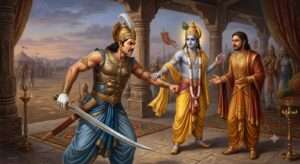
These piercing words struck Arjuna like poisoned arrows. Bound by a terrible vow never to tolerate anyone suggesting that he surrender the Gandiva to another, his heart blazed with consuming fury. In silence he laid his hand upon his sword, prepared to sever the head of the very king whom he had always revered as father, guide, and sovereign.
Sri Krishna, whose wisdom perceived the storm before it erupted, immediately discerned Arjuna’s intention. With calm authority he questioned him, “Why do you grasp your sword? None of our enemies stand before us. The Kauravas are far away. We came only to learn of the king’s welfare, and by the grace of destiny his life has been preserved. This is not the hour for wrath. Why then do you become the very embodiment of anger, as though a mortal enemy stood before you?” His words, though touched with gentle irony, sought to awaken Arjuna from the blindness of passion.
Yet Arjuna’s eyes remained crimson with rage. Turning to Madhava, he confessed, “Long ago I made a solemn vow within my heart that whoever advised me to surrender my Gandiva to another would lose his life by my hand. Those words, though lightly spoken, carry the punishment of death according to my oath. The king, though the very image of truth and righteousness, has uttered them. If I spare him, I violate my sacred pledge and incur the sin of falsehood. Tell me, O Murari, what should I do? You alone understand the ways of the world. Whatever counsel you give, I shall faithfully follow.”
Then Sri Krishna, the supreme teacher of Dharma, smiled with profound compassion and addressed Arjuna. “Your anger has mastered your wisdom. Without just cause you leap toward destruction. Such conduct reveals not strength but a failure to honour elders, well-wishers, and the subtle principles of righteousness. The scriptures declare that Dharma cannot always be measured by rigid words or impulsive vows. It must be understood through discernment, compassion, and the demands of circumstance. Those who truly know Dharma never rush into acts that destroy its very purpose.”
He continued with timeless instruction. “Learn to distinguish between the proper and the improper, between the letter of a vow and its spirit. The path of Dharma is exceedingly subtle. Truth is indeed sacred, yet it exists alongside non-violence as its inseparable companion. Truth must always be protected by non-violence whenever possible. At times, the wise even permit words that are not literally true if they preserve innocent life and uphold the greater purpose of righteousness. Such discernment belongs to those whose wisdom penetrates beyond appearances into the eternal heart of Dharma.”
While this profound dialogue unfolded within the Pandava camp, an unexpected current stirred elsewhere. In Hastinapura, the aged Dhritarashtra experienced a fleeting joy, believing that division had arisen among the sons of Pandu. To him, their discord appeared as the dawn of Kaurava victory. Yet Sanjaya, blessed with divine vision and deeper understanding, perceived the hidden design unfolding beneath these events. He recognised that Krishna was not merely calming Arjuna’s anger but reshaping his spirit, transforming wounded pride into disciplined resolve. What seemed a crisis was, in truth, the preparation of the greatest archer on earth for the decisive encounter that would forever alter the destiny of the Kurukshetra war.

