Lakshmanrao Upadhyayula
The venerable sage Śaunaka Gṛtsamāda, one of the illumined seers of the Ṛgveda, invokes the mighty Lord Indra in majestic Triṣṭubh metre, the rhythmic cadence most often employed for hymns of heroic power and spiritual exaltation. In the Vedic vision, a mantra is not merely poetry; it is a vibratory force perceived by the awakened consciousness of the ṛṣi. Through disciplined intuition, the seer beholds truths hidden in the subtle fabric of the cosmos and clothes them in sacred sound. Thus, the hymn to Indra becomes both invocation and revelation, a bridge between the human aspirant and the cosmic intelligence that sustains order, strength, and illumination.
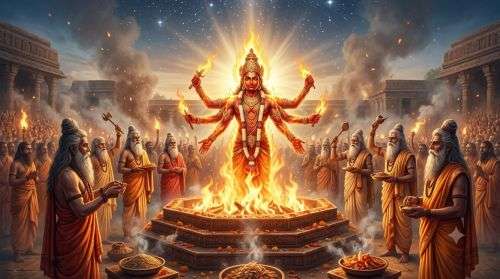
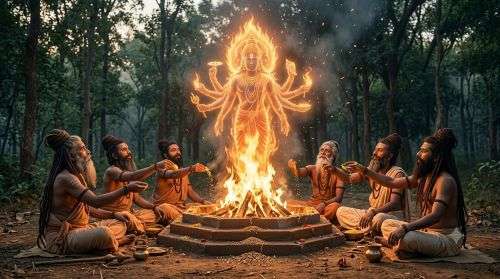
The sacred yajña commences at the appearance of Uṣas, the radiant Dawn, who in the Vedas is celebrated as the harbinger of awakening. Her arrival signifies not only the transition from night to day but the movement from ignorance to knowledge, from inertia to spiritual endeavour. As the eastern sky glows with crimson light, the altar becomes a microcosm of the universe. The sacrificial ground is sanctified by precise arrangement, and every object placed therein embodies a profound correspondence with cosmic principles.
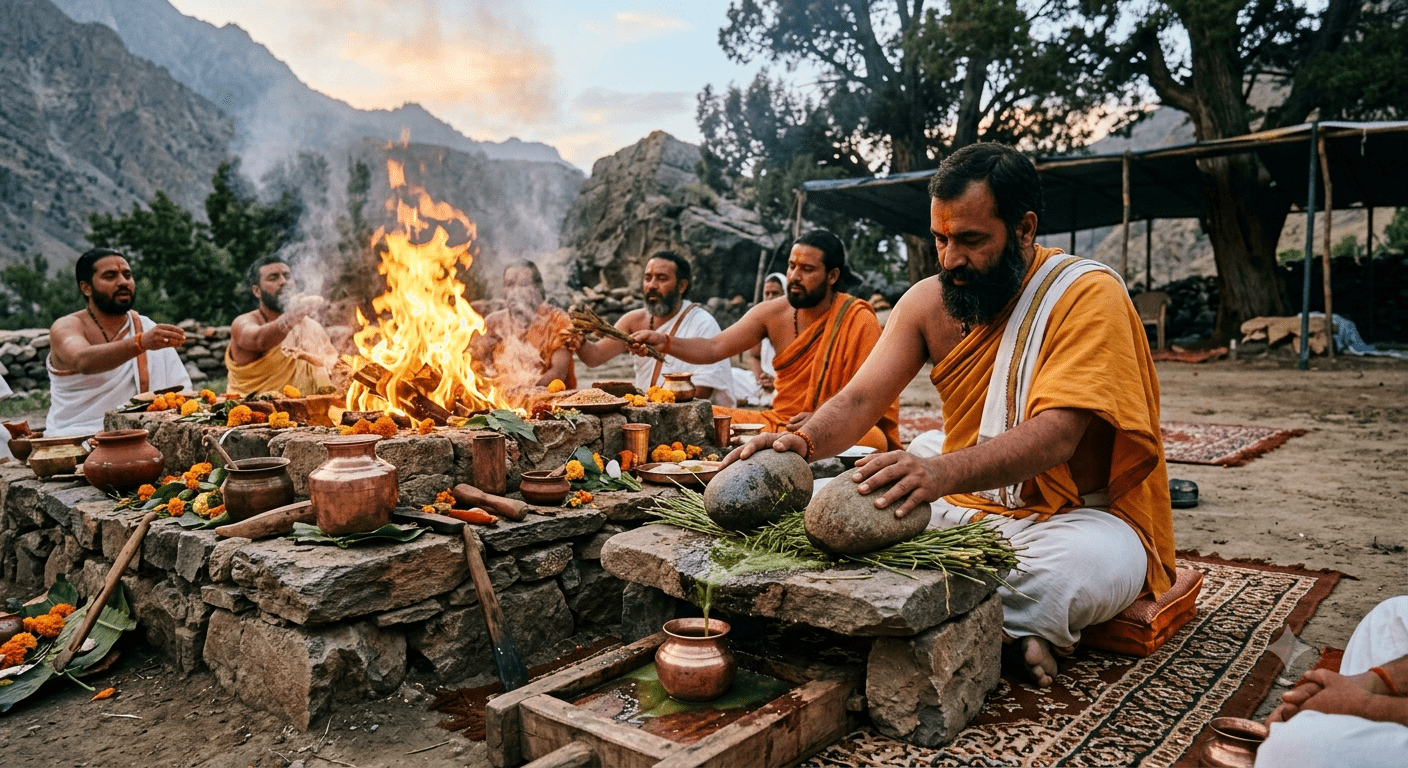
Within this holy enclosure stand four consecrated stones used for pressing the Soma. These four stones may be contemplated as symbols of the four Yugas, the four Vedas, or the four quarters of space. Their function is to release the hidden essence from the Soma plant, just as spiritual discipline extracts divine wisdom from the experience of life. Three kinds of sacred melodies resound through the ritual, corresponding to the three Vedic accents, the three worlds—Bhūḥ, Bhuvaḥ, and Svaḥ—and the three principal officiating priests. Seven metres, or chandas, govern the recitation, reflecting the seven rays of knowledge, the seven notes of music, the seven rivers of consciousness, and the seven luminous centres within the human frame. Ten vessels hold the Soma, representing the ten directions, the ten senses, and the complete extension of manifested existence.
This symbolic architecture reveals the scientific temperament of the Vedic sages. They perceived recurring numerical patterns in nature and encoded them in ritual. Four expresses stability and foundation; three indicates dynamic balance; seven signifies harmonious expansion; ten denotes completion and totality. The yajña is therefore a living model of the cosmos, designed to align human thought and action with universal law. In this sense, Vedic ritual is a science of consciousness, using sound, number, geometry, and disciplined intention to harmonise the individual with the greater order of creation.
At the heart of the rite, three Soma libations are offered to Indra. The first invokes his presence; the second strengthens his power within the sacrificer; the third consummates the union of divine force and human aspiration. Soma, the luminous nectar, is both a ritual offering and a symbol of spiritual ecstasy. It represents the distilled essence of purified awareness, which nourishes the gods and awakens higher faculties in the human being. To drink Soma is to partake of inspiration, courage, and expanded consciousness.
Priests of different Vedic traditions join in the sacrifice, reciting hymns from diverse streams of revelation. This convergence illustrates the inclusive nature of Vedic spirituality. Though the forms of recitation may vary, their purpose is one: to invoke the Divine through sound and intention. The yajña thus becomes a collective endeavour, uniting many voices in a single act of cosmic cooperation. Each deity invoked represents a distinct principle of universal intelligence, and all work together to sustain Ṛta, the sacred order.
Indra, the lord of luminous power and victorious consciousness, is invited to the sacrifice in his resplendent chariot drawn by the two tawny steeds named Hari. These horses symbolise dynamic energies—often interpreted as prāṇa and apāna, or the dual currents of life-force moving within the body. As the hymn progresses, the number of horses increases: two, four, six, eight, ten, and onward to twenty, thirty, fifty, and even one hundred. This numerical expansion signifies the progressive intensification of divine energy. The more concentrated the devotion, the greater the force with which Indra descends into the field of sacrifice.
The increasing numbers also reveal a psychological truth. Spiritual power does not manifest all at once; it unfolds in stages. As discipline deepens and consciousness broadens, latent energies are harnessed and directed toward a unified purpose. The chariot of Indra is the illumined mind, and the horses are the controlled faculties that draw the seeker toward insight and mastery. The ascent from two to one hundred symbolises the multiplication of strength when human aspiration aligns with divine will.
The sacrificers repeatedly implore Indra not to let the prepared Soma remain unused. This plea expresses a central Vedic principle: spiritual effort must culminate in divine response. The altar is prepared, the chants are offered, and the sacred vessels are filled; now the presence of the deity must complete the rite. In inner terms, this means that earnest practice must be crowned by revelation. Without the descent of grace, ritual remains form; with divine participation, it becomes transformation.
The sage declares that no other patrons can satisfy Indra as deeply as the devoted worshippers assembled at this yajña. This is not a boast of material abundance but an affirmation of sincerity. The gods respond not to outward display but to inward purity, disciplined action, and heartfelt praise. The true offering is the consecrated mind, the purified heart, and the aspiration that seeks truth above all else.
A profound intimacy is expressed when the sage prays that his friendship with Indra may never become barren. In the Vedic tradition, the relationship between deity and devotee is dynamic and reciprocal. The divine is not distant; it is a conscious ally who protects, strengthens, and guides the seeker. To preserve this friendship is to maintain an uninterrupted connection with higher wisdom and inner power.
The prayer continues with gratitude for Indra’s two hands. One bestows generous gifts, while the other wards off harm. Together they represent the dual action of divine grace: nourishment and protection. To grasp both hands of Indra is to accept the fullness of spiritual assistance—receiving abundance while being shielded from inner and outer obstacles. Empowered by this support, the devotee seeks victory in the battles of life, whether against external adversity or the internal enemies of fear, ignorance, and doubt.
The hymn culminates in a noble aspiration. The worshippers ask for blessings that are enduring and exclusive, not in the spirit of selfish possession, but as a prayer that the fruits of devotion may remain firmly established in their lineage. They envision themselves continuing these sacred chants with their children and grandchildren, transmitting the wisdom of the Veda across generations. In this continuity lies the true wealth of the Vedic household: not transient possessions, but a living inheritance of knowledge, discipline, and reverence.
Viewed in its deepest sense, this hymn presents the yajña as both cosmic event and inner process. The altar is the human heart; the Soma is refined awareness; the priests are disciplined faculties; the chants are vibrations of consciousness; and Indra is the awakened force that conquers darkness. When all these elements are harmonised, the sacrifice opens the path to heaven—not merely as a distant realm, but as a state of illumined being attained here and now.
Thus, Śaunaka Gṛtsamāda’s invocation to Indra stands as a magnificent synthesis of spirituality, symbolism, and proto-scientific insight. It reveals a civilization that understood sound as energy, number as sacred structure, and ritual as a method for aligning human life with cosmic intelligence. Through devotion, knowledge, and disciplined action, the Vedic seers discovered that the universe itself is a perpetual yajña, and that every sincere soul is invited to participate in its eternal offering.