



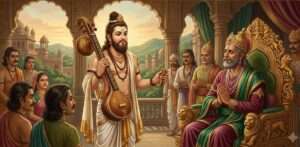
Narada, the divine sage of serene wisdom, thus addressed the grief-stricken King Srunjaya: “Why does thy heart sink beneath the weight of sorrow for the son who has departed? Has there ever been an age wherein life did not relinquish its mortal sheath? Shall the dead return because tears flow unceasingly? I speak not from cold reason, but from the warmth of friendship and reverence; therefore, compose thy mind, attend with steadiness, and receive these reflections which illumine truth.”
“There once lived the great sage Samvartha, who, estranged from Brihaspati through the stirrings of jealousy, descended upon the earth and undertook the sacred office of priest. At the foothills of the Himalayas he conducted a magnificent yajna, supported by Indra, Varuna, and hosts of sages. The sanctified grounds overflowed with clarified butter, milk, and honey, contained in golden vessels, while silken garments and abundant offerings adorned the rite. The patron of this sacrifice was King Maruth, whose glory extended beyond realms, yet even he, radiant in merit, could not escape the final decree of mortality.”
“Consider King Suhotra, who, by valour and unyielding courage, extended his dominion across vast lands. Through his rituals and charities, he endeared himself alike to celestial beings and earthly subjects. By divine grace his kingdom flourished with rich harvests, forests, mountains, and valleys yielding treasures unceasingly. Having performed the Ashvamedha and many grand rites to the satisfaction of all, he too met the inevitable end without resistance.”
“Reflect upon King Anga, whose generosity defies all measure—elephants adorned with gold and jewels, horses richly embellished, and innumerable cows with gilded horns and hooves were bestowed upon worthy scholars. Goats decorated with pearls, corals, and precious stones were gifted in abundance. His charity shone across heavenly realms, yet even such a sovereign, unequalled in devotion, was compelled to abandon his mortal frame.”
“The illustrious monarch Sibi, sovereign of vast territories, bore no enemy in the universe and never burdened his people with unjust levies. Pleased with his virtue, Lord Shiva granted him inexhaustible wealth. On the banks of the sacred Ganga, he performed countless yajnas, and though one might count the stars or the drops of rain, none could reckon the cows he donated. Yet the praises of all beings could not stay the hand of time, and he too departed from the world.”
“Recall Rama, son of Dasaratha, who in youth embraced penance and, in obedience to his father, entered exile. He bridged the ocean, vanquished Ravana and his hosts, and upheld righteousness upon the earth. Under his reign no child died prematurely, and his subjects were cherished as his own offspring. Having fulfilled all duties and performed sacred rites, even he relinquished his mortal form.”
“Bhagiratha brought the celestial Ganga to earth to redeem his ancestors and purify the world. His donations of gold, land, cattle, and countless riches satisfied sages and gods alike, yet he too ascended to higher realms, leaving behind the transient body. King Dilipa, companion of celestial beings, whose court resounded with music and art, ensured that none in his kingdom suffered hunger. Yet where now is that just ruler? He too has passed beyond mortal sight.”
“Mandhata, nourished by Indra himself in infancy, ascended the throne at a tender age and ruled the entire earth. His charities flowed like rivers, and his sacrifices earned the highest merit, yet he too departed. Yayati, ally of the gods in their battles against demons, established a noble order in society and performed many sacred rites, giving away all his wealth in charity. Despite his righteousness, he too relinquished life.”
“Ambarisha, whose valour subdued hostile kings, forgave those who sought refuge and matched his bravery with generosity; Sasibindu, blessed with countless worthy offspring and renowned for virtue; Gaya, whose penance and self-restraint illumined the path of dharma and sanctified the land that bears his name—all these, though exalted in merit and praised by gods and men, were bound by the same law of departure.”
“Rantideva, who fed multitudes without ceasing; Bharata, the valiant youth who tamed beasts and later ruled with righteousness; Prithu, who made the earth fertile and prosperous; and Parashurama, who cleansed the world of tyranny—all these illustrious souls performed deeds that resound through ages, yet none could retain their mortal forms.”
“Thus, O King, in every age and in every realm, even the greatest among men—renowned for courage, charity, and righteousness—have yielded to the inevitable. Thy son, noble and valiant, is not alone in this destiny. Why then dost thou grieve beyond measure? Let faith arise within thee; let devotion steady thy mind; let understanding dispel thy sorrow.”
Hearing these words, the veil of grief lifted from King Srunjaya, and wisdom dawned upon his heart. Peace replaced anguish, and he stood firm in the knowledge of life’s eternal law. Thus spoke the sage, and the tale, recounted to Dharmaraja by Vyasa, became a beacon of understanding, guiding the mind from sorrow to serenity.

