MS Shanker
Every Indian knows that Siachen is the world’s highest battlefield. Few realise that it has claimed more Indian soldiers through its unforgiving weather than through enemy fire. At temperatures plunging below -50°C and at altitudes where oxygen levels are nearly half of those at sea level, Siachen tests not just human endurance, but also the limits of technology.
An Indian soldier posted there routinely carries more than 60 kilograms of equipment while navigating treacherous terrain. Lightening that burden is not merely a matter of convenience—it is a matter of survival.
And three young engineers from Chennai decided that this was the problem they wanted to solve.
At a time when most engineering graduates dream of lucrative campus placements and corporate careers, Vignesh M, Vibhakar Senthil, and Karthikeyan B chose a different path. The three mechatronics engineers from SRM University walked away from placement offers and dedicated themselves to building technology for India’s armed forces.
Their journey began in their very first year at SRM University’s robotics programme, which challenged students to identify real-world problems and engineer practical solutions. They designed miniature surveillance robots, developed a single-seat solar-powered vehicle, and won several competitions along the way. More importantly, they discovered their shared passion—to build indigenous technologies that could serve the nation.
After three years of painstaking research, multiple field visits and extensive interactions with officers of the Indian Armed Forces and the Army Design Bureau, the trio founded Torus Robotics in Chennai in 2019. Investing their own savings and building everything from scratch, they embarked on a mission few would dare attempt.
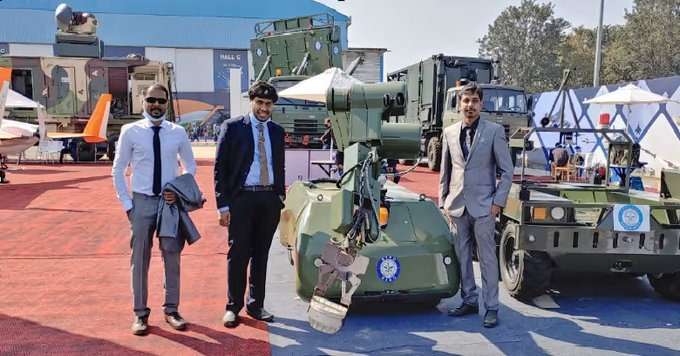
The result is the MARS UGV (Unmanned Ground Vehicle)—a fully electric indigenous robotic platform designed for some of the world’s harshest environments. Equipped with a six-degree-of-freedom robotic arm capable of detecting and disposing of explosive devices, it can be remotely operated from a distance of one kilometre.
But perhaps its most significant contribution lies elsewhere. Under a Memorandum of Understanding with BEML, Torus Robotics is now developing a logistics variant capable of carrying the equivalent payload of ten soldiers across high-altitude terrain—a development that could dramatically reduce the physical burden borne by our jawans in places like Siachen.
The innovation extends well beyond the vehicle itself. Torus has developed indigenous electric motors that are 50 per cent lighter, 15 per cent more efficient and 10 per cent more cost-effective than imported alternatives. At a time when India’s dependence on imported powertrain technologies—particularly from China—remains a strategic vulnerability in both defence and electric mobility sectors, such indigenous breakthroughs carry immense significance.
Recognition has naturally followed. Torus Robotics has delivered the MARS UGV to DRDO, received innovation grants from both the Government of India and the Government of Tamil Nadu, and has been recognised as a Pioneer Defence Innovator by iDEX, which cited it as the youngest defence startup to deliver an indigenous unmanned ground vehicle to Indian Defence. The company also won the Birla Global Innovation Challenge in 2020.
There is something profoundly inspiring about this story. No corporate legacy. No billion-dollar backing. Just three young engineers armed with knowledge, determination and a sense of purpose.
In an age when India’s technological ambitions are soaring—from space exploration to semiconductor manufacturing—the story of Torus Robotics reminds us that nation-building is also happening quietly in university laboratories and startup workshops across Bharat.
Some innovations make headlines. Others save lives.
At Siachen, an Indian jawan still shoulders nearly 60 kilograms through ice and snow. Somewhere in Chennai, three young engineers are working to ensure that burden becomes a little lighter.
That, perhaps, is engineering at its noblest.