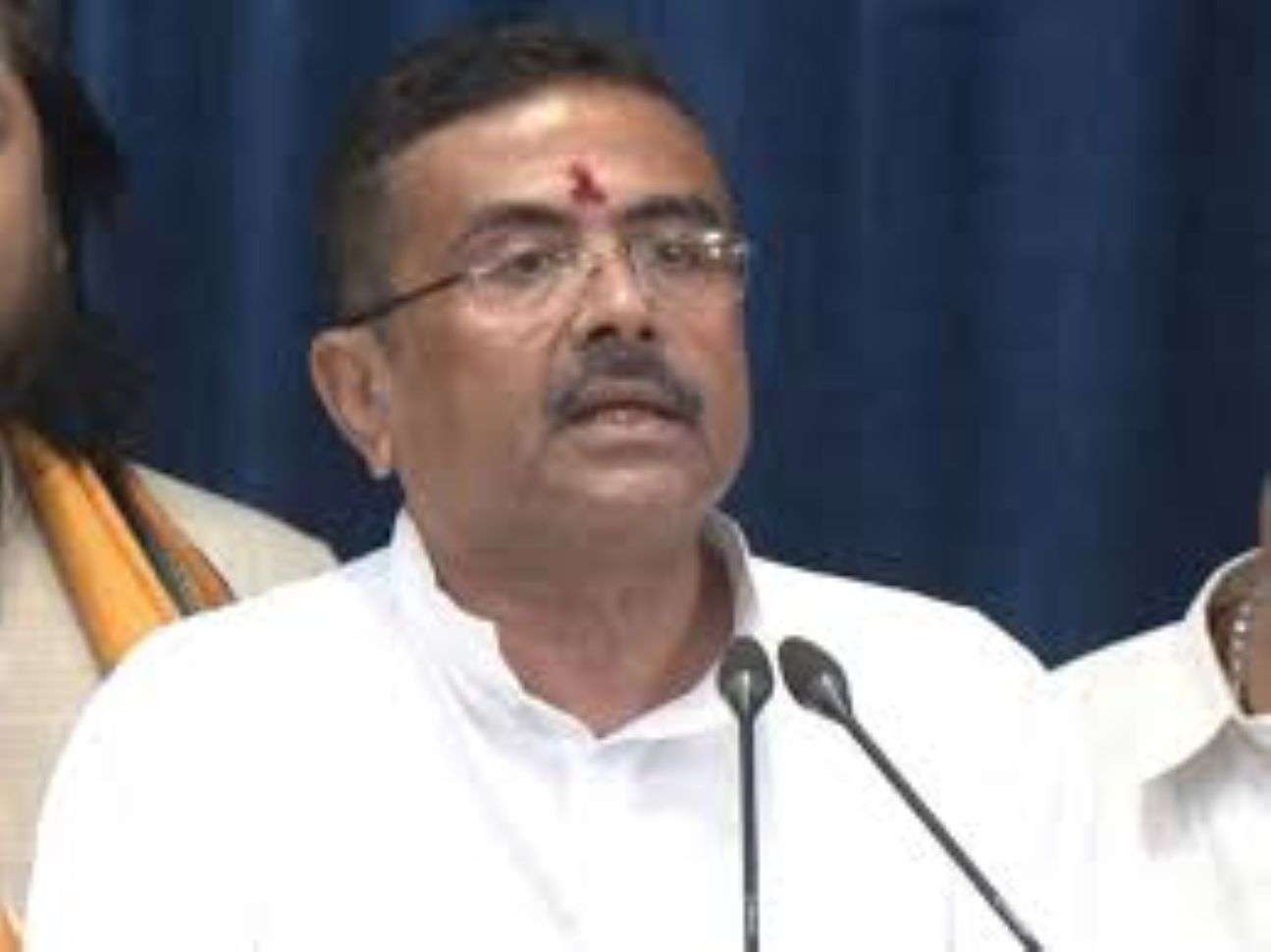
Kolkata: West Bengal Chief Minister Suvendu Adhikari on Sunday mounted a strong defence of the Election Commission amid the escalating political row over the Special Intensive Revision of electoral rolls, blaming former CM Mamata Banerjee for the deletion of 27 lakh names and asserting that neither the BJP nor the poll panel could be held responsible for the exclusions.
Addressing a press conference here, Adhikari also seized on Saturday’s meeting of Chief Election Commissioner Gyanesh Kumar and Election Commissioners Sukhbir Singh Sandhu and Vivek Joshi, saying the meeting and the subsequent statement issued by the poll panel made it clear that decisions relating to the SIR were not taken unilaterally by the CEC.
Showing a photograph of the CEC and the two election commissioners sitting together, as released by the poll panel a day ago, the BJP leader said the meeting of the three proved that the decisions were taken collectively.
The Election Commission said on Saturday that the June 24 order last year for the nationwide SIR, as well as subsequent schedules, had the unanimous approval of all three commissioners.
The clarification came amid a controversy triggered by a report in The Indian Express that Sandhu and Joshi had recorded objections on at least 14 occasions over 10 months to various decisions and orders.
“The responsibility for the deletion of 27 lakh names lies with Mamata Banerjee, not the BJP or the Election Commission. Judicial officers took the decision following the Supreme Court’s directions in a case filed by her,” Adhikari said at a press conference here.
Adhikari’s remarks came a day after Banerjee sharpened her attack on the chief election commissioner, alleging that the SIR was being used to help the BJP capture Bengal and demanding fresh elections with the pre-SIR voter list.
The TMC lost the West Bengal Assembly polls to the BJP in May this year, ending its uninterrupted 15-year rule in the state. The party subsequently attributed its electoral debacle, among other factors, to the SIR and a “biased Election Commission”.
The voter roll revision led to the deletion of lakhs of names and placed lakhs more under adjudication.
Seeking to blunt that offensive, Adhikari said, “The meeting of the three commissioners and the statement issued thereafter have made it clear that the SIR-related decisions were not taken by the CEC alone.”
He was referring to the meeting at Nirvachan Sadan in New Delhi on September 26.
The Election Commission on Saturday asserted that all SIR orders had received unanimous consent from all three commissioners and that changes to Form 6 for voter enrolment had been upheld by the Supreme Court, as the poll panel sought to address issues at the centre of a raging row over decision-making in the commission and concerns over exclusion of voters from the rolls.
After its first meeting following reports claiming differences between the CEC and the two election commissioners, the poll panel said in the statement that letters sent by Sandhu and Joshi to the Cabinet Secretary pertained to an officer on deputation, rather than policy or IT division matters.
The chief minister sought to exploit the contrast between the reported internal exchanges and the commission’s public show of unity, arguing that the latter undermined the opposition’s contention that the SIR was driven by the CEC alone.
The political stakes are high. More than 22 lakh of the 27.16 lakh electors deleted during the Bengal SIR have appealed for restoration, according to figures submitted by the EC to the Supreme Court.
On the controversy over the 27 lakh deletions, Adhikari said, “You (Mamata Banerjee) went to the Supreme Court. Acting on your petition, the court entrusted the matter to judges. So why is the EC being blamed now? She is responsible for this.”
The poll panel has said the adjudication process involved discrepancies identified in electoral rolls, while the judicial officers ultimately ordered the deletion of 27.16 lakh names.
The Supreme Court subsequently directed the setting up of appellate tribunals to hear challenges against the deletions.
Adhikari, however, framed the issue primarily as a political battle over the 2026 Assembly verdict.
“If SIR is good in Kerala, why is it bad in West Bengal? We have won 208 seats, while the two sides (TMC and its allies) have 80. Mamata Banerjee is unable to accept the people’s verdict,” he said.
Adhikari’s reference to Kerala was aimed at questioning Banerjee’s opposition to the exercise in West Bengal even as such voter roll revisions hav been undertaken in other parts of the country.
For the BJP, the electoral-roll dispute has become an opportunity to challenge the opposition’s allegations against the poll panel and defend the electoral process. The TMC, on the other hand, has made the issue a central part of its campaign against the SIR.
Adhikari said those questioning the Election Commission were attempting to create controversy around an exercise whose decisions, according to the poll panel, had the approval of all three commissioners.
The political battle over the SIR is thus unfolding on two parallel tracks — over the legal and procedural questions surrounding electoral-roll revision and over political responsibility for the consequences of the exercise.
With the poll panel facing continued scrutiny over its functioning and more than 22 lakh deleted electors having appealed against their exclusion, the SIR is set to remain a major issue in West Bengal’s post-election politics.