



The Opposition has every constitutional right to question the government, scrutinise institutions and protest against policies it disagrees with. But there is a line between legitimate opposition and repeatedly casting constitutional institutions in a political light without establishing the charge. The Election Commission of India cannot become the latest casualty of this politics.
With the INDIA bloc preparing to meet on September 30 to chalk out a joint campaign over the Special Intensive Revision (SIR) of electoral rolls, and the Congress already organising protests, Leader of Opposition Rahul Gandhi and his colleagues would do well to pause and examine the facts before turning the Election Commission into another political battlefield.
The latest clarification from the Election Commission is significant. Chief Election Commissioner Gyanesh Kumar and Election Commissioners Sukhbir Singh Sandhu and Vivek Joshi met on September 26 and the Commission stated categorically that the principal SIR orders had the approval of the full Commission. It also said the original SIR order was upheld by the Supreme Court.
That does not mean every operational question surrounding SIR is beyond scrutiny. It means scrutiny should be conducted through evidence, statutory procedures and Parliament—not through sweeping political narratives.
Why is a revision of electoral rolls being treated as though it were inherently suspicious? Electoral rolls are not sacred documents frozen for eternity. People die. People move. People become eligible to vote. People may have duplicate or outdated entries. And citizens who attain 18 must be brought into the electoral system. The Election Commission itself states that every Indian citizen who is 18 on the qualifying date and otherwise eligible can be registered as a voter. Its voter portal continues to provide mechanisms for new registration and corrections.
SIR therefore has a legitimate administrative purpose: ensuring that eligible citizens are included while ineligible or duplicate entries are identified and removed. The Government has also stated that the exercise includes safeguards such as enumeration, claims and objections, and verification, to ensure that no eligible elector is left out.
There is another reality that cannot simply be wished away. India faces continuing challenges relating to migration and the integrity of identity and electoral databases. Any allegation concerning illegal immigration—whether from Bangladesh, Myanmar or elsewhere—must be established through lawful verification, not political rhetoric. But equally, the possibility of ineligible persons entering electoral rolls is precisely why systematic verification of electoral rolls matters.
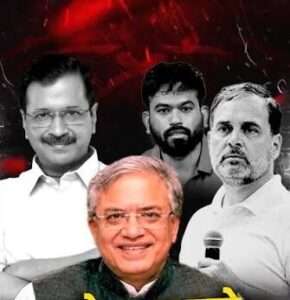
The Opposition should also distinguish between disagreement inside a constitutional institution and institutional collapse. Reports have described objections by two Election Commissioners on several issues. The Commission has not denied that differences or observations arose during deliberations. But it has now publicly asserted that the principal SIR decisions were unanimously approved.
That distinction matters.
So does India’s larger picture.
While political discourse is increasingly consumed by allegations of “vote theft” and institutional conspiracy, the economy is producing numbers that demand serious attention. Real GDP grew 7.8% in the first quarter of FY2026–27, while nominal GDP grew 10.3%. Finance Minister Nirmala Sitharaman has now said that India can achieve growth of more than 10%, provided technology, innovation and productivity are pushed further.
This is the India that political parties must engage with—a country competing for investment, technology, manufacturing, markets and global influence.
Rahul Gandhi, as Leader of Opposition, certainly has the right to question the Election Commission. But constitutional institutions deserve scrutiny based on evidence, not sustained political suspicion. If there is a specific irregularity, expose it. If an eligible voter has been wrongly excluded, pursue the statutory remedy. If an EC decision violates the law, challenge it in the appropriate forum.
But turning every institutional disagreement into proof of a grand conspiracy risks diminishing the very democratic institutions the Opposition claims to defend.
India’s voters are not passive spectators. They are watching the transformation around them—and they are perfectly capable of distinguishing between a genuine democratic concern and a political narrative that has not been established by evidence.
The Opposition should oppose. That is its constitutional role.
But it should also know when to stop.


The article rests on the stilts of govt propaganda.
Readers should not be blind to hard facts.