



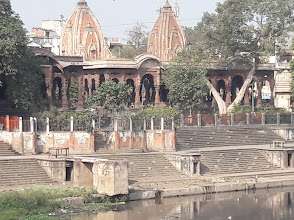
Shri Gurudev Datt Mandir is situated on the banks of the Kanh River near the historic Krishnapura Chhatris in the heart of Indore, Madhya Pradesh. Surrounded by the bustling city, the temple offers a serene spiritual atmosphere and has remained one of the most revered centres of Datta worship in central India for centuries.
The temple is believed to be around 700–800 years old, making it older than the city of Indore itself. Archaeological remains discovered in the surrounding area, including sculptures and architectural fragments dating to the 12th century, indicate that this locality was inhabited long before Indore developed into an important settlement. The present temple structure was reconstructed in 1896 during the reign of Shivajirao Holkar while preserving the sanctity of the ancient shrine.
The temple is dedicated to Lord Dattatreya, revered as the combined incarnation of Lord Brahma, Lord Vishnu and Lord Shiva, and worshipped as the eternal Guru who guides devotees towards knowledge, righteousness and liberation. The sanctum houses a beautiful three-faced black stone idol representing the Divine Trinity.
Devotees believe that worshipping Shri Gurudev Datta with faith helps remove obstacles, grants wisdom and inner peace, and relieves ancestral afflictions (Pitru Dosha). The temple complex also houses shrines dedicated to Lord Ganesha, Sant Dnyaneshwar Maharaj and the sacred Padukas of Sri Vasudevananda Saraswati (Tembe Swami). Adjacent to the temple stands the ancient Chhatreshwar Mahadev Temple, which enshrines three Shiva Lingas traditionally associated with Maharani Ahilyabai Holkar.
The temple is built on a raised platform and consists of a Sabha Mandapa (assembly hall), Antarala (vestibule) and Garbhagriha (sanctum), crowned by a 27-foot-high Shikhara.
The three-faced black stone idol of Lord Dattatreya is the temple’s spiritual focal point. Behind the deity stands Kamadhenu, symbolising Mother Earth and divine abundance, while four dogs seated before the Lord represent the four Vedas, signifying that divine knowledge exists in every direction.
Within the temple premises grows a sacred Audumbar (Cluster Fig) tree, regarded as highly auspicious in the Datta Sampradaya. Devotees perform pradakshina around the tree and offer prayers, believing it to be especially dear to Lord Dattatreya.
The temple has served as an important centre of Datta worship for several centuries and is closely associated with the spiritual heritage of Indore. The Holkar rulers held this shrine in great reverence, and local tradition states that Maharani Ahilyabai Holkar regularly visited the temple for darshan.
Originally constructed mainly of wood, the temple underwent extensive reconstruction in 1896 during the reign of Shivajirao Holkar. Subsequent renovations strengthened the structure while preserving its ancient sanctity.
The temple preserves the sacred Padukas of Sri Vasudevananda Saraswati (Tembe Swami), one of the greatest saints of the Datta Sampradaya. Tradition holds that he visited this shrine and inspired many devotees through his teachings. Local traditions also associate the temple with visits by Adi Shankaracharya, Guru Nanak Dev Ji and Samarth Ramdas Swami, although these associations are based on oral tradition rather than conclusive historical records.
The divine origin of Lord Dattatreya is described in the Brahma Purana, Markandeya Purana, and other sacred texts.
Sage Atri and his virtuous wife Anasuya were renowned throughout the three worlds for their unwavering devotion and extraordinary spiritual power. Their fame reached the heavens, where the divine consorts of Brahma, Vishnu and Shiva wished to test Anasuya’s chastity.
The Trimurti descended to their hermitage disguised as wandering ascetics and requested alms. However, they placed an unusual condition before Anasuya—they would accept food only if she served them without wearing any clothes.
Faced with this impossible dilemma, Anasuya closed her eyes and prayed wholeheartedly to her husband, Sage Atri. Through the power of her purity and devotion, she sprinkled sanctified water upon the three ascetics. Instantly, they were transformed into innocent infants. Seeing them as helpless children, she lovingly nursed and fed them, thereby fulfilling their request without compromising her virtue.
When the divine consorts realised what had happened, they prayed to Anasuya and sought forgiveness. Pleased with her unmatched purity and devotion, Brahma, Vishnu and Shiva revealed their true forms and blessed the divine couple that they would together incarnate as their son.
Thus was born Lord Dattatreya, embodying Brahma’s wisdom, Vishnu’s compassion and Shiva’s renunciation. Revered as the eternal Guru, Lord Dattatreya continues to guide seekers on the path of knowledge, devotion and liberation. The magnificent three-faced idol enshrined in this ancient temple beautifully symbolises this timeless divine truth.
Datta Jayanti is the temple’s grandest annual celebration and attracts thousands of devotees from across Madhya Pradesh and neighbouring states. The festival is marked by special abhishekas, Paduka Pujas, bhajans, spiritual discourses and grand processions.
Guru Purnima is celebrated with great devotion as devotees offer prayers to Lord Dattatreya and the sacred Padukas of Tembe Swami. Mahashivaratri is observed with elaborate worship at the adjoining Chhatreshwar Mahadev Temple. Every Thursday, considered especially sacred to Lord Dattatreya, the temple witnesses a large gathering of devotees who participate in special pujas and seek the blessings of Shri Gurudev Datta.


