This is an article series. Please read all previous articles before reading this article. The URLs for all previous articles are located in the SPECIAL THOUGHTS section.
Let’s continue to ponder over Shiva’s form and Shiva Parivaara from where we left off earlier.
Shiva is depicted as Shashidhara, Chandra Shekhara, and Chandra Mauli. We learnt earlier that Shashi (Moon) is one of the Abhimaani Devata-s for our mind. One of the specific traits of the mind is Manana. While I don’t clearly understand the word “Manana”, I’ve heard the wise ones use the word “contemplation” as an equivalent English word for the Sanskrit term “Manana”. Well… I don’t understand “Contemplate” either. When I search the internet for the meaning of the word “Contemplate”, the result shown reads “to think deeply and carefully about something for a prolonged period”. That didn’t help me either because that explanation too is very general. So, I had to go with what I did understand. I do understand the word “Template”. And the word “Contemplate” has the word “Template” in it. So, here is my take on the word Manana (Contemplation).
From our experience, we know that Soorya Rashmi (sunlight) is what reveals everything in full colour and clarity. Soorya (Sun) is very bright and very hot despite being very far away. So, philosophically speaking, Soorya is symbolic of Paramaatma and Soorya Rashmi is symbolic for the Veda-s because, per Shree Krishna’s very own declaration in Bhagavad Gita (Chapter 15, Verse 15), only Veda-s can reveal Paramaatma in full clarity. We’ve also understood how Chandra is symbolic for our Guru (our spiritual mentor) as Chandra reflects the light emitted by Soorya. A Jeevaatma that has not perceived Paramaatma is in the dark. It is like us being in darkness. My Guru reveals to me a little bit about Paramaatma and the Veda Vidya, which is like the Soorya Rashmi reflected by Chandra which is helpful to me in understanding the location of various objects around me in the darkness of night. Though I don’t see everything in full clarity, I understand somethings. As Shree Krishna says in Bhagavad Gita (Chapter 2, Verse 40) “swalpam apyasya dharmasya traayate mahato bhayaat” (knowing even a little bit about Dharma, which is one of the names for Paramaatma, will save us from the greatest of fears). Therefore, whatever little I understand is invaluable. Therefore, I use what I learn from my Guru (my spiritual preceptor) as a “template”. I evaluate all that I learn and all that I come across through that “template” or “Spiritual Lens”.
Coming back to the symbolism in Shiva’s form, the way I understand this is that Shiva himself represents the Amukta Jeevaatma, Gangaa is symbolic for Veda Vidya and Chandra is symbolic for Manana. In other words, Gangaadhara–Shashidhara indicates to me that an Amukta Jeevaatma has to rely on Veda Vidya as taught by a Guru and contemplate on it to find his/her way out of the seemingly eternal cycle of birth/death to Jeevan Mukti.
And, it is this Jeevan Mukti that is depicted through many aspects of Shiva, as below:
- Naaga Bhooshana – I’m told that, in Yoga Shaastra, Naaga symbolized the Kundalini energy or the serpentine power. For progeny, Kundalini energy must flow downward to the genitals. And for spiritual upliftment, the same Kundalini energy has to flow upwards. It has been depicted that Naaga is around Shiva’s neck. This, I’m told, is symbolic of the Kundalini energy reaching the Vishuddhi Chakra in the neck and flowing upwards from there, which is essential for Jeevan Mukti.
We’ve also learnt earlier how Naaga (serpent) is always crawling, which is basically a form of locomotion with the entire body touching the ground, and that this symbolizes Vinaya and Vinamrata (humility). Also, offering a garland to someone has always been a respectful gesture. For example, when a woman places a garland around a man’s neck, it symbolizes that the man has won the woman’s heart. Placing a garland over a dignitary’s neck is symbolic of that dignitary having won the respect of all those assembled through his accomplishments. Similarly, Naaga depicted as a garland around Shiva’s neck, symbolizes a Jeevaatma, that is seeking spiritual upliftment and is striving to contemplate on the Veda Vidya received through a Guru, becoming humble.
What I am understanding by looking at the Naaga in Shiva’s neck is actually something I don’t know how to put into words in English. Therefore, let me put it in Kannada so that at least those readers who know Kannada can understand. “ವಿದ್ಯಾ ದದಾತಿ ವಿನಯಂ” ಎಂಬ ಮಾತಿನಂತೆ, ವೇದ ವಿದ್ಯೆಯನ್ನು ಗುರು ಮುಖೇನ ಶ್ರದ್ಧಾ ಭಕ್ತಿಯಿಂದ ಅಧ್ಯಯನ ಮಾಡುವ ಸಾಧಕ ಜೀವನಿಗೆ ವಿನಯ, ವಿನಮ್ರತೆಗಳು ಒಲಿದು ಬರುತ್ತವೆ. A loose translation I can offer for the above is as follows: There is a statement in Sanskrit which means “Education is that which imparts humility”. Just as that Sanskrit statement goes, a Jeevaatma, who strives to contemplate on Veda Vidya with reverence… to him “humility” surrenders, adorns, gives itself as a gift. I’m sorry, I don’t know how to translate the Kannada words “olidu baruttave”
2) Shiva is depicted as Trinetra. The third eye is the Aajnyaa Chakra. It is very powerful. It grants the ability to see/experience far more than the external eyes can see and experience. I don’t know this from personal experience, but I’ve known a few people who, in my opinion, have their Aajnyaa Chakra. Among many traits that the third eye bestows on to a spiritual seeker, an important trait is Doora Shravana Darshana, which is perhaps what is referred to as Clairvoyance in English. I’ve known some Yogi-s who would be able to see what I am doing sitting halfway around the globe.
3) Shiva is depicted as Trishooladhara. Trishoola reminds me of Shree Krishna’s words “trigunya vishayaa veda, nistraigunyo bhavaarjuna” (Bhagavad Gita, Chapter 2, Verse 45). In this verse, the word “vishaya” refers to what our Indriya-s are able to experience from the external world, which is made of 3 Guna-s namely Satva, Raja and Tama. Moksha is a state beyond this universe and thus beyond the 3 Guna-s. Attaining Moksha by breaking free from these three Guna-s is what Trishoola reminds me of.
4) Shiva is depicted as having 4 arms. Any time we see a Devata depicted with 4 arms (be it Ganapati, Skanda, Shiva or any other Devata), it should remind us of the 4 Purushaartha-s. Each Aayudha in their 4 arms can be interpreted as one of the 4 Purushaartha-s. For example, let me offer my take on the 4 Aayudha-s in Shiva’s hands namely: Damaru, Khatvaanga, Harina and Trishoola. We’ve already looked at how Trishoola represents Moksha. Let’s look at the other Aayudha-s.
Shiva’s Damaru Naada reminds me of the verses in Bhagavad Gita, “tatha: shankhaa: cha bheryashcha panavaanaka gomukhaa:… sa shabda: tumulo~bhavat” (Chapter 1, Verse 13) and “sa ghosho dhaartaraashtraanaam hrudayaani vyadaarayat” (Chapter 1, Verse 19). It reminds me of the portrayal in Bhagavad Gita, where Bheeshma blew the conch, signalling the beginning of the Kurukshetra battle. Soon after, everyone started beating the drums and all the loud sounds of drums echoed from the earth to the sky causing tremendous noise. And that noise tore into the hearts of Dhrutaraashtra’s children, who were on the side of Adharma. That is the effect Damaru Naada should/will have on those people in the society who are evil and are on the side of Adharma. Thus, Shiva’s Damaru symbolizes Dharma.
The Harina in Shiva’s hand reminds me of the next Purushaartha, namely Artha, which basically refers to valuable and exchangeable resources useful in upholding Dharma. These resources are always Chanchala (not stagnant or permanent but constantly moving and difficult to get a grip on), just like how a Harina is very Chanchala. All resources are very attractive, like a Harina. Interestingly, Krishna Mruga is also one type of Harina and the skin of this Krishna Mruga is what a Gruhastha (a family man) ought to sit on while doing Pooja or undertaking any task to seek spiritual upliftment. In summary, all resources (including our body) belong to Paramaatma and are to be used judiciously to uphold Dharma and to seek spiritual upliftment and ultimately Moksha.
Khatvaanga is an Aayudha made of the human femur bone and the human skull. Among all the resources we have, the Manushya Shareea (human body, also referred to as Saadhana Shareera) is extremely rare to be bestowed with. Only when a Jeevaatma acquires this Saadhana Shareera can it realistically aspire to seek Moksha and not through any Praani Shareera (animal body). Interestingly, humans are one of the very few species that use only their 2 legs for locomotion. All other species use their 2 legs and their 2 hands too for locomotion. This means the 2 hands are free for doing Karma only in this Manushya Shareera, and that’s why it is referred to as Saadhana Shareera. And the femur bone of this Saadhana Shareera is what Khatvaanga is made of. Also, the femur bone comes from the legs, and the legs represent Shoodra Guna, which basically pertains to the trait of servitude. And the skull in Khatvaanga too is from this Saadhana Shareera, and it represents Braahmana Guna, which basically pertains to the trait of seeking resourceful knowledge. Thus, Khatvaanga is basically the coming together of Yathaartha Jnyaana (resourceful knowledge) and Sevaa Bhaava (servitude). But this Saadhana Shareera is also temporary. And the femur bone and skull are the remains of this Saadhana Shareera after it has been confined to flames. As we know, Agni purifies everything it touches and so does Yathaartha Jnyaana. Agni represents Yathaartha Jnyaana. Therefore, Khatvaanga represents a spiritual seeker who sought Yathaartha Jnyaana and was purified by it and also by his Sevaa Bhaava (servitude). This is a Satkaamanaa (good desire) that a spiritual seeker should have. Thus, Khatvaanga represents the Purushaartha of Kaama.
5) Shiva is sometimes depicted as Shweta Varna (fair or white coloured). White represents purity, which is what a spiritual seeker ought to seek through the subsidence of Raja and Tama Guna-s. Also, a spiritual seeker becomes pure when all his Paapa (sin) vanishes.
6) Shiva is sometimes depicted as Neela Varna (Violet coloured), and so is Paramaatma. In other words, Neela Varna too represents Moksha.
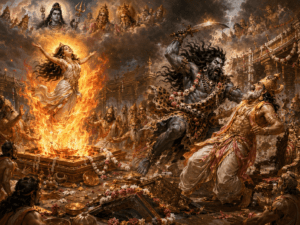
Next, it is also relevant to learn about the rift between Shiva and his father-in-law, Daksha Prajaapati. In short, the stories in Puraana-s convey to us that a Yajnya was being conducted by Mareechi (one of the 7 Rushi-s) and other Rushi-s. Both Daksha Prajaapati and Shiva had been invited to the Yajnya. Shiva had arrived before Daksha Prajaapati. When Daksha Prajaapati arrived, everyone assembled stood up in respect, except Shiva. This angered Daksha Prajaapati so much that, later on when he planned to perform a Yajnya, he deliberately did not invite Shiva. Sati, being the daughter of Daksha Prajaapati, wanted to attend the Yajnya that was being performed by her father. Shiva advised her against it. But Sati went anyway, against her consort Shiva’s advice. It turned out that Daksha not only ignored Sati, but also publicly insulted Shiva. As a result, Sati jumped into the Yajnyaagni and gave up her body. This completely enraged the all the Devata’s in Shiva Gana, and they destroyed the entire Yajnya. One of the Devata-s in Shiva Gana, namely Veerabhadra, killed Daksha Prajaapati. But how does it matter to me today if Shiva and Daksha had a rift? Of what use is it to me, as a spiritual seeker, to note this incident? If we take a philosophical perspective, we can learn several things from the above incident. We’ll delve into them next.
Daksha Prajaapati, as we learnt earlier, is Abhimaani Devata for our Jananendriya (genitals). And Shiva is Abhimaani Devata for Manas. The pleasure involved in the Jananendriya is something that can grind a spiritual seeker’s mind down completely. Among all the urges, the urge of the Jananendriya is the strongest. A spiritual seeker must acknowledge this and should learn to deal with it by taking small steps. A spiritual seeker should rather not attempt to completely suppress this urge to seek the pleasure involved in Jananendriya as it will surely backfire, and may even erupt in some extremely unpleasant ways. Philosophically, this is what has been portrayed as the rift between Shiva (Abhimaani for Manas) and Daksha Prajaapati (Abhimaani for Jananendriya).
From a familial perspective too, there are some lessons to be learnt from the above anecdote. Looking at the world around us, it is pretty evident that every Jeevaatma is different. They have a different history and a different path. Any 2 Jeevaatma-s coming together is for a short time. It takes adjustment and cooperation in order to coexist. Animals coexist only among their own kind/species, and that too only to a small extent. Any other animal of any other species is usually chased away or worse yet, they are killed and eaten (as in case of carnivorous animals and even humans). Coexistence is hard and requires more effort than we think. And this is especially true for humans and even more so in family life. In fact, in my opinion, coexistence is what establishes a Jeevaatma’s eligibility for Moksha.
Shiva Pooja is especially done with the intention of seeking marital bliss. It is always hard for a father-in-law to accept a son-in-law because he will have protected his daughter all his life very diligently from the preying eyes of oglers and ensured she stays chaste and doesn’t overstep her boundaries to have a physical relationship with anyone outside before marriage. But now, the daughter is to be married off and be allowed to have a physical relationship with some man the father-in-law doesn’t know too well. No matter how much effort he has put in to evaluate the man (like matching horoscopes, interviews, internet searches, private detectives, etc) a father-in-law will find it hard to accept the son-in-law. This is especially because, subconsciously, he knows that he has to allow his daughter to have a physical relationship with this man. And that is very hard for any father. So, a father-in-law will end up being any son-in-law’s nemesis and may even end up being a villain of his life. This may become noticeable in most marriages as the father-in-law loves his grandchildren but wants to avoid his son-in-law as much as he can.
This always puts the daughter in a very difficult position. She is bound by her respect for her father, and at the same time, she has to ensure to stay un-widowed. When her father resorts to insulting her husband in public, as a committed wife, she has to ensure that her husband’s reputation is not tarnished. This is symbolically shown in the above anecdote as Sati/Paarvati (who is the Abhimaani for our speech) in this case jumped into the Yajna Agni (who is the Abhimaani for the vocal organ). The message I’m taking from this is that all family members need to come together in resonance and a good frame of mind. And when that happens, their joint Yajnya will result in Loka Kalyaana. Insult-filled, vitriolic speech is detrimental to any Yajnya. As Shree Krishna says in Bhagavad Gita “yajnya shishtaamruta bhujo yaanti brahma sanaatanam, naayam lokosti ayajnyasya kuto anya: kuru sattama” (Chapter 4, Verse 31). Only those who partake in the remnant offerings of a Yajnya (greater good of the world) are bestowed with eternal bliss. Those who don’t take part in Yajnya won’t do well in this Loka itself, let alone past it.
This is what I understand from the above anecdote of the rift between Shiva and Daksha Prajaapati.
Thus, the various aspects of Shiva’s form and Shiva Parivaara are all symbolic for various thoughts that a seeker ought to keep in mind and embody in his/her spiritual pursuit. The various anecdotes are to be viewed philosophically rather than literally. Such a spiritual seeker’s mind will be focused on Paramaatma. Such a seeker will focus on upholding Dharma during his or her existence in this world, and in the process, he/she strives to embody those traits that establish his/her eligibility for Moksha.
There are still a few more things I like to elaborate on in the context of Upaasana of Shiva and debunk some of the misconceptions. We’ll get to them next time.
Daksha Yajnya, picture generated through AI by Karthik Dinesh.