



Brig (Retd.) G.B. Reddi
It is deeply disturbing to watch the political discourse in the country being reduced to sensational claims, sweeping allegations and arguments that appear to substitute suspicion for evidence. More disturbing is when such narratives are projected on national television as though they constitute facts.
The latest controversy surrounding the Special Intensive Revision (SIR) of electoral rolls is a case in point.
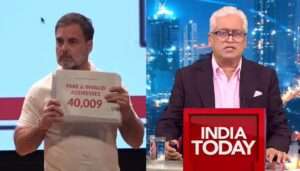
The allegation being propagated by Congress leader and Leader of Opposition Rahul Gandhi, with arguments echoed by journalist Rajdeep Sardesai, is that the Election Commission of India, after Gyanesh Kumar assumed office as Chief Election Commissioner, has somehow “deleted” more than 30 crore voters from the electoral rolls under the SIR exercise.
If such a claim is being made, the obvious question is: where is the evidence?
An electoral roll is not a permanent register of every person who has ever been a voter. It is a continuously updated statutory record. People die. People migrate. People change residences. Duplicate entries emerge. Names are corrected. New citizens attain the age of 18 and become eligible for enrolment. Some voters become ineligible for other reasons. Electoral rolls therefore have to be revised periodically if the integrity of the democratic process is to be protected.
The first factual point that appears to have been lost in the political noise is the distinction between deletion of names from an electoral roll and disappearance of citizens from the country.
Removing a name from a particular electoral roll does not mean that the individual has been stripped of citizenship. Nor does the revision of an electoral roll mean that 30 crore living Indian citizens have suddenly been deprived of their franchise.
The Election Commission’s own data provide a useful reality check.
The electorate for the 2004 Lok Sabha election was approximately 67.15 crore. By the 2024 Lok Sabha election, the registered electorate had risen to approximately 96.88 crore—an increase of nearly 30 crore over two decades.
That number itself should make responsible observers pause before accepting dramatic claims without examining the underlying data.
How can a country that allegedly had tens of crores of voters arbitrarily “deleted” also have an electorate that has grown by almost 30 crore since 2004?
The explanation is straightforward: electoral rolls are dynamic.
The population has changed enormously since the last nationwide SIR exercise. India’s population was around 105 crore in 2001 and is now estimated at roughly 145 crore. Millions of people have died during the intervening period. Millions have attained voting age. Millions have changed addresses. There have been enormous demographic movements within the country.
Therefore, comparing an old electoral roll with a contemporary roll without accounting for these demographic and administrative changes is neither meaningful nor intellectually honest.
The last nationwide SIR exercise took place in the early 2000s. Two decades is an exceptionally long period in the life of a country of India’s size.
A voter list prepared around 2002–04 cannot simply be treated as a sacred document whose every entry must remain untouched forever. If anything, the longer the interval between comprehensive revisions, the greater the possibility of obsolete, duplicate, deceased or otherwise ineligible entries accumulating.
This is precisely why electoral-roll revision is not an assault on democracy. A credible electoral roll is one of the foundations of democracy.
That does not mean every action of an election official should be accepted unquestioningly. Far from it. Any voter whose legitimate name is wrongly omitted must have an accessible mechanism to object, appeal and secure correction. Transparency in the revision process is essential. Political parties, civil society and citizens are entitled to scrutinise the methodology.
But there is a fundamental difference between questioning the implementation of SIR and declaring, without producing verifiable evidence, that tens of crores of genuine voters have been deliberately erased.
The latter is an extraordinary allegation and therefore requires extraordinary evidence.
If 30 crore legitimate voters have actually been deleted, the political parties making the allegation should produce the underlying voter-level evidence, constituency-wise figures, the number of objections filed, the number of claims accepted and rejected, and the final reconciliation between the previous and revised rolls.
That is how a serious democratic argument is made.
Television rhetoric is not evidence.
Nor should every deletion be automatically characterised as evidence of electoral manipulation. The Election Commission’s roll-management process necessarily involves identifying deaths, duplicate registrations, shifted electors and other discrepancies. At the same time, legitimate voters who have been wrongly removed must be protected. Both propositions can be true simultaneously.
There is another demographic fact that cannot be ignored.
The electorate has not merely expanded numerically; its composition has changed. The 2024 electoral roll crossed 96.88 crore electors, and the Election Commission reported significant increases in registrations among women and young voters. More than two crore electors in the 18–29 age group were added during the 2024 revision process.
That is the normal consequence of a living democracy.
Every election cycle brings millions of new voters into the system while millions of others cease to be eligible because of death or other changes in status.
The central issue, therefore, should not be whether names have been removed. The issue should be whether the right names have been removed and whether every eligible citizen has an effective opportunity to remain enrolled or to be enrolled.
That is a legitimate democratic question.
What is not legitimate is to begin with a politically convenient conclusion and then search for numbers to support it.
There is also a dangerous tendency in contemporary political discourse to convert every administrative exercise into a conspiracy. If the Election Commission undertakes revision, it is accused of manipulating the electorate. If it does not undertake revision, it can equally be accused of allowing bogus or obsolete entries to remain. Either way, an independent constitutional institution is placed under political pressure.
The Election Commission must certainly be accountable. But accountability cannot mean that every administrative decision becomes evidence of conspiracy merely because a political party disagrees with it.
Rahul Gandhi, as Leader of the Opposition, has every right—and indeed a constitutional responsibility—to question the Election Commission. But that responsibility should make the standard of evidence higher, not lower.
Likewise, journalists have every right to interrogate the Election Commission and expose shortcomings. That is an essential function of a free press. But journalism becomes considerably less useful when assertions are allowed to travel faster than verification.
The country deserves facts, not manufactured certainties.
If there is documentary evidence that 30 crore legitimate electors have been wrongly deleted, let that evidence be placed before the nation. If there are constituencies where unusual deletions have occurred, identify them. If legitimate voters have been excluded, help them seek restoration of their names. If the Commission’s procedures have shortcomings, expose them with data.
But if the number being repeatedly cited is a composite figure arising from comparisons of electoral rolls across different periods, then it must be presented honestly as such—not converted into a claim that 30 crore living voters have been deliberately erased.
India is too large, too diverse and too consequential a democracy to conduct electoral debates through insinuation.
The credibility of elections ultimately depends on three things: accurate rolls, transparent procedures and public confidence. Political parties, election authorities and the media all have responsibilities in protecting these three pillars.
SIR should therefore be subjected to rigorous scrutiny—not political hysteria.
Question the Election Commission where there is evidence. Demand transparency where procedures require it. Protect every eligible voter whose name has been wrongly omitted.
But let us not manufacture a democratic crisis out of demographic reality and administrative revision.
The nation deserves nothing less than the truth.


Foregt about politics. The entire exercise needs course correction. Any chance or cleaning process should be better than what it was. Only cleaning voters list is not sole worrk. The way election campaign is being carried out dates/phases are announced is also important. if it was partial then, its more partial now. Can anyone tell from when Bulldozer have part of election campaign machinery? There are many more reforms are need of hour more than for technical or other reason the voting rights are snatched. Redresell are cumbersome.
How voters who have submitted online form and got acknowledgement were removed. Can understand voters are missed if form are submitted offline. Now voters who were wrongly placed in Permanently shifted category are being made to submit Form 6 to apply for new voter ID card. How can a voter who existed and cast votes for so many years can be forced to apply new voter id. Why old people should be made to go around to apply for new voter for no fault of theirs.
Even such an exercise was carried out it’s wrong, present ruling party would have raised this issue for sure. Systemic failure calls for explanation. For you and voter id may not be a issue of citizenship, but for poor they have the fear of loosing the citizenship.
Don’t care for Rajdeep who is performing his job or Rahul who is not a Gandhi. Let’s be fair. Voters who have submitted online form and got acknowledgement should be brought back in voters list. By the way voters whose names were wrongly deleted from voter list have applied for new card, not inch it has moved to next level.
I have nothing against your views. We can’t be partisan unless we are a member of particular party.
Jai Hind