



Sañjaya said unto Dhṛtarāṣṭra: “O King, I went forth to the camp of your army and beheld a sight magnificent and terrible. Karṇa advanced upon his splendid chariot, adorned with lofty banners and resplendent with gems of many hues. Its ornaments gleamed with the lustre of polished ivory, while the steeds yoked to it were pure white, resembling celestial swans soaring through the heavens with the speed of the Sun’s own horses. His mighty bow, strung and prepared for battle, shone with dazzling brilliance. Embellished with liquid gold and radiant as the rising sun, it appeared as a divine weapon destined to decide the fate of kingdoms. Throughout every division of the army, joyous preparations for war were underway. Conches resounded with fearsome echoes, drums thundered across the field, and the faces of warriors blossomed with fresh beauty born of martial enthusiasm. Princes, kings, and commanders moved among the ranks, discussing the dynamics of war and the strategies by which victory might be secured.
Surrounded by his illustrious retinue, Karṇa set forth in regal splendour. Upon his command, the leaders of the divisions gave the signal to advance, and immediately the kings and princes began their march toward the battlefield. The thunder of countless hooves shook the earth, while clouds of fine dust rose into the sky and veiled the horizon. The combined music of innumerable instruments seemed capable of rending the very heavens. The twang of bowstrings, the lion-like roars of heroes, and the tumult of war-drums merged into a single dreadful symphony. The ornaments of the chariot warriors cast forth streams of multicoloured light, dimming even the brilliance of the sun’s rays.
Meanwhile, the Pāṇḍavas, whose hearts had been burdened by the fall of the grandsire Bhīṣma, learned that Karṇa had been appointed commander-in-chief of the Kaurava forces. Upon hearing this, their sorrow gave way to renewed determination. Gazing upon Karṇa with unwavering eyes, they watched as he infused fresh energy into his army and prepared for the first battle under his command. He arranged his forces in the formidable Makara-vyūha, the Crocodile Formation, difficult for any foe to penetrate. Karṇa himself, fully armed and radiant in armour, stood at its mouth. Śakuni and his son Ulūka occupied the two eyes. Aśvatthāmā guarded the head. On the front left flank stood Kṛtavarmā with the mighty Nārāyaṇa forces, while Kṛpācārya, accompanied by the Trigartas and the southern kings, secured the front right. The rear left was held by many monarchs and their contingents, while Suṣeṇa commanded the rear right with a complete fourfold army. At the tail stood Citrā and his brother Citrasena with a vast regiment. The remaining warriors were carefully stationed at crucial points throughout the formation.
Before this deployment was completed, Yudhiṣṭhira had already arrived upon the battlefield with his own splendid fourfold army, shining with confidence and resolve. Observing the enemy formation, he addressed Savyasācī Arjuna, saying, “Though the Kaurava army appears diminished when examined closely, the son of Rādhā has transformed it into a formidable force through his skill and determination. Standing at its mouth, he bears upon his shoulders the entire burden of this war. Desiring to display his prowess and intoxicated by his own strength, he roars before the world. For twelve long years we have wandered through an ocean of sorrow. Now answer him fittingly. Drown him beneath a tempest of arrows and cast him into an ocean of grief. O son of Indra, among all the Kaurava host, it is Karṇa alone who boasts ceaselessly of his might. Display your valour, slay him in battle, and Duryodhana’s hopes shall perish with him. Then victory shall stand steadfastly at your side.”
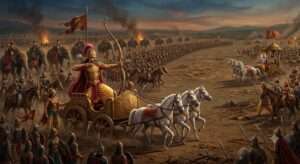
Hearing these words, Arjuna arranged the counter-formation known as the Ardha-Candra, the Half-Moon Formation. He stood at its centre like a blazing sun. Bhīma occupied the left extremity, while Dhṛṣṭadyumna held the right. Behind Yudhiṣṭhira stood Nakula and Sahadeva, vigilant and prepared. Yudhamanyu and Uttamaujā guarded Arjuna’s wheels. Every face in the Pāṇḍava ranks shone with fierce enthusiasm and unwavering courage. Duryodhana rejoiced, imagining that Kṛṣṇa, Arjuna, and the Pāṇḍavas would soon fall. Yudhiṣṭhira, however, remained firmly resolved upon Karṇa’s destruction. Thus both armies were filled with joy, each nourished by its own expectation of triumph.
The sounds of trumpets, tabors, kettle-drums, and cymbals reverberated in all directions. Conches blared repeatedly, inflaming the spirits of warriors on both sides. Then the armies surged forward and collided according to the strategies assigned by their commanders. The jingling bells of elephants mingled with their mighty trumpeting, producing strange and awe-inspiring sounds. Chariot wheels rolled with thunderous force, horses neighed fiercely, and their rhythmic hoofbeats echoed across the field. Warriors slapped their arms and tightened their bowstrings, while princes uttered leonine roars. The combined tumult seemed powerful enough to shatter the universe itself. Celestial beings, Siddhas, Gandharvas, and holy seers watched the conflict with wonder and curiosity.
As the armies clashed, the battlefield became dreadful to behold. Severed limbs lay scattered across the earth like serpents cast down by mighty eagles. The heads of youthful princes, adorned with shining ornaments, gleamed like reflections of the moon upon a dark lake. Jewels and ornaments fell from slain warriors like celestial beings descending from heaven after the exhaustion of their accumulated merit. Within the vast fourfold armies, elephant fought elephant, horse met horse, chariot engaged chariot, and foot soldier challenged foot soldier. All fought with unwavering determination to achieve victory, and multitudes fell on every side. The elephants collided like mountains crashing together, crushing unfortunate warriors who ventured too near. From both armies came every conceivable display of martial skill. Wrath and perseverance blazed among the combatants like consuming fire.
Sātyaki, Dhṛṣṭadyumna, Chekitāna, and the sons of Draupadī fought with extraordinary vigour. In fierce and enthusiastic combat they routed many divisions, including the Prabhadrakas, Cedis, Pāṇḍyas, Cholas, Magadhas, Vaṅgas, and numerous allied contingents. Everywhere the fury of battle increased, and the field became a theatre of astonishing heroism and destruction.
Then mighty Bhīma, proud of his immense strength, mounted a colossal war elephant and charged into the enemy ranks. The opposing forces trembled at this unexpected assault. The advancing elephant corps resembled a moving range of mountains. The beast ridden by Bhīma was fierce and uncontrollable in battle, and none could easily withstand its fury. Upon its back, the son of Vāyu shone like the rising sun upon the eastern peaks. At that moment, King Kṣemadhūrti of Kulūta beheld Bhīma and urged his own forces forward. Mounted upon a mighty elephant, he charged toward Bhīma like a mountain hurled against another mountain.
The two warriors engaged one another with small spears and other weapons. Their rogue elephants circled each other with terrifying movements and thunderous trumpeting, striking fear into those nearby while astonishing distant spectators. They next took up bows and unleashed showers of arrows. Their pride, strength, and skill were evident in every action. Again and again their bows were shattered, only to be replaced and drawn anew, to the amazement of all who watched. When they resorted to spears and heavy pestles, Kṣemadhūrti struck Bhīma in the chest with seven sharp lances, causing the king’s confidence to surge. Yet Bhīma, blazing like the rays of the sun, seized a mighty spear and hurled it against the ruler. The weapon was shattered in mid-air, and immediately a storm of arrows followed. Thus the combat continued with equal intensity, neither warrior yielding ground. Their contest grew increasingly fierce and difficult, and the outcome remained uncertain as I, O King, witnessed and now recount these events unto you.”

