New Delhi: India and Finland are looking to deepen business and technology partnerships in the circular economy as companies from both countries explored opportunities for resource-efficient and sustainable growth at a forum here.
The concluding day of the two-day India Circular Economy Forum (ICEF) 2026, which focused on Finland, on Friday brought together policymakers, businesses and circular economy experts to discuss opportunities arising from the evolving India-EU economic relationship, an official statement.
Held from August 20 to 21, the ICEF 2026 was a precursor to the World Circular Economy Forum (WCEF) 2026, which will be held for the first time in South Asia in Gandhinagar from September 15 to 18.
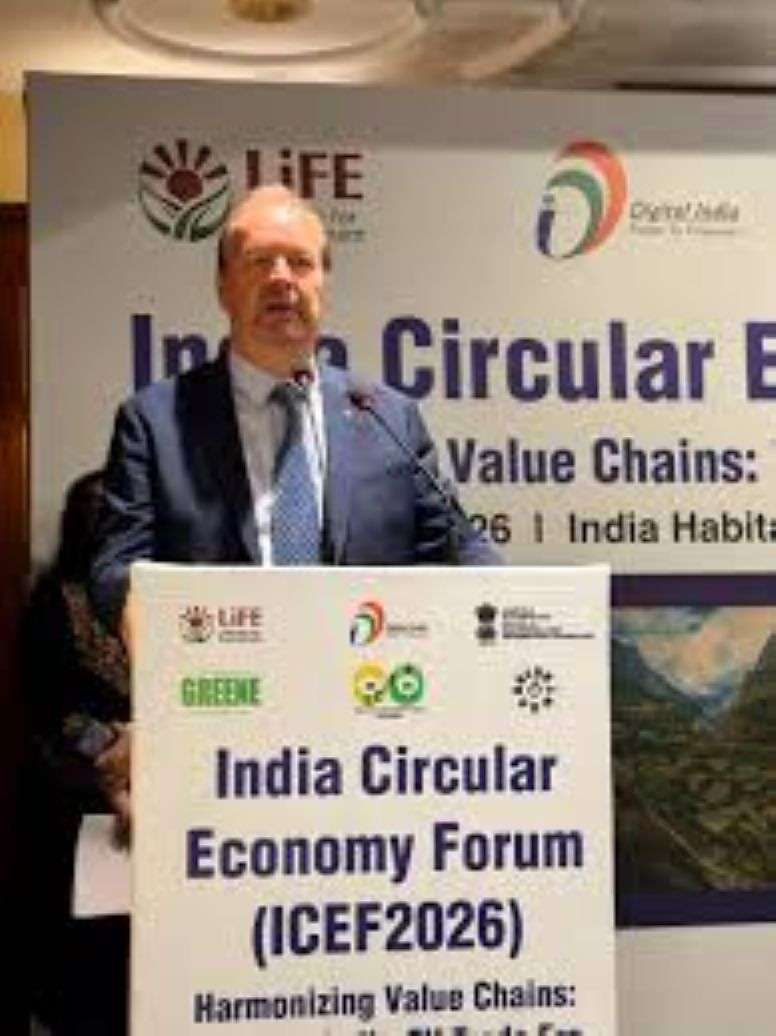
At the forum, which was a precursor to the World Circular Economy Forum (WCEF) 2026, Dr Antti Herlevi, Counselor for Trade and Investments (Water, Forest and Circular Economy), Embassy of Finland in New Delhi, said, “Circular economy is not just an environmental agenda; it is an economic and industrial one. Finland has a long history of developing circular solutions, and more than 100 Finnish companies are already active in India across sectors including clean energy, waste management, recycling, digital solutions and sustainable design. As the Indian market continues to grow rapidly, there is a significant opportunity for Finnish businesses to work alongside local partners in India across a range of fields, combining expertise and innovation to support resource-efficient and sustainable growth. In a world of rising material demand and increasing pressure on resources, our shared experience and technologies can help advance circular solutions that retain value, reduce resource use and contribute to a more sustainable future. ”
As India – EU economic engagement evolved, businesses increasingly needed to navigate changing environmental, sustainability and resource-efficiency expectations. Discussions at ICEF2026 highlighted how circularity, traceability, resource efficiency and responsible value chains could strengthen long-term competitiveness while opening new opportunities for innovation and international collaboration.
The forum provided actionable insights and strategies for businesses to meet their environmental compliance requirements and improve their ESG and circularity score while identifying potential growth opportunities. Indian and Finnish companies came together to explore collaboration, investment and technology partnerships, with a dedicated B2B session connecting Finnish expertise with Indian scale to advance circular solutions.
Major Finnish companies such as Peikko, Nokia, Normet, Mirasys, Lamor, etc., and Indian companies including Orbigreen Techsource Private Limited, LoopM Alternatives, Re:Gen Collective, Syaahi Uniforms participated in discussions centred on creating meaningful business opportunities, facilitating cross-border collaboration and connecting Indian enterprises with the global circular economy ecosystem.
For India, the transition to a circular economy represented not only an environmental imperative but also a significant economic opportunity. ICEF2026 provided a platform for industry, startups, academia, policymakers and international stakeholders to identify practical pathways for embedding circularity across business operations and supply chains.
Shalini Goyal Bhalla, Founder and Managing Director, International Council for Circular Economy (ICCE), said, “India is at an important point in its circular economy transition. Circularity can no longer remain limited to waste management; it must become an integral part of how we design products, build value chains, use resources, develop skills and create new business models. At ICCE, our focus has consistently been on bridging policy, industry, knowledge and implementation so that circular economy principles translate into measurable economic, environmental and social value. Platforms such as the India Circular Economy Forum are important because they bring these diverse stakeholders together and help move the conversation from intent to action. As India strengthens its manufacturing capabilities and global partnerships, embedding resource efficiency, innovation and circular design into our growth story will be critical to building a more competitive, resilient and sustainable economy.”
As India sought to strengthen its position in global value chains, discussions at the forum examined how circular economy principles could help businesses improve resource efficiency, manage regulatory and market risks, strengthen ESG performance and identify new growth opportunities.