



Religion is not merely a matter of worship or rituals in human life. It is deeply rooted in one’s faith, culture, morality, tradition, and outlook on life. For thousands of years, religious texts have imparted to society the message of moral values, duty, compassion, restraint, truth, and philanthropy. This is why millions of people read religious texts with reverence and draw inspiration from them in their lives. But faith cannot mean accepting everything written in a book without questioning it, without understanding its context, and without testing it with logic.
The most pressing question today is whether everything written in religious texts should be accepted as literal truth. If a statement bears the imprint of historical circumstances, if it reflects a particular social system, if its meaning has changed in today’s context, or if its interpretation promotes discrimination between humans, is it anti-religion to question it? Certainly not. Questioning is the first step to knowledge and the hallmark of a healthy society.
It is a grave mistake to consider religion and critical thinking as incompatible. Faith may be a personal belief, but when the interpretation of a religious idea begins to influence public life, law, education, social relations, or civil rights, public debate on that idea becomes natural and necessary. In a democracy, an idea cannot be exempt from criticism simply because it originates from a religious context.
An important distinction must be made here—criticism of religion and insulting a religious figure are two different things. Questioning a statement in a religious text, its interpretation, or its social impact should not be done with the intention of insulting the dignity of any religious person. Criticism should be directed at an idea, not at a person. Argument should be answered with logic, not emotional outrage.
In our society, we often see a tendency that when a question is raised about something in a religious text, the focus of the discussion shifts from answering the question to the questioner’s intentions. They are labeled anti-religion, anti-tradition, or anti-social. This shuts down dialogue and fosters fanaticism. If an answer to a question is available, it should be presented peacefully. If there are different interpretations of a statement, they should be discussed. And if something existed in a historical context, its context should be explained.
Reading religious texts out of context and context can also create problems. Society thousands of years ago was unlike today’s society. The social structure, governance system, education, science, family system, and economic conditions of that time were different. Therefore, to understand the meaning of an ancient statement, it is essential to understand its original context, language, symbols, and the social conditions of that time. A literal interpretation of the same statement in modern times can often lead to assumptions that are completely different from the original context.
Therefore, religious texts should be studied not only with devotion, but also with a view of knowledge, history, language, and philosophy. Devotion inspires humanity, while reason helps us understand the true meaning. A balance of both contributes to a more mature society.
The most sensitive issue arises when an interpretation of a religious statement attempts to justify gender inequality, caste discrimination, untouchability, violence, social exclusion, or hatred against a particular community. Modern democratic society is founded on equality, freedom, dignity, and justice. Therefore, any interpretation that diminishes human dignity is bound to raise questions.
The Constitution also plays a crucial role here. In a diverse country like India, different religions, sects, languages, and traditions coexist. Our social life is governed not by any single religious text, but by the civil rights and duties established by the Constitution. Every citizen has the right to their own religious beliefs, but they must also respect the freedom and equality of others.
Therefore, it is essential to strike a balance between religious freedom and critical thinking. No one should be prevented from expressing their faith, and no one should be allowed to violate the rights of others in the name of their faith.
Another challenge is the arbitrary interpretation of religious texts. Sometimes, the interpreters of religious texts have more influence than the original text itself. Different scholars interpret the same statement differently. Some consider it symbolic, some historical, some spiritual, and some literal. Therefore, to claim that only one interpretation is the ultimate truth is not intellectually sound.
The goal of religious education in society should not only be to teach people what to believe, but also to explain why. Asking questions will not diminish their faith; rather, it will likely deepen their understanding. A faith that fears questions can weaken; but a faith that can face questions becomes more mature and stronger.
Today, in the digital age, this topic has become even more important. In the name of religious texts, incomplete quotes, mistranslations, and statements taken out of context spread rapidly on social media. People often believe a viral post to be true without even consulting the original text. This leads to religious controversies and increased social tension. Therefore, before objecting to a statement, it is essential to verify whether it actually appears in the original text, its correct translation, and its accompanying context.
The critic also has a responsibility. If they are questioning a statement in a religious text, they should support their arguments with evidence, context, and logic. Deliberately misquoting, insulting followers of a religion, or inciting religious sentiments is not critical thinking. It is merely creating controversy.
Similarly, religious scholars have a responsibility not to mistake criticism for hostility. Society changes, language changes, and questions change. If an old interpretation poses a problem in today’s context, reconsidering it may not be a sign of a religion’s weakness, but rather a sign of its vitality.
Religious traditions have a long tradition of introspection. Saints, philosophers, and reformers have periodically questioned dogmas. They have attempted to convince society that the fundamental purpose of religion is to unite, cultivate morality, and cultivate compassion, not to separate human beings from each other.
In this context, we must adopt a broad principle—we should not hesitate to accept what strengthens humanity, compassion, truth, justice, and equality; and we should not be afraid to question what appears to be contrary to these values.
This approach should not be limited to any one religion. If we consider it a freedom to question the writings of one religious tradition, then the same freedom should apply to other religious traditions. Selective criticism is not impartiality. True intellectual freedom means that all ideas should be judged equally by logic.
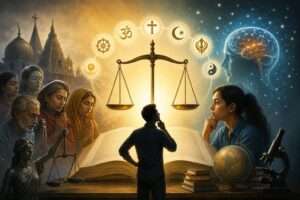
It must also be understood that religious texts are not merely historical documents. They are connected to the sentiments of millions of people. Therefore, restraint in language is essential when discussing them. Tough questions can be asked, but without using derogatory language. Disagreement with an idea can be expressed, but without demeaning its adherents. This is the hallmark of civilized discourse.
Today, India is in particular need of such dialogue. On one hand, religious faith is the foundation of life for a large segment of society, while on the other, scientific thinking, constitutional values, and modern education are expanding. Instead of pitting these two against each other, we must build bridges of dialogue.
If religious literature is studied in schools and universities, it can be explained not only from the perspective of faith, but also through history, sociology, philosophy, literature, and comparative studies. This will help students understand different traditions and develop both tolerance and discernment. Understanding religious diversity does not mean accepting any particular religion; it is a means to understand society.
Ultimately, the question is not whether everything in religious texts is true or false. Such generalizations lead to both extremes. The real need is to understand each statement in its context, purpose, language, and social impact. Draw inspiration from what reinforces timeless moral values; understand what is symbolic as symbolic; and engage in logical and peaceful debate on interpretations that conflict with modern human dignity.
Faith must be respected, but conscience cannot be silenced in the name of faith. Asking questions is not disrespect. Disagreement is not rebellion. Criticism is not hostility. And reconsidering an idea is not a betrayal of one’s culture.
If religion makes a person a better human being, then it need not fear questions. True faith is not weakened by rational discourse, but rather grows more mature. Therefore, the need today is not to put any religion on trial, but to test every idea against the touchstone of reason, humanity, the Constitution, and truth.
After all, books are for humans, not humans for books. The purpose of words is to improve life. If the interpretation of a word breeds hatred, discrimination, or injustice among humans, then society has not only the right but also the responsibility to question that interpretation.
There should be faith, there should be devotion, but conscience should also remain alive – because a society that runs away from questions can save tradition, but not progress.

