

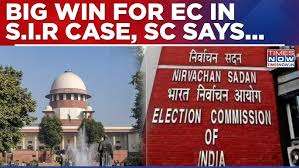
In a significant and timely verdict, the Supreme Court has reaffirmed a simple but powerful constitutional truth: free and fair elections are impossible without clean and credible electoral rolls. Upholding the Election Commission of India’s (ECI) authority to conduct a Special Intensive Revision (SIR) of electoral rolls, the apex court has not merely defended an administrative exercise — it has defended the very foundation of Indian democracy. The two-judge bench headed by Chief Justice of India Justice Surya Kant rightly observed that the ECI was acting well within its constitutional mandate under Articles 324 and 326 of the Constitution. Article 324 vests the superintendence, direction, and control of elections in the Election Commission, while Article 326 provides for elections based on adult suffrage. Together, they form the backbone of India’s electoral democracy. The Court’s observation that the SIR “advances the constitutional imperative of free and fair elections” is both legally sound and morally unassailable. At a time when concerns over illegal migration, duplicate voters, deceased persons continuing on electoral rolls, and fake identities have become serious national issues, any responsible constitutional authority would be duty-bound to cleanse and update voter databases periodically. Yet, what should have been welcomed as a corrective democratic exercise was converted into a political drama by a frustrated and repeatedly discredited Opposition that increasingly appears incapable of winning people’s mandate through genuine political credibility. Instead of introspection, many Opposition parties have chosen the easier route — attacking constitutional institutions whenever electoral outcomes do not suit their political interests. The irony is glaring. The very parties that once lectured the nation about institutional autonomy are today the first to cast aspersions on the Election Commission, judiciary, investigative agencies, and even the armed forces whenever political convenience demands. Their objection to electoral roll revision exposes a deeper anxiety: fear of losing carefully cultivated “vote banks,” including allegations surrounding illegal migrants or unverifiable identities finding place in voter lists.
Can any mature democracy function with bloated or questionable electoral rolls? Should names of deceased persons remain indefinitely? Should duplicate or fraudulent entries be ignored merely because questioning them may discomfort certain political parties? Most importantly, should newly eligible 18-year-old citizens not be encouraged to enrol so that democracy remains representative and current? The answer is obvious. The ECI’s stand that Aadhaar or even voter identity cards alone cannot conclusively establish citizenship is legally valid. Citizenship verification and electoral integrity cannot be reduced to paperwork convenience. The petitioners’ attempt to paint the exercise as an “NRC-like process” was clearly an effort to generate fear rather than uphold constitutional morality. Equally disturbing is the growing ecosystem of professional litigants, publicity-seeking activists, and what many now describe as “brokers within the judiciary ecosystem,” who rush to file sensational Public Interest Litigations primarily to remain in the headlines. PILs were conceived as instruments of justice for the voiceless and oppressed — not as political weapons or livelihood tools for habitual petitioners and agenda-driven intermediaries. This dangerous culture of casually dragging every constitutional authority to court for political mileage risks weakening public trust in democratic institutions. Today it is the Election Commission. Tomorrow it could be the judiciary itself. Institutions survive not merely on constitutional powers, but on public confidence. Criticism of institutions is legitimate in a democracy. But systematic attempts to delegitimise every institution that does not align with Opposition politics are deeply irresponsible. India’s democracy is far too robust to be held hostage by perpetual conspiracy theories. The Supreme Court’s verdict therefore deserves to be welcomed not merely as a legal endorsement of the Election Commission’s powers, but as a strong reminder that constitutional institutions cannot be bullied into paralysis by political insecurity. Democracy does not weaken when voter lists are cleaned. Democracy weakens when political actors fear transparency more than they fear losing public trust.