



Global silver has been in a structural deficit for six consecutive years. In 2025 global mine production reached 846.6 million ounces. Even after considerable recycling prompted by high prices and other secondary supply sources, total available metal fell short of demand, which the Silver Institute estimated at 1,130.6 million ounces. The result was a reported market deficit of 40.3 million ounces. The Institute projects the deficit will widen to 46.3 million ounces in 2026.
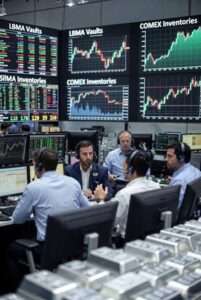
This supply imbalance showed up most clearly on exchange inventories. Stocks on COMEX and the London bullion market have seen sustained drawdowns, with registered balances reaching multi-decade lows at various points. Physical metal left vaults faster than it could be replenished, driven by robust industrial offtake from electronics, solar, electric vehicles and the infrastructure supporting artificial intelligence.
In mid-May 2026, the steady depletion abruptly slowed. Exchange inventory drawdowns paused or sharply decelerated at almost the same time that India implemented a significant policy change.
India’s sudden import restrictions
India is one of the largest consumers of silver, both for jewelry and for physical investment, and it is historically a large net importer. In May 2026 the government raised import duties on silver and gold from 6 percent to 15 percent. It also moved high-purity silver bars and most semi-manufactured forms from the free category into a restricted category that requires prior authorization from the Directorate General of Foreign Trade.
The effect was immediate. Official silver imports in May 2026 collapsed, falling roughly 87 percent in value and 94 percent in volume to about 33 metric tons, the lowest monthly level in more than three years. A steady channel that had absorbed a meaningful portion of global supply effectively dried up overnight.
Because India accounts for a meaningful share of global physical silver demand, this abrupt contraction in imports reduced the amount of metal flowing out of global refining and vault systems. The timing coincides closely with the stabilization observed in COMEX and other exchange inventories. In effect, the policy shock from New Delhi appears to have acted as an unintended circuit breaker on the global physical drain.
Domestic political and commercial pressure
The restrictions did not occur in a political vacuum. India’s jewellery sector, a significant employer and a major downstream user of silver, has warned of liquidity stress, job losses and the risk of a growing grey market. Industry bodies such as the Gem and Jewellery Council have argued that the policy threatens legitimate trade and harms small businesses and artisans.
Opposition voices have also criticised the move on economic and social grounds. Lobbying for relief or more targeted measures is already building and is likely to intensify ahead of the Union Budget in July 2026. When Indian governments face clear economic or political costs from trade restrictions they have historically shown a willingness to adjust policy. The current measures are new, but the domestic feedback loop is operating.
Short term price implications if restrictions remain
With India’s official import channel constrained, visible global physical demand has eased and exchange inventory declines have moderated. That has helped stabilise prices in the very short term. However the structural deficit has not changed. Industrial demand, particularly from China’s solar and electronics sectors, remains strong.
If the restrictions remain in force over the next three to six months, silver prices are likely to find support or grind higher. Limited mine supply continues to restrict new physical metal entering the market. At the same time, the policy has suppressed visible demand in India and allowed pent up purchasing power to build. The market is therefore more fragile than headline deficit figures alone would suggest. Any renewed registered stock drawdowns or meaningful spikes in lease rates would indicate that underlying tightness is returning and would likely accelerate upward price pressure.
The scale of deferred Indian demand is the main wildcard. Official imports have collapsed, but cultural and investment demand has not disappeared; it has been deferred or redirected through non official channels. That creates a reservoir of backlogged buying power.
Timing and likely conditions for easing
The restrictions are still recent. A meaningful relaxation is unlikely immediately unless economic or political costs escalate markedly. The most probable window for easing is around the Union Budget in July 2026, when duties and trade policy are commonly reviewed. A more stable exchange rate, rebuilt reserves and intensified industry lobbying would provide the conventional rationale for policy adjustment.
Market reaction when restrictions lift
When India relaxes or removes the restrictions, the release could be swift. Pent up demand accumulated during months of constrained imports would likely reassert itself. A conservative estimate of built up demand is between 150 million and 250 million ounces over a four- to eight-month restriction period, based on India’s historical import run rates and the gap between official flows and underlying consumption. Not all of that demand would hit the market at once, but even a partial resurgence would constitute a substantial increase in global physical offtake.
In that scenario, silver prices would probably experience a pronounced upside move. The structural deficit would reemerge quickly and any remaining exchange inventories could face renewed pressure. The recent pause in COMEX outflows could reverse into accelerated drawdowns once Indian buying resumes at scale.
Key risks and variables
Policy timing: an earlier relaxation would front-load the demand surge, while a later relaxation would allow more pressure to accumulate.
Global industrial demand: sustained strength from China would magnify any Indian rebound.
Price elasticity: persistent very high prices could permanently dampen some jewellery demand in India even after restrictions are eased.
Unofficial flows: some consumption is already being satisfied outside official channels, which could dampen the magnitude of any rebound.
India’s May 2026 import measures created a near-term reprieve for exchange inventories by sharply reducing a major channel of global physical demand. That policy shock paused what had been an almost continuous drain on COMEX and other markets, but it did not eliminate the underlying structural deficit. The market now carries a latent risk: deferred Indian demand that could return rapidly once policy conditions change. For investors and market participants, the immediate focus should be on Indian policy signals, the state of domestic buying, and indicators of renewed physical tightness such as registered stock drawdowns and lease rates.


Insightful read