This is an article series. Please read all previous articles before reading this article. The URLs for all previous articles are located in the SPECIAL THOUGHTS section.
Before we go on to the Devata-s in Level 5, I’d like to share an incident that happened last Sunday. As you may know, I had mentioned about Tulasi and Saalagraama in my previous article. I had also mentioned that Tulasi had Jaambavati Sannidhaana in it and that Jaambavati, and the Six Mahishi-s, are not Abhimaani-s for anything. That is about all I had heard about the Six Mahishi-s. I even mentioned specifically that, I’ve heard very little about the Devata-s in level 6 so far. Whatever information I had shared about Tulasi, about the Six Mahishi-s, about Vairaagya was all my belief. I have not had a chance to have any scholar evaluate my understanding. I do remember having asked my Guru as to why we wear the Tulasi Maalaa. He didn’t tell me and I’ve known my Guru to not always explain everything but let people figure out instead. So, this may be one of the things he let me figure out for myself. So, what if I was completely wrong about my belief on Tulasi? It would really help to get some indication that someone like me can observe, interpret and confirm my belief. Fortunately, such an indication did come by.
We’ve lived in this town, called Rochester, for over 30 years. It is located upstate on the Appalachian Mountains, in the State of New York. We have the dubious distinction of being the 3rd highest grosser of annual snowfall in the whole of continental USA. The weather is pretty cold for at least 6 months in a year. And therefore, Tulasi plant usually does not survive the winter. Nor do we see anyone sell Tulasi plants around here. So, if we have Saalagraama-s, we usually make do with Tulasi powder.
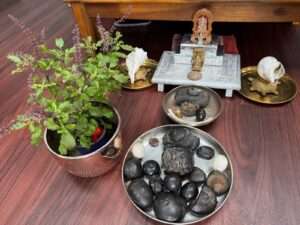
We have plenty friends from Bharat who’ve lived here for decades. My wife decides to visit one of her friends and on her way back she suddenly decides to visit this garden store, which we’ve NEVER visited in the 30 years that we’ve lived here. Guess what she finds there? A very nicely grown Tulasi plant. She purchased and brought it home last Sunday, the day my article on Tulasi was published. I thought that was a great indication in evaluation of my personal belief. I’ll let you evaluate the above.
My reason for sharing this incident is because, we all like to see “Miracles”. Miracles seem to capture the minds of innocent humans, especially in matters pertaining to faith and spirituality. But what we learn from those “Miracles”, and the conclusions we draw from them, is where most humans go wrong. Most common outcome of a certain “Miracle”, in my observation, is that the ones who witnessed the “Miracle” usually do NOT give credit where it is actually due. But instead, they end up giving credit to someone or something else. This is best explained with an example. We all need water for our survival. There are mainly 3 ways to get water for our daily use.
Firstly, in urban and suburban homes today, we have taps installed in our kitchens and bathrooms. The taps don’t produce water. They merely let water flow through them. And for the water to flow through the tap, it needs to be plumbed into the water supply main in the house or the apartment complex, which needs to be connected to the water main in your area/suburb. The water main, in turn, should be connected with the water tank and the tank should be receiving regular water supply from an inexhaustible source of water, like a river or lake. There is usually a government board managing the water supply, evaluating the water quality, handling the repairs and maintenance and so on. So, when you draw water from the tap, you actually know the source of water and have some assurance about its quality.
Secondly, in rural areas, people may draw water from lakes or wells. While the water source may still be considered inexhaustible, there’s almost no management, nobody to attend to repairs, and no assurance about water quality.
Thirdly, and perhaps the worst option, is what we see today all over the world, i.e., bottled drinks. We have no idea about the source of the water, or its quality… but it is DEFINITELY advertised to be THE ABSOLUTE BEST water available, and that you must prefer this drink over anything else. Many times it is even endorsed by celebrities. And the advertisements usually do a VERY good job to impress upon you that the water from the tap and/or the wells is filled with extreme levels of impurities and therefore, REALLY BAD for you.
Philosophically speaking…
The tap that fetches us water from an inexhaustible source through a water supply system is like our Guru Parampara, which draws us the correct knowledge of the eternal Vedic way of life. The tap is like my Guru. He/she will be connected with his Guru (my Parama Guru), who is connected with his guru (my Parameshti Guru), and thus going back to our Aadi Guru who connects us to the omniscient Paramaatma. The knowledge drawn is highly reliable, quality assured, time-tested, and therefore resourceful & useful in spiritual upliftment.
The well water is more like folklore. Though time-tested, its not very well explained, may have become defective while passing from person to person over successive generations due to a lack of clarity in understanding the basics. It is good enough for survival and safety.
But the bottled drinks are like going to the various Pir-s, Fakir-s, Saints, “Baba Ji-s,” etc. We don’t know the source of knowledge, the connection to Paramaatma is almost always questionable, and no assurance of the knowledge being correct. In fact, based on my observation, the knowledge being served to the “consumers” (don’t even like calling them devotees) is almost always incorrect. But they are EXTREMELY Popular, VERY Well Advertised, and sometimes internationally popular. Most of the time, the “Baba Ji” won’t be able to answer even simple questions. One such “Baba Ji” was asked in an interview, “Where is the soul?”. That “Baba Ji” was clueless. But these “Baba Ji-s” are immensely popular, and some even show “Magic”. Common people usually fall for popularity and/or Magic. They fail to realize that what is True is seldom popular and what is popular is seldom True. Common people never muster up the courage to ask the “Baba Ji” any questions because Baba Ji’s strategy to impress upon the common people is to ridicule the questioner in public. Reels are made and posted on social media. Sometimes, even simple and genuine questions risk public humiliation rather than guidance. Most of these “Baba Ji-s” won’t be connected with a Guru Paramparaa, which connects us to the omniscient Paramaatma.
Coming back to the reason I shared the incident above… the point I’m trying to make is that what people call “Miracle” is what I call “Alignment”. For example, a dog trainer trains the dog to do various tasks, such as jump through hoops, crawl under tiny spaces, sniff an explosive or narcotics or people buried under rubble or thieves and so on. Each time the dog executes a task well, it gets a treat. Thus, the dog has understood its handler’s instructions well. If we could say the human intelligence is like 100 times better than that of a dog, we could similarly say that the intelligence level of the Devata-s is millions of times superior to ours. The Devata-s take Shree Krishna’s words “paritraanaaya saadhoonaam vinaashaaya cha dushkrutaam dharma sam-sthaapanaarthaaya…” (Bhagavad Gita, 4-8) as their motto. Thus, they are constantly striving for upholding Dharma. But we are mere mortals who don’t understand the word Dharma well. However, we are the ones currently living on earth and we should dedicate ourselves for upholding Dharma as well. So, we must first get a correct understanding of the word Dharma through a Guru Paramparaa and work towards upholding Dharma. Just like how a dog figures out, we too need to figure out our purpose in life. Devata-s should be our “handlers”. This is what leads to “Alignment”. It is possible only when one is connected with the Guru Parampara like the water supply system described above. Once aligned, one can witness things gradually falling into place in his/her life. Life becomes more meaningful and serves a purpose as intended by the Devata-s.
Shree Krishna has said “swalpam apyasya dharmasya traayate mahato bhayaat” (Bhagavad Gita, Chapter 2, Verse 40). I’m understanding this as “even a slight alignment with dharma will save us from the greatest of fears”. Honestly, I may not be totally wrong if I say that I consider myself and my family to be far more fortunate than most people on earth. I attribute all the good fortune to “Alignment”. Of course, in my personal experience, my Guru Ji is far more aligned than me and my Parama Guru Ji even more aligned than my Guru Ji.
Now let’s move on to the Devata-s in Level 5.
Garuda, Shesha, and Rudra (Shiva)
As mentioned earlier, the hierarchical Levels 7 through 3 have 100 “seats” in each level. We learnt earlier that the Devata-s in Level 7, positions 100, 99 and 98 are Suparni, Vaaruni and Paarvati respectively. They are Abhimaani Devata-s for Vaak Tatva. Vaak refers to the words we speak and they are the manifestation of the thoughts formed in our mind. We also learnt earlier that all the Indriya-s are connected to the mind. The Abhimaani Devata-s for our mind are in Level 5. As mentioned earlier, Suparni’s consort is Garuda and he is in Level 5, Position 100. Vaaruni’s consort is Shesha and he is in Level 5, Position 99. And, Paarvati’s consort is Shiva (a. k. a Rudra) and he is in Level 5, Position 98.
Garuda
Garuda is referred to by a few other names, such as Suparna, Garutmaan or Garutmanta, Vainateya (son of Vinataa), Naagaari (enemy of snakes) and a few other international variations too, such as Ga-lon (Myanmar), Karuta (Thailand), Karura (Japan), and so on. The syllable ‘Ga’ refers to Yathaartha Jnyaana (precise factual knowledge which is useful and resourceful), and ‘uda’ refers to flying high. The word “Parna” refers to a feather, and the syllable ‘Su’ qualifies it as “very highly auspicious”. The word “Parna” also means leaf (“chandaamsi yasya parnaani”, Bhagavad Gita, 15-1), referring to the Veda-s. Let’s think about the word “Parna” as in feather. It sprouts out of the skin. What also sprouts out from the skin is “Roma” (body hair). When what grows out of the follicles in the skin is just hair, such as in animals, it can help retain heat and make that animal’s skin look very attractive. But in many other cases, and in humans, body hair is pretty much useless. Despite very thick body hair, a human or an animal can swing the hairy fore hands as fast as possible, but it will never result in flight. However, when the same “Roma” becomes “Parna”, the hands become wings and enable flight. It should also be noted that birds that fly have a very low bone and body weight. Many birds fly at great heights, and some are known to fly thousands of kilometers without even food or water.
I look at it this way. Our body weight is due to gravity, which is a downward pull and thus it represents Tamo Guna. Air around us blows in all directions and spreads any odour or gas, thus representing Rajo Guna. To move upwards against the gravitational pull is representative of Satva Guna. So, with reduced body weight, a bird is symbolic for a Jeevaatma which has brought its Tamo Guna (about the gravitational downward pull) to a minimal optimal level. With the feathers instead of body hair, a bird is symbolic for a Jeevaatma that has learnt to harness the Rajo Guna (about the wind) to keep itself from falling down. And, with the ability to use its muscles in its hands, which have transformed to wings, hands pertain to doing Karma and earning knowledge from it – a bird is symbolic for a Jeevaatma which has learnt to rise to great heights to gain a higher understanding of the Creator and his Creation. Thus, a bird has mastered the ability to harness the Raja and Tama Guna-s to fly high. While mere birds can fly far and high, Rushi-s and Devata-s are those who’ve learnt to harness Raja and Tama Guna-s through the strength of their Vedic knowledge. Among them, Garuda refers to someone whose knowledge of the Veda-s is superior to all other Rushi-s and Devata-s. Thus, the Sanskrit word “Garuda” refers to someone who is flying very high on the strength of very highly auspicious Veda Vidya. For this reason, in Vedic terminology, Garuda is also referred to as Veda Purusha. With the above elaboration, you may now be able to get a better idea as to why Paramaatma is referred to as “Garuda Vaahana” and also Shree Krishna’s statement “vedaishcha sarvai: ahameva vedya:” in Bhagavad Gita, Chapter 15, Verse 15. In conclusion, Garuda’s Anugraha bestows upon us the Vedic Wisdom.
Garuda does not take Avataara on earth. Why? My take is… taking Avataara on earth is something that even the Devata-s like to avoid. For example, we read in the Mahaa Bhaarata about the 8 Vasu-s who got cursed to be born on earth. But dreading taking Avataara on earth, they begged Ganga to drown them in the Ganga river as soon as they are born. And therefore, Ganga put a precondition to her marriage with Shantanu, that he will not question her actions, and if/when he does, she’ll break free from her marriage with him and walk away. Shantanu agreed. They got married. And soon, the Vasu-s started taking Avataara one by one. But each time a Vasu was born as a child, Ganga drowned that child as requested by the Vasu-s and as per her prenuptial agreement with Shantanu. Another example is, when the 4 Sana-s cursed Jaya and Vijaya (the two Dwaara Paalaka-s of Vishnu), Jaya/Vijaya were given a choice to take 7 births as Paramaatma’s devotee or 3 births as Paramaatma’s enemies. Dreading the hardship of taking Avataara on earth, Jaya/Vijaya chose to take only 3 Avataara-s as Paramaatma’s enemies instead of 7 Avataara-s as his devotees. These examples clearly show us that Devata-s like to avoid taking Avataara on earth. In other words, not taking Avataara on earth is a huge privilege that the Devata-s need to earn. Garuda has earned this privilege after relentless spiritual pursuit for 199 Para Kaala-s (1 Para Kaala = 100 years of Brahma, i.e., 311,040,000,000,000 earth years).
Shesha
Shesha is known by a few other names such as Sankarshana, Ananta, Aadi Shesha, Shesha Naaga, Naaga Pati, Ahi, Phani Raaja, Phaneendra and so on. Among the above, let us delve into 2 names: Sankarshana and Naaga.
Sankarshana is a synonym for the popular Sanskrit word Aakarshana, which refers to the force of attraction. In other words, Sankarshana is the Abhimaani Devata for the force of attraction in this entire universe. To think of it, everything in the entire universe is held together by the force of attraction, ranging from the attraction between the protons and electrons in an atom to the celestial bodies billions of light-years away. In fact, as per the Vedic scriptures, this earth rests on the hood of Shesha. While that is not to be taken literally, we ought to now get the point, considering that Sankarshana means the force of attraction, which is what holds the earth in its path around the Sun and also holds all celestial bodies in their respective places in the universe. What I also learnt is that Sankarshana is also Abhimaani for the attraction between male and female.
The popular meaning for the word Naaga is Serpent or Snake. A Serpent is always seen crawling. What exactly is crawling? It is a locomotion where the entire body is touching the ground. In other words, a Serpent is always fully grounded. But, in colloquial language, we always say that “being grounded” is a great quality. It is synonymous with humility. This should now make it clear as to why Paramaatma is seen reclining on Shesha Naaga. Symbolically, Shesha Shayana conveys to us that Paramaatma will come and recline in those who are filled with humility. Humility is the quality that attracts Paramaatma towards the Jeevaatma.
Unlike Garuda, Shesha does take Avataara on earth. A few popular Avataara-s of Shesha are: Lakshmana (Shree Raama’s younger brother), Balaraama (Shree Krishna’s older brother). Other than the above, Patanjali (who contributed to Yoga, Ayurveda, Sanskrit grammar and so on), Shree Raamaanuja Achaarya (1017-1137 CE), and also Padmanaabha Teertha (disciple of Shree Madhvaachaarya) are considered Avataara-s of Shesha. Interestingly, there is an elaborate description of Vaikuntha (abode of Shesha along with Paramaatma) as portrayed by Shesha to the Rushi-s documented in Shree Madhvaachaarya’s biography.
We’ll learn about Shiva next week. May Garuda bestow upon us the Vedic wisdom as much as we deserve and Shesha bestow upon us the humility and the deep sense of servitude.